

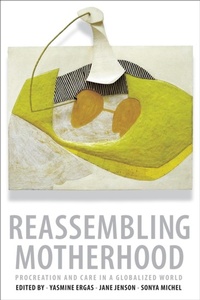
Reassembling Motherhood
Description

Reassembling Motherhood brings together contributors from across the disciplines to consider the transformation of motherhood as both an identity and a role. It examines how the processes of bearing and rearing a child are being restructured as reproductive labor and care work change around the globe. The authors examine issues such as artificial reproductive technologies, surrogacy, fetal ultrasounds, adoption, nonparental care, and the legal status of kinship, showing how complex chains of procreation and childcare have simultaneously generated greater liberty and new forms of constraint. Emphasizing the tension between the liberalization of procreation and care on the one hand, and the limits to their democratization due to race, class, and global inequality on the other, the book highlights debates that have emerged as these multifaceted changes have led to both the fragmentation and reassembling of motherhood.
All prices
More details
Other editions
Additional editions
Persons
Jane Jenson is professor emerita of political science at the Université de Montréal.
Sonya Michel is professor emerita of history, American studies, and women's studies at the University of Maryland, College Park.
Content
List of Illustrations
Acknowledgments
Introduction. Negotiating "Mother" in the Twenty-First Century: Between Choice and Constraint, by Yasmine Ergas, Jane Jenson, and Sonya Michel
1. Certain Mothers, Uncertain Fathers: Placing Assisted Reproductive Technologies in Historical Perspective, by Nara Milanich
2. Assisted Reproductive Technologies and the Biological Bottom Line, by Linda G. Kahn and Wendy Chavkin
3. Multiple "Mothers," Many Requirements for Protection: Children's Rights and the Status of Mothers in the Context of International Commercial Surrogacy, by Claire Achmad
4. The Borders of Legal Motherhood: Rethinking Access to Assisted Reproductive Technologies in Europe, by Letizia Palumbo
5. Pregnant Bodies and the Subjects of Rights: The Surrogacy-Abortion Nexus, by Yasmine Ergas
6. The Motherless Fetus: Ultrasound Pictures and Their Magic Disappearing Trick, by Anne Higonnet
7. Contracting for Motherhood: Postadoption Visitation Agreements, by Carol Sanger
8. Relinquishment and Adoption in Tamil Society: Mothers' Experiences with De-kinning, by Pien Bos
9. Marginalized Mothers and Intersecting Systems of Surveillance: Prisons and Foster Care, by Dorothy Roberts
10. Care and Gender, by Martha Albertson Fineman
11. The Double Lives of Transnational Mothers, by Sonya Michel and Gabrielle Oliveira
12. Euro-Orphans and the Stigmatization of Migrant Motherhood, by Helma Lutz
13. The New Maternalism: Children First; Women Second, by Jane Jenson
Afterword: Crossing into the Future, by Alice Kessler-Harris
Contributors
Index
