

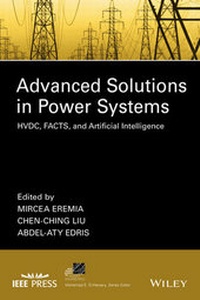
Advanced Solutions in Power Systems
Description

More details
Other editions
Additional editions
Persons
Content
Contributors xxi
Foreword xxiii
Acknowledgments xxv
Chapter 1 Introduction 1 Mircea Eremia, Chen-Ching Liu, and Abdel-Aty Edris
Part I HVDC Transmission Mircea Eremia
Chapter 2 Power Semiconductor Devices for HVDC and Facts Systems 11 Remus Teodorescu and Mircea Eremia
2.1 Power Semiconductor Overview 12
2.2 Converter Types 21
2.3 HVDC Evolution 23
2.4 FACTS Evolution 30
References 33
Chapter 3 CSC-HVDC Transmission 35 Mircea Eremia and Constantin Bulac
3.1 Structure and Configurations 35
3.2 Converter Bridge Modeling 47
3.3 Control of CSC-HVDC Transmission 59
3.4 Reactive Power and Harmonics 78
3.5 Load Flow in Mixed HVAC/HVDC-CSC Systems 91
3.6 Interaction Between AC and DC Systems 96
3.7 Comparison Between DC and AC Transmission 101
3.8 Application on a CSC-HVDC Link 109
Appendix 3.1 CSC-HVDC Systems in the World 118
References 123
Chapter 4 VSC-HVDC Transmission 125 Mircea Eremia, Jos¿e Antonio Jardini, Guangfu Tang, and Lucian Toma
4.1 VSC Converter Structures 126
4.2 Modulation Techniques 151
4.3 DC/AC Converter Analysis 166
4.4 VSC Transmission Scheme and Operation 188
4.5 Multiterminal VSC-HVDC Systems and HVDC Grids 203
4.6 Load Flow and Stability Analysis 221
4.7 Comparison of CSC-HVDC Versus VSC-HVDC Transmission 246
4.8 Forward to Supergrid 249
Appendix 4.1 VSC-HVDC Projects Around the World 261
Appendix 4.2 Examples of VSC-HVDC One-Line Diagrams 263
References 263
Part II Facts Technologies Abdel-Aty Edris and Mircea Eremia
Chapter 5 Static VAr Compensator (SVC) 271 Mircea Eremia, Aniruddha Gole, and Lucian Toma
5.1 Generalities 271
5.2 Thyristor-Controlled Reactor 273
5.3 Thyristor-Switched Capacitor 284
5.4 Configurations of SVC 287
5.5 Control of SVC Operation 294
5.6 SVC Modeling 296
5.7 Placement of SVC 312
5.8 Applications of SVC 314
5.9 SVC Installations Worldwide 324
References 337
Chapter 6 Series Capacitive Compensation 339 Mircea Eremia and Stig Nilsson
6.1 Generalities 339
6.2 Mechanical Commutation-Based Series Devices 339
6.3 Static-Controlled Series Capacitive Compensation 342
6.4 Control Schemes for the TCSC 365
6.5 TCSC Modeling 370
6.6 Applications of TSSC/TCSC Installations 382
6.7 Series Capacitors Worldwide 387
Appendix 6.1 TCSC Systems Around the World 404
References 405
Chapter 7 Phase Shifting Transformer: Mechanical and Static Devices 409 Mylavarapu Ramamoorty and Lucian Toma
7.1 Introduction 409
7.2 Mechanical Phase Shifting Transformer 410
7.3 Thyristor-Controlled Phase Shifting Transformer 428
7.4 Applications of the Phase Shifting Transformers 439
7.5 Phase Shifting Transformer Projects Around the World 450
References 456
Chapter 8 Static Synchronous Compensator - Statcom 459 Rafael Mihalic, Mircea Eremia, and Bostjan Blazic
8.1 Principles and Topologies of Voltage Source Converter 459
8.2 STATCOM Operation 473
8.3 STATCOM Modeling 476
8.4 STATCOM Applications 506
8.5 STATCOM Installations in Operation 515
References 524
Chapter 9 Static Synchronous Series Compensator (SSSC) 527 Laszlo Gyugyi, Abded-Aty Edris, and Mircea Eremia
9.1 Introduction 527
9.2 Architecture and Operating Principles 528
9.3 Comparison of SSSC with Other Technologies 533
9.4 Components of an SSSC 540
9.5 SSSC Modeling 546
9.6 Applications 551
9.7 SSSC Installation 552
References 556
Chapter 10 Unified Power Flow Controller (UPFC) 559 Laszlo Gyugyi
10.1 Introduction 559
10.2 Basic Characteristics of the UPFC 567
10.3 UPFC Versus Conventional Power Flow Controllers 571
10.4 UPFC Control System 575
10.5 Equipment Structural and Rating Considerations 584
10.6 Protection Considerations 596
10.7 Application Example: UPFC at AEP's INEZ Station 600
10.8 Modeling of the UPFC Device 613
References 627
Chapter 11 Interline Power Flow Controller (Ipfc) 629 Laszlo Gyugyi
11.1 Generalities 629
11.2 Basic Operating Principles and Characteristics of the IPFC 630
11.3 Generalized Interline Power Flow Controller for Multiline Systems 636
11.4 Basic Control System 638
11.5 Equipment Structural and Rating Considerations 640
11.6 Protection Considerations 642
11.7 Application Example: IPFC at NYPA's Marcy Substation 643
References 649
Chapter 12 Sen Transformer: A Power Regulating Transformer 651 Kalyan K. Sen
12.1 Background 651
12.2 The Sen Transformer Concept 656
References 679
Chapter 13 Medium Voltage Power Electronics Devices for Distribution Grids 681 Ion Etxeberria-Otadui, David Frey, Seddik Bacha, and Bertrand Raison
13.1 Introduction 681
13.2 High Power Switching Valves: Association of Semiconductor Components 683
13.3 Topologies Used in High Power Converters 694
13.4 Power Electronic Converter Control 697
References 717
Part III Artificial Intelligence Techniques Chen-Ching Liu and Mircea Eremia
Chapter 14 Artificial Intelligence and Computational Intelligence: A Challenge for Power System Engineers 721 Chen-Ching Liu, Alexandru Stefanov, and Junho Hong
References 729
Chapter 15 Expert Systems 731 Mircea Eremia, Kevin Tomsovic, and Gheorghe Câr¿ina
15.1 Fundamental Concepts 731
15.2 Architecture of Expert Systems 735
15.3 Expert Systems Application 745
References 753
Chapter 16 Neural Networks 755 Dagmar Niebur, Ganesh Kumar Venayagamoorthy, and Ekrem Gursoy
16.1 Introduction 755
16.2 Neural Network Architectures 755
16.3 Adaptive Critic Designs 759
16.4 Independent Component Analysis 760
16.5 Learning Algorithms: The Determination of Weights 760
16.6 Examples of Neural Network Applications for Power System Monitoring and Control 763
References 781
Chapter 17 Fuzzy Systems 785 Germano Lambert-Torres, Luiz Eduardo Borges da Silva, Carlos Henrique Valerio de Moraes, and Yvo Marcelo Chiaradia Masselli
17.1 Introduction 785
17.2 Fundamental Notions 787
17.3 Fuzzy Logic 797
17.4 Fuzzy Model 801
17.5 An Application of Fuzzy Logic in Control System 811
17.6 Final Remarks 816
Acknowledgments 817
References 817
Chapter 18 Decision Trees 819 Constantin Bulac and Adrian Bulac
18.1 Introduction 819
18.2 Decision Trees 820
18.3 Oblique Decision Trees 829
18.4 Applications of Decision Trees in Power Systems 833
18.5 Case Study 836
References 843
Chapter 19 Genetic Algorithms 845 Anastasios Bakirtzis and Spyros Kazarlis
19.1 Introduction to Evolutionary Computation 845
19.2 Genetic Algorithms 859
19.3 On The Optimal Location and Operation of FACTS Devices by Genetic Algorithms 897
References 898
Chapter 20 Multiagent Systems 903 Nan-Peng Yu and Chen-Ching Liu
20.1 Overview 903
20.2 Multiagent Technology Overview 909
20.3 Applications of Multiagent Systems in Power Engineering 917
20.4 Electricity Markets Modeling and Simulation with Multiagent Systems 920
Simulation 922
References 927
Chapter 21 Heuristic Optimization Techniques 931 Kwang Y. Lee, Malihe M. Farsangi, Jong-Bae Park, and John G. Vlachogiannis
21.1 Introduction 931
21.2 Evolutionary Algorithms for Reactive Power Planning 932
21.3 Genetic Algorithm for Generation Planning 943
21.4 Particle Swarm Optimization for Economic Dispatch 951
21.5 Ant Colony System for Constrained Load Flow Problem 961
21.6 Immune Algorithm for Damping of Interarea Oscillation 968
21.7 Simulated Annealing and Tabu Search for Optimal Allocation of Static VAr Compensators 974
21.8 Conclusions 980
References 981
Chapter 22 Unsupervised Learning and Hybrid Methods 985 Nikos Hatziargyriou and Manolis Voumvoulakis
22.1 Generalities 985
22.2 Supervised Learning Methods 988
22.3 Unsupervised Learning Methods 996
22.4 Som Variants 1000
22.5 Combined Use of Unsupervised with Supervised Learning Methods 1007
22.6 Applications to Power Systems 1007
References 1030
Index 1033
CHAPTER 1
INTRODUCTION
Mircea Eremia, Chen-Ching Liu, and Abdel-Aty Edris
POWER SYSTEM RELIABILITY is a primary concern for power system engineers in planning and operation of the power grids to ensure adequate and secure electricity service to consumers. As an electrical network, a power system should be operated in such a way that the electrical quantities, for example, bus voltages and line currents, will be maintained within an acceptable range in an operating condition. Power system security is a criterion for planning and operation of a power grid. To meet the system security standards, various control devices and tools are needed.
As policies and technologies evolve, power systems have become more complex and difficult to plan and operate. These major changes include the creation of electricity markets, large-scale integration of renewable energy sources, and increasing demand response programs on the customer side. Due to the intermittency of wind and solar generation resources, large and sudden changes in power flow may be experienced, causing the power system to be operated closer to its capability limits. Under these conditions, voltage control becomes a significant challenge for power system operators.
Major progress in technology for control, automation, protection, sensing, and communication has been achieved. New facilities are being added to replace the aging power infrastructures. Further investment in new transmission lines is important to upgrade transmission capacities to meet new requirements. Recent major events affected large parts of the interconnected power systems of Europe (the Italian blackout in September 2003, the UCTE (Union for the Co-ordination of Transmission of Electricity) event in November 2006), and the Northeast United States in August 2003. A root cause of these blackouts is the insufficient transmission capacity to serve the increasing load demand while meeting the N-1 security requirement.
Reliable and secure operation of power systems is fundamental to support the continuing development of civilization and provide the social and economic foundations. Power system engineers must be innovative in order to ensure highly reliable and cost-effective electric energy supply to the end users. A power system is expected to operate efficiently by supporting a well-designed market and achieve sustainable use of natural resources.
Power system operators need efficient solutions and tools to operate the power systems in order to meet the economic and regulatory requirements. Due to the difficulties regarding construction of new transmission lines and need for fast and robust voltage and power flow control, the power electronic technology is a critical solution. Power electronics-based technology has shown excellent performance since its first use in direct current transmission in early 1960s and provide solutions for some limitations of the alternating current (AC) transmission systems. As technology advances, applications are also developed and deployed at the distribution system level.
Economic efficiency targets should be met from design to operation. Power system optimization is an important part of the literature. Optimal planning and operation as well as adaptation to constantly changing operating conditions can be achieved by well-designed tools for operation and decision support. Artificial intelligence (AI) techniques have been deployed in a range of applications due to the availability of powerful and versatile techniques. Application of power electronics and AI techniques help power systems to advance toward a "smart grid." Power electronic and AI techniques are among the critical tools available to modernize the power grids. As part of the vision for a smart grid, renewable energy sources and distributed generations have been integrated in large scale. Automation, protection, sensing, and other information and communication technologies have also advanced significantly.
Significant work has been done by authors to provide guidelines and techniques regarding the application of power electronics in power systems. We have benefited greatly from the prior work, including
- Adamson, C., and Hingorani, N. G., High voltage Direct Current Power Transmission, 1960
- Kimbark, E. W., Direct Current Transmission, 1971.
- Uhlmann, E., Power Transmission by Direct Current, 1975.
- Arrillaga, J., High Voltage Direct Current Transmission, 1983.
- Padiyar, K. R., HVDC Power Transmission Systems. Technology and System Interactions, 1990.
- Song, Y. H., and Johns, A. T. (Eds.), Flexible AC Transmission Systems (FACTS), 1999.
- Hingorani, N. G., and Gyugyi, L., Understanding FACTS. CONCEPTS and Technologies of Flexible AC Transmission Systems, 2000.
- Mathur, R. M., and Varma, R. K., Thyristor Based FACTS Controllers for Electrical Transmission Systems, 2002.
- Sood, V. K., HVDC and FACTS Controllers: Application of Static Converters in Power Systems, 2004.
- Zhang, X. P., Rehtanz, C., and Pal, B., Flexible AC Transmission Systems: Modelling and Control, 2006.
- Sen, K. K., and Sen, M. L., Introduction to FACTS Controllers. Theory, Modeling and Applications, 2009.
- Yazdani, A., and Iravani, R., Voltage Sourced Converters in Power Systems. Modeling, Control and Applications, 2010.
- Jovcic, D., and Ahmed, K., High-Voltage Direct-Current Transmission: Converters, Systems, and DC Grids, 2015.
AI techniques were developed as complementary techniques to traditional methods that are based on rigorous mathematical foundations. AI techniques have been extensively applied to power system problems, such as genetic algorithms, artificial neural networks, expert systems, fuzzy logic, and decision trees. More recent applications are under development such as intelligent agents or particle swarm optimization. Genetic algorithms are good additions to the suite of tools including traditional optimization techniques. Expert systems can be used to support the power system operators in dispatching centers or substations in an online environment. Among the AI applications in power systems, rule- or logic-based technologies have been developed and deployed as decision support tools for distribution systems in an online environment. Artificial neural networks for load forecasting in power systems have been in practical use. Fuzzy logic is successfully applied in industrial controllers in power systems.
A significant amount of work has been done for development of AI applications in power systems, and further work is needed as the technology is continuously advancing. We acknowledge the following contributions:
- Nilsson, N.J., Learning machines, 1965.
- Zadeh, L. A., Fuzzy sets. Information and control, 1965.
- Kaufmann, A., Introduction to the theory of fuzzy sets, 1975.
- Quinlan, J. R., Introduction of decision trees, 1986.
- Barr, A., and Feigenbaum, A., Le manuel de l'intelligence artificielle, 1986
- Goldberg, D. E., Genetic algorithms in search, optimization and machine learning, 1989.
- Dillon, T. S., and Laughton, M.A., Expert systems applications in power systems, 1990.
- Zimmerman, H.J., Fuzzy set theory, 1990.
- El-Sharkawi, M., and Niebur, D. (Eds.), Artificial Neural Networks with applications to power systems, 1996.
- Tsoukalas, L. H., Uhrig, R. E., and Zadeh, L. A., Fuzzy and neural approaches in engineering, 1997.
- El-Hawary, M.E., Electric power applications of fuzzy systems, 1998.
- Jennings, N., and Wooldridge, M. (Eds.), Agent technology: Foundations, applications, and markets, 1998.
- Wehenkel, L., Automatic learning techniques in power systems, 1998.
- Lee, K. Y, and El-Sharkawi, M.A. (Eds.), Modern heuristic optimization techniques. Theory and applications to power systems, 2008.
The idea of this project was conceived as a comprehensive handbook on high voltage direct current (HVDC)/flexible alternating current transmission systems (FACTS) and AI applications for power engineering professionals and students. These subjects are already embedded in the academic curricula around the world. This is the case of the master program in electrical power systems at the University "Politehnica" of Bucharest (UPB), which includes courses on "high voltage direct current transmission" and "advanced technologies in power systems: FACTS and AI." Several international courses have been organized at UPB under the title "Advanced technologies in power systems: FACTS and AI," with participants from European countries. The support from various European programs (e.g., Erasmus, Tempus), the activities organized under Institute of Electrical and Electronics Engineers (IEEE) and International Council on Large Electric Systems / Conseil International des Grands Réseaux Électriques (CIGRE), and other opportunities have allowed the development of linkages among universities and industry from many countries, including Brazil, Canada, China, Denmark, France, Greece, Korea, India, Iran, Ireland, Romania, Slovenia, Spain and United States to carry out the project of this book. Topics related to the application of power electronics and AI techniques in power systems have been integrated in the academic curricula and extensively studied in PhD research in many universities around the world, for example, North America, South America,...
