

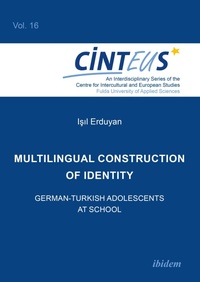
Multilingual Construction of Identity
German-Turkish Adolescents at School
Published on 30. November 2018
400 pages
978-3-8382-7201-6 (ISBN)
Description

Reporting on a linguistic ethnographic study, Isil Erduyan explores multilingual identity construction of high school students with Turkish descent enrolled in a downtown high school (Gymnasium) in Berlin. She focuses on naturally occurring classroom interactions across German, Turkish, and English classes and attends to the complex relationship between identities and multilingual repertoires through a scalar analytical perspective. Her findings demonstrate how multilingual students' linguistic repertoires are bound by linguistic performances within and across multiple timescales. The study takes an innovative path by attending to the everyday linguistic practices of a group of multilingual immigrant students with the same national background through linguistic ethnographic lenses in the context of mainstream schooling in Europe, and by focusing on a much-understudied group, namely higher achieving students of immigrant descent enrolled in a German high school.
More details
Series
Edition
New edition
Language
English
Place of publication
Hannover
Germany
Target group
Professional and scholarly
Edition type
New edition
Illustrations
Illustrations
File size
2,78 MB
ISBN-13
978-3-8382-7201-6 (9783838272016)
Copyright in bibliographic data and cover images is held by Nielsen Book Services Limited or by the publishers or by their respective licensors: all rights reserved.
Schweitzer Classification
Other editions
Additional editions
Book
01/2019
ibidem
€39.90
Shipment within 7-9 days
Persons
Content
- Intro
- Abstract
- Acknowledgements
- Table of Contents
- Preface
- 1 Introduction to the Study
- 1.1 Introduction
- 1.2 Rationale for the Study and Research Questions
- 1.3 A Demographic Profile
- 1.3.1 Turkish Migration to Berlin
- 1.3.2 Turkish Community in Kreuzberg
- 1.3.3 Students with Immigrant Background in the Berlin School System: Population Facts
- 1.4 Plan of the Book
- 2 Situating the Study
- 2.1 Epistemological and Paradigmatic Considerations
- 2.2 Theoretical Framework
- 2.2.1 Wortham's perspective of identity
- 2.2.2 Bakhtinian notion of chronotopes
- 2.3 Linguistic Ethnographic Methodology
- 2.4 Establishing the Terminology: Identity Ascriptions
- 2.5 Situating Multilingualism and Multilingual Speakers
- 3 Review of Literature
- 3.1 Multilingualism and Identity in Contemporary Europe
- 3.2 Immigrant Youth Language Practices
- 3.3 Identity in Multilingual Classroom Research
- 4 Methodological Choices
- 4.1 Locating the Research Site
- 4.1.1 The Tracking System in German Secondary Education
- 4.1.3 Berlin Central High School (BCHS)
- 4.1.4 Turkish, German, and English Instruction at BCHS
- 4.1.5 The Physical Setting
- 4.2 Negotiating Access
- 4.2.1 Gaining Entry
- 4.2.2 Gaining Access
- 4.3 Participants
- 4.3.1 Deniz
- 4.3.2 Yelda
- 4.3.3 Mert
- 4.3.4 Simla
- 4.3.5 Ela
- 4.3.6 Other Actors
- 4.4 Generating the Ethnographic Data
- 4.4.1 Classroom Observations
- 4.4.2 Audio-Recordings of Classroom Interactions
- 4.4.3 Taking Fieldnotes
- 4.4.4 Interviews
- 4.5 Methods of Data Analysis and Interpretation
- 4.5.1 Choosing Analytical Tools
- 4.5.2 Transcribing the Interactional Data
- 4.6 Ethnographic Design Study Concerns
- 4.6.1 Strategies for Validating Findings
- 4.6.2 Ethical Considerations
- 5 Local Construction of Identity in the German Classroom
- 5.1 Introduction
- 5.2 Setting the Scene: 9th Grade German
- 5.3 Yelda and Deniz
- 5.3.1 "We can never in our lives speak like these"
- 5.3.2 Mocking Oneself
- 5.3.3 Lacking Participation: "Words are missing"
- 5.3.4 Multilingual Word Search
- 5.4 Mert
- 5.4.1 Super German - Normal German - High German
- 5.4.2 Flying Solo
- 5.4.3 Managing the Micropolitics of Group Work
- 5.5 Simla and Ela
- 5.5.1 Ela: ".because our mother tongue is not German"
- 5.5.2 Teacher as Peer
- 5.5.3 Intermediary in Group Work
- 5.5.4 Ela's Displeasure
- 5.6 Chapter Summary
- 6 Local Construction of Identity in the Turkish Classroom
- 6.1 Introduction
- 6.2 Setting the Scene: 9th and 10th Grade Turkish
- 6.3 Yelda
- 6.3.1 The Grammar Expert
- 6.3.2 Turkey-Turkish Colloquial as a Resource Kit
- 6.4 Simla
- 6.4.1 Turkish as a Matter of Challenging Self
- 6.4.2 Experimenting with Ottoman Turkish
- 6.5 Mert
- 6.5.1 Urban Turkey-Turkish Forms
- 6.5.2 Embracing Neoconservativism
- 6.6 Ela
- 6.6.1 Ela's Originality
- 6.6.2 Being Modern
- 6.7 Chapter Summary
- 7 Local Construction of Identity in the English Classroom
- 7.1 Introduction
- 7.2 Setting the Scene: 9th and 10th Grade English
- 7.3 Deniz
- 7.3.1 Enacting Criticality
- 7.3.2 Role-play as a Safe House
- 7.4 Yelda
- 7.4.1 Lost in Listening
- 7.4.2 Constructing Distance
- 7.5 Mert
- 7.5.1 Enacting Masculinity
- 7.5.2 Content with English
- 7.6 Simla
- 7.6.1 Making Reception Work
- 7.6.2 Teasing and Dueling in Group Work
- 7.7 Ela
- 7.7.1 Constructing Intolerance
- 7.7.2 Impatience in Group Work
- 7.8 Chapter Summary
- 8 Discussion and Conclusion
- 8.1 Multilingual Construction of Identity
- 8.2 Timescales and Chronotopes
- 8.3 Limitations to the Study
- 8.4 Directions for Future Research
- Appendix A
- Appendix B1
- Appendix B2
- Appendix B3
- Appendix C
- Appendix D
- Appendix E
- Appendix F
- References
