

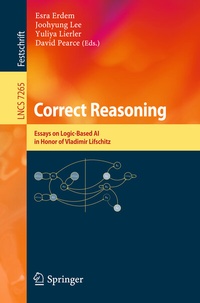
Correct Reasoning
Essays on Logic-Based AI in Honour of Vladimir Lifschitz
Published on 3. June 2012
XI, 594 pages
978-3-642-30743-0 (ISBN)
Description

This Festschrift published in honor of Vladimir Lifschitz on the occasion of his 65th birthday presents 39 articles by colleagues from all over the world with whom Vladimir Lifschitz had cooperation in various respects. The 39 contributions reflect the breadth and the depth of the work of Vladimir Lifschitz in logic programming, circumscription, default logic, action theory, causal reasoning and answer set programming.
More details
Other editions
Additional editions
Esra Erdem | Joohyung Lee | Yuliya Lierler
Correct Reasoning
Essays on Logic-Based AI in Honour of Vladimir Lifschitz
Book
06/2012
1st Edition
Springer
€53.49
Shipment within 7-9 days
Content
- Title
- Preface
- Table of Contents
- To Vladimir Lifschitz on His 65th Birthday
- Introduction
- Vladimir Lifschitz in the Soviet Union
- Vladimir Lifschitz's Early Years in the United States
- Vladimir Lifschitz's Scientific Contributions
- Mechanical Theorem Proving in the USSR
- Stable Model Semantics for Normal Logic Programs
- Disjunctive Theories and Negation
- McCarthy's 1959 AI Planning Problem and Its Solution in 2010
- Early Study of Complexity Issues
- Contributions to McCarthy's Theory of Circumscription
- Reasoning about Actions
- Mathematics of Logic Programming
- Closing Remarks
- References
- Vladimir Lifschitz - A Youth at 65
- Reminiscences of Working with Vladimir Lifschitz
- Being a Part of Lifschitz's School
- An Ideal Advisor
- Keeping Things Simple
- Happy Birthday, Vladimir!
- A Cool Advisor
- A Youth at 65
- Endless Wisdom
- A "Conservative" Approach to Extending Answer Set Programming with Non-Herbrand Functions
- Introduction
- The Syntax of ASP{f}
- Semantics of ASP{f}
- Knowledge Representation with Non-Herbrand Functions
- Relationship with ASP
- Conclusions and Future Work
- References
- The Inverse Lambda Calculus Algorithm for Typed First Order Logic Lambda Calculus and Its Application to Translating English to FOL
- Introduction
- Background
- Typed First-Order Logic Lambda Calculus
- Type Order
- The Inverse -Algorithms
- The Inverse -Operators
- Examples
- Use Case Example
- Theorems
- Related Work
- Implementation Success and Evaluation
- Conclusion
- References
- Parameterized Splitting: A Simple Modification-Based Approach
- Introduction
- Background
- Quasi-splittings for Argumentation Frameworks
- Quasi-splittings for Logic Programs
- Algorithms for Quasi-splittings
- Discussion
- References
- From Primal Infon Logic with Individual Variables to Datalog
- Introduction
- PIV, Axiomless PIV, and Datalog
- PIV
- Local Derivations
- Parse Trees and Parse Forests
- From PIV to Axiomless PIV
- Datalog
- Succinct Representations of PIV Formulas
- Reduction to Datalog
- The Vocabulary of (P,r)
- Rendition of Local Formulas
- Program P and Query r
- Soundness and Completeness
- Complexity Considerations
- References
- Here and There among Logics for Logic Programming
- Introduction
- The Structural Logic of Logic Programs
- The Logic of Here-and-There
- Desiderata for a Logic of Logic Programming
- Negations: Gödel versus Lukasiewicz
- Rules and Implications
- A Reconciliation
- Conclusions
- References
- Causal Logic Programming
- Introduction
- Motivation and Examples
- A Semantics for Causal Proofs
- Positive Programs and Minimal Models
- Default Negation and Stable Models
- Related Work
- Conclusions
- References
- On the Interaction of Existential Rules and Equality Constraints in Ontology Querying
- Introduction
- Interaction of TGDs and EGDs in Ontology Querying
- Technical Definitions
- Query Answering under TGDs and EGDs
- Separability of TGDs and EGDs
- Concrete Separable Classes
- Key-Based Inclusion and Key Dependencies
- Non-key-Conflicting Inclusion and Key Dependencies
- Non-conflicting TGDs and KDs
- Non-conflicting TGDs and EGDs
- Separability in Conceptual Modelling
- DL-Lite Family of Description Logics
- Entity-Relationship Model
- UML Class Diagrams
- F-Logic Lite
- References
- Extending Action Language C+ by Formalizing Composite Actions
- Introduction
- Preliminaries
- Defining Composite Actions
- Syntax
- Semantics
- Properties of Extended Action Descriptions
- Generalized Monkey and Bananas Domain
- Formalization
- Reasoning with Extended Action Descriptions
- Performance
- Conclusion
- References
- Strong Equivalence of RASP Programs
- Background on RASP
- Reduct-Based RASP Semantics
- Strong Equivalence of RASP Programs
- Strong Equivalence of RASP Programs Revisited
- Conclusions and Future Directions
- References
- Considerations on Belief Revision in an Action Theory
- Introduction
- Background
- Transition Systems
- Belief Revision
- Reasoning about Action and Knowledge
- Revision in Transition Systems
- The Problem
- Revision in the Context of Sensing
- The Approach
- Discussion
- Related Work
- Extending the Approach
- References
- Approximation Fixpoint Theory and the Semantics of Logic and Answers Set Programs
- Introduction
- Approximation Fixpoint Theory of Lattice Operators
- Relationship to the Stable Model Semantics of Logic Programs
- Extending the Stable Semantics to Predicate Rule Sets and Non-Herbrand Structures
- Preliminaries: FO Syntax and Semantics
- Generalized Programs and Stable and Well-Founded Semantics
- Generating Stable and Well-Founded Semantics from Three- and four-Valued Semantics
- The Bilattice View on Three- and Four-Valued Logic
- Semantics of Programs through the Four-Valued Consequence Operator
- Some Pragmatic Consequences Regarding the Semantics
- References
- Privacy Preservation Using Multi-context Systems and Default Logic
- Introduction
- Privacy Preservation Problem
- Solving Privacy Preservation Problems Using Multi-context Systems and Hybrid Knowledge Bases
- Solving First-Order Privacy Preservation Problems Using Default Logic
- First-Order Privacy Preservation Problems
- Complexity of First-Order Privacy Preservation Problems
- Algorithm for First-Order Privacy Preservation Problems
- Conclusion and Future Work
- References
- Simulating Production Rules Using ACTHEX
- Introduction
- hex and acthex Programs
- hex Programs
- acthex Programs
- Simulating Production Rule Systems Using acthex
- Production Rule Systems
- Production Rule Systems over hex Programs
- Simulating hex-Based PRSs in acthex
- Instantiations and Properties
- Discussion
- RIF Potential
- Alternative Approaches Based on Answer Sets
- Conclusion
- References
- Applications of Action Languages in Cognitive Robotics
- Introduction
- Robotic Manipulation for Assembly Planning
- Example: Two Robots and Multiple Payloads
- Embedding Geometric Reasoning in Action Domain Descriptions
- Bilateral Interaction between Causal Reasoning and Motion Planning
- Housekeeping with Multiple Robots
- Embedding Commonsense Knowledge in Action Domain Descriptions
- Recovering from Execution Failures via Queries with Complex Goals
- Cognitive Factories
- Communication with Multiple Teams of Robot via Queries with Complex Constraints
- Diagnostic Reasoning in a Cognitive Factory
- Discussion
- References
- The Intelligent Grounder of DLV
- Introduction
- The DLV System and Its Applications
- The Input Language
- Basic Grounding Methods
- Dependency and Component Graphs
- Instantiation Procedure
- Instance Simplifications
- Dealing with Weak Constraints and Aggregates
- Finitely Ground Programs
- Optimization Techniques
- Related Work
- References
- Bi-state Logic
- Introduction
- Bi-state Logic
- Axiomatization
- Gentzen System
- Superstable Models and IF-Programs
- Relation with Equilibrium Logic
- Relation with the Logic of Here-and-There
- Equilibrium Models
- Bi-state Logic and Updates
- Relation to Classical Logic
- Summary and Conclusions
- References
- An Equational Approach to Logic Programming
- Equational Approach to Logic Programs
- Comparison with Answer Set Semantics
- Comparison with Argumentation Networks
- Conclusion
- References
- Gearing Up for Effective ASP Planning
- Introduction
- Incremental Logic Programs
- Blocks World Planning
- Incremental Blocks World Planning
- Towers of Hanoi
- Towards PDDL-Based ASP Planning
- Discussion
- References
- Toward Question Answering in Travel Domains
- Introduction
- Travel Logic Form
- Complete Travel Stories
- Uncertain Group Affiliation
- Uncertain Identity of Objects in the Initial Situation
- Uncertainty in the Number of Movers
- Discussion
- References
- Algorithms for Solving Satisfiability Problems with Qualitative Preferences
- Introduction
- Satisfiability and Qualitative Preferences
- Computing All Optimal Solutions in a SAT Problem with Preferences
- Computing All Optimal Solutions by Pruning Non-optimal Models
- Computing All Optimal Solutions via Generate-and-Test
- Extensions
- Alternative Complete Sets of Optimal Models
- Quantitative and Qualitative Preferences on Formulas and Their Mixing
- Discussion and Related Work
- Conclusions
- References
- Oscillating Behavior of Logic Programs
- Introduction
- Stable Classes
- Supported Classes
- Boolean Networks
- From Boolean Networks to Logic Programs
- From Logic Programs to Boolean Networks
- Between Stable and Supported Classes
- References
- Applying Visible Strong Equivalence inAnswer-Set Program Transformations
- Introduction
- Background
- Frequently Used Classes of Logic Programs
- Stable Model Semantics
- Basic Notions of Equivalence
- Visibility-Based Variants
- Visible Strong Equivalence
- Application in Program Transformations
- Translation-Based Verification
- Related Work
- Conclusions
- References
- From Turner's Logic of Universal Causation to the Logic of GK
- Introduction
- Preliminaries
- Propositional Languages
- The Logic of GK
- Turner's Logic of Universal Causation
- Embedding Turner's Logic of Universal Causation to GK
- Conclusion
- References
- Lifschitz and Circumscription
- Introduction
- McCarthy's Definition of Circumscription
- Lifschitz's Definition of Circumscription
- Lifschitz's Contributions to Applications of Circumscription
- References
- Towards Formalizing Non-monotonic Reasoning in Physics: Logical Approach Based on Physical Induction and Its Relation to Kolmogorov Complexity
- Non-monotonic Features of Physics Reasoning and Their Formalization Based on Kolmogorov Complexity
- First Result: Reformulating the above Definition of Typical Elements in Purely Logical Terms
- Second Result: Computability from Uniqueness to Approximate Uniqueness
- Definability: A Detailed Discussion
- Reformulating Action Language C+ in Answer Set Programming
- Introduction
- Preliminaries
- Multi-valued Propositional Formulas
- Nonmonotonic Causal Theories and C+
- Stable Model Semantics
- Stable Models of a Propositional Formulas
- Stable Models of a Multi-valued Propositional Logic Programs
- Turning Multi-valued Propositional Formulas into Propositional Formulas under the Stable Model Semantics
- Representing Definite C+ in Multi-valued Propositional Formulas under SM
- Turning Definite Causal Theories into Multi-valued Logic Programs
- Reformulating Definite C+ in Multi-valued Logic Programs
- Reformulating Definite C+ in Propositional Logic Programs
- Representing Definite C+ in the Language of ASP
- Monkey and Bananas in the Language of f2lp
- Discussion
- References
- The Truth about Defaults
- Introduction
- Truth and Semantics
- Belief and Defaults
- Only Knowing: The Simple Case
- Only Knowing: Three Variants
- An Axiomatic Account
- Moore
- Konolige
- Reiter
- The First-Order Case
- Conclusion
- References
- Parsing Combinatory Categorial Grammar via Planning in Answer Set Programming
- Introduction
- Preliminaries
- Planning
- Answer Set Programming (for Planning)
- Combinatory Categorial Grammar
- CCG Parsing via Planning
- Problem Statement
- ASP Encoding
- Normalizations
- ASPCCG Toolkit
- Experimental Evaluation
- Discussion and Future Work
- References
- Declarative Distributed Computing
- Introduction
- Declarative Description of Distributed State Machines
- The Language
- Formal Semantics
- An Analysis Framework for Distributed Algorithms
- Communication Models
- Query Language
- Formal Semantics of Narratives and Queries
- Example Analysis
- Related Work
- Final Remarks
- References
- Disjunctive Programs with Set Constraints
- Introduction
- Preliminaries
- Selector Stable Models for Disjunctive Logic Programs
- A Stable Model Semantics for SCD Programs
- Conclusions and Further Research
- References
- The G¨odel-Tarski Translations of Intuitionistic Propositional Formulas
- Introduction
- Gödel-Tarski Translation
- Predicate Translations
- References
- Stepwise Debugging of Description-Logic Programs
- Introduction
- Preliminaries
- Description Logics
- DL-Programs
- A Stepping Framework for DL-Programs
- External Support and Unfounded Sets for DL-Programs
- States and Computations
- Applying Stepping
- Related Work
- Conclusion
- References
- Answer Set Programming and Planning with Knowledgeand World-Altering Actions in Multiple Agent Domains
- Introduction
- Preliminaries
- Answer Set Programming
- Belief Formulae and Kripke Structures
- Update Models
- Basic ASP Encodings
- An Application in Multi-agent Planning
- Syntax
- Modeling mA0 Actions in ASP
- ASP for Reasoning in mA0
- From Theory to Practice
- Conclusion and Future Work
- References
- A Language for Default Reasoning about Actions
- Introduction
- Action Language D
- Syntax
- Semantics
- Query Answering
- Implementation
- Proof of Correctness
- The Qualification Problem
- Discussion
- References
- Connecting First-Order ASP and the Logic FO(ID) through Reducts
- Introduction
- Stable Models in Infinitary Propositional Logic
- Stable Models in First-Order Logic
- Programs
- Logics PC(ID) and FO(ID)
- Conclusions
- References
- A New Incarnation of Action Language H
- Introduction
- Syntax
- Semantics
- Methodology
- An Example of Using H to Represent Hybrid Domains
- Comparison with Sitcalc and Event Calculus
- Implementing H
- Specifying History
- Solvers for H
- Conclusions and Future Work
- References
- Well-Supported Semantics for Logic Programs with Generalized Rules
- Introduction
- Preliminaries
- Logic Programs with Generalized Rules
- A Generalized Notion of Well-Supportedness
- Complexity
- Related Work
- Well-Supportedness
- Relation with the FLP-Semantics
- Relation with Aggregate Programs
- Well-Supported Answer Sets for DL-Programs
- Final Remarks
- References
- Author Index
