

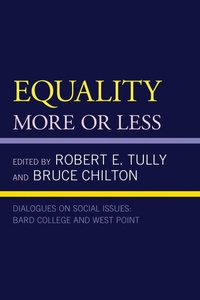
Equality
More or Less
Hamilton Books (Publisher)
1st Edition
Published on 12. December 2019
366 pages
978-0-7618-8392-0 (ISBN)
Description

The essays in this volume on the subject of equality are the work of scholars at Bard College and West Point. Their research falls within the areas of history, religion, legal theory, social science, ethics and philosophy. The regions covered include the Middle and Far East, Europe, and America; the time periods studied are both contemporary and historical. Each essay is a well-detailed exploration which assumes the reader has no prior acquaintance with the topic.
Together, the studies reveal both conflicting standards of equality as well as patterns of pernicious inequality. In an ideal world, equality and inequality among humans would vary in acceptable proportion, increase of the one ensuring decrease of the other. Unfortunately, as the studies illustrate, any such expectation of progress in the real world is almost routinely thwarted.
Despite the wide variety of topics, a common thread binds these essays. Human nature seems to harbor a moral deficiency lying deeper than any written laws and those traditional customs which promote inequality and breed injustice. The fault is prominent in those who champion unjust laws or who willingly enforce discrimination but it is no less active in the silent many who condone the practice. The essays reveal the same persistent and unappealing trait which social groups from the remote past to the present manifest in various ways: blind determination to perpetuate whatever advantages one group believes it enjoys over another, convinced that its own members are more equal than theirs. Being made unequal, the others too easily become targets who are considered less worthy, sometimes even less human.
Together, the studies reveal both conflicting standards of equality as well as patterns of pernicious inequality. In an ideal world, equality and inequality among humans would vary in acceptable proportion, increase of the one ensuring decrease of the other. Unfortunately, as the studies illustrate, any such expectation of progress in the real world is almost routinely thwarted.
Despite the wide variety of topics, a common thread binds these essays. Human nature seems to harbor a moral deficiency lying deeper than any written laws and those traditional customs which promote inequality and breed injustice. The fault is prominent in those who champion unjust laws or who willingly enforce discrimination but it is no less active in the silent many who condone the practice. The essays reveal the same persistent and unappealing trait which social groups from the remote past to the present manifest in various ways: blind determination to perpetuate whatever advantages one group believes it enjoys over another, convinced that its own members are more equal than theirs. Being made unequal, the others too easily become targets who are considered less worthy, sometimes even less human.
More details
Series
Edition
1. Auflage
Language
English
Place of publication
Lanham, MD
United States
Publishing group
University Press of America
Illustrations
2 BW Illustrations, 4 BW Photos
ISBN-13
978-0-7618-8392-0 (9780761883920)
Copyright in bibliographic data and cover images is held by Nielsen Book Services Limited or by the publishers or by their respective licensors: all rights reserved.
Schweitzer Classification
Other editions
Additional editions
Book
12/2019
Hamilton Books
€65.60
Shipment within 10-20 days
Persons
Robert Tully is professor emeritus of philosophy at West Point and the University of Toronto.
Bruce Chilton is Bernard Iddings Bell professor of philosophy and religion and director of the Institute of Advanced Theology at Bard College.
Bruce Chilton is Bernard Iddings Bell professor of philosophy and religion and director of the Institute of Advanced Theology at Bard College.
Content
List of Illustrations
Acknowledgments
Introduction by R. E. Tully
Part I: Historical Perspectives
Chapter 1: Equality Deferred: A Litany of Discrimination byRobert J. Goldstein
Chapter 2: Equality and Diversity in the Late Ottoman Empire and Modern Turkey byGeorge
W. Gawrych
Chapter 3: The Social Practice of (In)equality in Nazi Germany byDavid S. Frey
Chapter 4: Social Inequality and the United States Army: The (Un)lucky Seven by Morten G.
Ender and Betsy Lucal
Chapter 5: Civil War Pension Policy: The Politics of Policy Subsystems byBrandon Jason
Archuleta
Chapter 6: Selecting a Military Court-Martial Panel: A Study of Inequality byLTC Christopher
Jacobs
Chapter 7: United Nations Peace Missions and Protection of Civilians: Equality versus
Efficiency? by Darya Pushkina
Part II: Theological Perspectives
Chapter 8: Ultimately Equal and Relatively Complicated: Questions about Equality in TeachingBuddhist Studies byDominique TownsendChapter 9: The Rabbinic Meritocracy and Its Discontents byShai Secunda
Chapter 10: Equality in Paul of Tarsus-More and Less by Bruce Chilton
Chapter 11:The Perilous Promise of Equality: Scriptural Politics in Contemporary Iran by
Tehseen Thaver
Chapter 12:Gandhi, Krishna, and Caste: Inequality More or Less byRichard H. Davis
Part III: Philosophical Perspectives
Chapter 13: Men of Fortitude: Gender and Combatant Non-Immunity in War byGraham
Parsons
Chapter 14:Minding Gibbon's Manners: Unwritten Rules and the Rhetoric of Equality byHugh
Liebert
Chapter 15:A Kantian Approach to Recognizing Privilege byCourtney Morris
Chapter 16: Inequality in Skepticism by R. E. Tully
Epilogue by Bruce Chilton
Index
About the Contributors
Acknowledgments
Introduction by R. E. Tully
Part I: Historical Perspectives
Chapter 1: Equality Deferred: A Litany of Discrimination byRobert J. Goldstein
Chapter 2: Equality and Diversity in the Late Ottoman Empire and Modern Turkey byGeorge
W. Gawrych
Chapter 3: The Social Practice of (In)equality in Nazi Germany byDavid S. Frey
Chapter 4: Social Inequality and the United States Army: The (Un)lucky Seven by Morten G.
Ender and Betsy Lucal
Chapter 5: Civil War Pension Policy: The Politics of Policy Subsystems byBrandon Jason
Archuleta
Chapter 6: Selecting a Military Court-Martial Panel: A Study of Inequality byLTC Christopher
Jacobs
Chapter 7: United Nations Peace Missions and Protection of Civilians: Equality versus
Efficiency? by Darya Pushkina
Part II: Theological Perspectives
Chapter 8: Ultimately Equal and Relatively Complicated: Questions about Equality in TeachingBuddhist Studies byDominique TownsendChapter 9: The Rabbinic Meritocracy and Its Discontents byShai Secunda
Chapter 10: Equality in Paul of Tarsus-More and Less by Bruce Chilton
Chapter 11:The Perilous Promise of Equality: Scriptural Politics in Contemporary Iran by
Tehseen Thaver
Chapter 12:Gandhi, Krishna, and Caste: Inequality More or Less byRichard H. Davis
Part III: Philosophical Perspectives
Chapter 13: Men of Fortitude: Gender and Combatant Non-Immunity in War byGraham
Parsons
Chapter 14:Minding Gibbon's Manners: Unwritten Rules and the Rhetoric of Equality byHugh
Liebert
Chapter 15:A Kantian Approach to Recognizing Privilege byCourtney Morris
Chapter 16: Inequality in Skepticism by R. E. Tully
Epilogue by Bruce Chilton
Index
About the Contributors
