

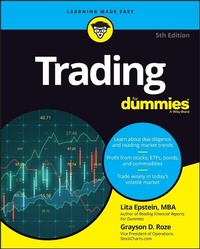
Trading For Dummies
Description

These days, the market is volatile, and you need to know how to ride the waves and navigate the changing tides. Trading For Dummies is for investors in search of a clear guide to trading stocks in any type of market. Inside, you'll get sample stock charts, position trading tips and techniques, and fresh ways to analyze trends and indicators. Learn how to make smart decisions by identifying the stocks, bonds, funds, and commodities that will net you the maximum gain. Assume more risk, reap more benefits, build a more aggressive portfolio, and enjoy the greater gains that come with short- and medium-term trading methods.
* Learn about due diligence, key indicator analysis, and reading market trends
* Trade successfully in downward market trends and during recessions
* Use the latest tools to create your own charts and make smart decisions
* Profit from ETFs, bonds, and commodities, along with good old-fashioned stocks
This is a perfect Dummies guide for experienced and novice traders and investors seeking the most-up-to-date information on trading wisely in any market.
More details
Other editions
Additional editions
Persons
Grayson D. Roze is the Vice President of Operations at StockCharts.com and the author of Tensile Trading: The 10 Essential Stages of Stock Market Mastery.
Content
Part 1: Getting Started with Trading 5
Chapter 1: The Ups and Downs of Trading Stocks 7
Chapter 2: Exploring Markets and Stock Exchanges 19
Chapter 3: Going for Broke(r): Discovering Brokerage Options 31
Chapter 4: Putting Your Key Business Tool to Work: The Computer 47
Part 2: Reading the Fundamentals: Fundamental Analysis 63
Chapter 5: Fundamentals 101: Observing Market Behavior 65
Chapter 6: Digging Into Fundamental Analysis 83
Chapter 7: Listening to Analyst Calls 103
Part 3: Reading the Charts: Technical Analysis 117
Chapter 8: Seeing Is Believing: An Introduction to Technical Analysis 119
Chapter 9: Reading Bar Charts Is Easy (Really) 131
Chapter 10: Following Trends to Boost Your Probability of Success 151
Chapter 11: Calculating Indicators and Oscillators 167
Part 4: Developing Strategies for When to Buy and Sell Stocks 189
Chapter 12: Money Management Techniques: Building a More Robust Portfolio 191
Chapter 13: Combining Fundamental and Technical Analyses for Optimum Strategy 209
Chapter 14: Minimizing Trading Risks Using Exchange-Traded Funds 229
Chapter 15: Executing Your Trades 239
Chapter 16: Developing Your Own Powerful Trading System 257
Part 5: Risk-Taker's Paradise 277
Chapter 17: The Basics of Swing Trading 279
Chapter 18: The Basics of Day Trading 293
Chapter 19: Doing It by Derivatives 309
Chapter 20: Going Foreign (Forex) 327
Part 6: The Part of Tens 343
Chapter 21: More Than Ten Huge Trading Mistakes 345
Chapter 22: Ten Trading Survival Techniques 353
Index 359
Chapter 1
The Ups and Downs of Trading Stocks
IN THIS CHAPTER
Making sense of trading
Exploring trading types
Gathering your trading tools
Discovering keys to success
Making lots of money is the obvious goal of most people who decide to enter the world of trading. How successful you become as a trader depends on how well you use the tools, gather the needed information, and interpret the data you have. You need to develop the discipline to apply all that you know about trading toward developing a winning trading strategy.
Discovering how to avoid getting caught up in the emotional aspects of trading - the highs of a win and the lows of a loss - is key to developing a profitable trading style. Trading is a business and needs to be approached with the same logic you'd apply to any other business decision. Setting goals, researching your options, planning and implementing your strategies, and assessing your success are just as important for trading as they are for any other business venture.
In this book, we help you traverse these hurdles, and at the same time, we introduce you to the world of trading. In this chapter, we give you an overview of trading and an introduction to the tools you need, the research skills you must use, and the basics of developing all this information into a successful trading strategy.
Distinguishing Trading from Investing
Trading is not the same thing as investing. Investors buy stocks and hold them for a long time - often too long, riding a stock all the way down and possibly even buying more along the way. Traders, on the other hand, hold stocks for as little as a few minutes or as long as several months, and sometimes possibly even a year or more. The specific amount of time depends on the type of trader you want to become.
Investors want to carefully balance an investment portfolio among growth stocks, value stocks, domestic stocks, and foreign stocks, along with long-, short-, and intermediate-term bonds. A well-balanced portfolio generally offers investors a steady return of between 5 percent and 12 percent, depending on the type of investments and amount of risk they are willing to take.
For investors, an aggressive portfolio with a mix of 80 percent invested in stocks and 20 percent in bonds, if well balanced, can average as high as a 12 percent annual return during a 20-year period; however, in some years, the portfolio will be down, and in others, it will go through periods of high growth. The opposite, a conservative portfolio with 20 percent invested in stocks and 80 percent in bonds, is likely to provide a yield on the lower end of the spectrum, closer to 4 percent. The volatility and risk associated with the latter portfolio, however, would be considerably less. Investors who have 10 or more years before they need to use their investment money tend to put together more-aggressive portfolios, but those who need to live off the money tend to put together less-aggressive portfolios that give them regular cash flows, which is what you get from a portfolio invested mostly in bonds.
As a trader, you look for the best position for your money and then set a goal of exceeding what an investor can otherwise expect from an aggressive portfolio. During certain times within the market cycle, your best option may be to sit on the sidelines and not even be active in the market. In this book, we show you how to read the signals to decide when you need to be in the market, how to find the best sectors in which to play the market, and the best stocks within those sectors.
Seeing Why Traders Do What They Do
Improving your potential profit from stock transactions is obviously the key reason most people decide to trade. People who want to grow their portfolios rather than merely maintain them hope that the way they invest in them does better than the market averages. Regardless of whether traders invest through mutual funds or stocks, they hope the portfolio of securities they select gives them superior returns - and they're willing to work at it.
People who decide to trade make a conscious decision to take a more active role in increasing their profit potential. Rather than just riding the market up and down, they search for opportunities to find the best times and places to be in the market based on economic conditions and market cycles.
Traders who successfully watched the technical signals before the stock crash of 2008 either shorted stocks or moved into cash positions before stocks tumbled and then carefully jumped back in as they saw opportunities for profits. Some position traders simply stayed on the sidelines, waiting for the right time to jump back in. Even though they were waiting, they also carefully researched their opportunities, selected stocks for their watch lists, and then let technical signals from the charts they kept tell them when to get in or out of a position.
Successful Trading Characteristics
To succeed at trading, you have to be hard on yourself and, more than likely, work against your natural tendencies, fighting the urge to prove yourself right and accepting the fact that you're going to make mistakes. As a trader, you must develop separate strategies for when you want to make a trade to enter a position and for when you want to make a trade and exit that position, all the while not allowing emotional considerations to affect the decisions you make on the basis of the successful trading strategy you've designed.
You want to manage your money, but in doing so, you don't have to prove whether your particular buying or selling decision was right or wrong. Setting up stop-loss points for every position you establish and adhering to them is the right course of action, even though you may later have to admit that you were wrong. Your portfolio will survive, and you can always reenter a position whenever trends indicate the time is right again.
You need to make stock trends your master, ignoring any emotional ties that you have to any stocks. Although you may, indeed, miss the lowest entry price or the highest exit price, you nevertheless will be able to sleep at night, knowing that your money is safe and your trading business is alive and well.
Traders find out how to ride a trend and when to get off the train before it jumps the tracks and heads toward monetary disaster. Enjoy the ride, but know which stop you're getting off at so you don't turn profits into losses.
Tools of the Trade
The first step you need to take in becoming a trader is gathering all the right tools so you can open and operate your business successfully. Your computer needs to meet the hardware requirements and other computer specifics we describe in Chapter 4, including processor speed, memory storage, and screen size. You may even want more than one screen, depending on your trading style. High-speed Internet access is a must; otherwise, you may as well never open up shop.
We also introduce you to the various types of software in Chapter 4, showing you what can help your trading business ride the wave to success. Traders' charting favorites such as StockCharts and TradeStation are evaluated, along with Internet-based charting and data-feed services. We also talk about the various trading platforms available and how to work with brokers.
After you have all the hardware and software in place, you need to hone your analytical skills. Many traders advocate using only technical analysis, but we show you how using both technical and fundamental analyses can help you excel as a trader. (Part 2 covers fundamental analysis, and Part 3 discusses technical analysis.)
Taking Time to Trade More Than Just Stocks
The ways traders trade are varied. Some are day traders, whereas others are swing traders and position traders. Although many of the tools they use are the same or similar, each variety of trader works within differing time frames to reach goals specific to the type of trades they're making.
Position trading
Position traders use technical analysis to find the most promising stock trends and enter and exit positions in the market based on those trends. They can hold positions for just a few days, a few months, or possibly as long as a year or more. Position trading is the type of trading that we discuss the most in this book. After introducing you to the stock markets, the types of brokers and market makers with whom you'll be dealing, and the tools you need, we discuss the basics of fundamental analysis and technical analysis to help you become a better position trader.
Short-term swing trading
Swing traders work within much shorter time frames than position traders, rarely holding stocks for more than a few days and looking for sharp moves that technical analysis uncovers. Even though we don't show you the specifics of how to become a swing trader, we nevertheless discuss the basics of swing trading and its strategies in Chapter 17. You can also read about the basics of technical analysis and money-management strategies, both of which are useful topics to check out if you plan to become a swing trader. However, you definitely need to seek additional training before deciding to pursue this style of trading - reading Swing Trading For Dummies by Omar Bassal, CFA (Wiley), would be a good start.
Day trading
Day...
