

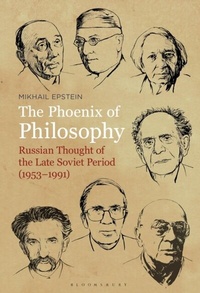
The Phoenix of Philosophy
Russian Thought of the Late Soviet Period (1953-1991)
1st Edition
Published on 27. June 2019
312 pages
978-1-5013-1643-2 (ISBN)
Description

This groundbreaking work by one of the world's foremost theoreticians of Russian literature, culture, and thought gives for the first time an extensive and detailed examination of the development of Russian thought during the late Soviet period. Countering the traditional view of an intellectual wilderness under the Soviet regime, Mikhail Epstein offers a systematic account of Russian thought in the second half of the 20th century. In doing so, he provides new insights into previously ignored areas such as Russian liberalism, personalism, structuralism, neo-rationalism, and culturology.
Epstein shows how Russian philosophy and culture has long been trapped in an intellectual prison of its own making as it sought to create its own utopia. However, he demonstrates that it is time to reappraise Russian philosophical thought and cultural theory, now freed from the bonds of totalitarianism. We are left with not only a new and exciting interpretation of Russian thought, but also an opportunity to rethink our own intellectual heritage.
Epstein shows how Russian philosophy and culture has long been trapped in an intellectual prison of its own making as it sought to create its own utopia. However, he demonstrates that it is time to reappraise Russian philosophical thought and cultural theory, now freed from the bonds of totalitarianism. We are left with not only a new and exciting interpretation of Russian thought, but also an opportunity to rethink our own intellectual heritage.
Reviews / Votes
Few books could be a better, more incisive and captivating guide to the intellectual richness of an important historical period than Mikhail Epstein's history of Russian thought in the late Soviet period ... a treasure-trove of discovery, opening up a vault of riches that is vast and multi-leveled. * Slavic Review * The Phoenix of Philosophy benefits from its author's encyclopaedic knowledge of the many philosophical tendencies and the individual philosophers he describes. He is brilliant at summarising their ideas ... Epstein's work is a great achievement * Marx and Philosophy Review of Books * Both a provocative analytical study and a philosophical dictionary of sorts, the book is absorbing and extremely valuable and should hopefully reach a large-and not just Slavic-audience. * Slavic and East European Journal * [T]his is a very helpful and stimulating work. * Slavonic & East European Review * Bold, comprehensive, and beautifully written, this book retrieves one of the best-forgotten parts of global intellectual history. While the lives of leading Soviet thinkers were tragic, Mikhail Epstein presents their philosophy as liberating: a sublime lesson of hope and resistance for our time. * Alexander Etkind, Professor of History of Russia-Europe Relations, European University at Florence, Italy * An impressive work of synthesis, this book offers a fascinating panorama of Soviet intellectual life in the second half of the 20th century. Epstein writes with clarity and conviction that stem from his knowledge and immediate experience of the times he revisits in these often riveting pages. * Galin Tihanov, George Steiner Professor of Comparative Literature, Queen Mary University of London, UK * This beautifully written book by one of our most eminent scholars of Russian culture confirms that even in the most inhospitable circumstances, such as Soviet ideocracy, Russian thought flourishes and liberates. It is a brilliant testimony to the power of ideas and of the human spirit. * Randall A. Poole, Professor of History, College of St. Scholastica, USA *More details
Edition
1. Auflage
Language
English
Place of publication
New York
United States
Publishing group
Bloomsbury Publishing PLC (Digital)
Target group
Professional and scholarly
ISBN-13
978-1-5013-1643-2 (9781501316432)
Copyright in bibliographic data and cover images is held by Nielsen Book Services Limited or by the publishers or by their respective licensors: all rights reserved.
Schweitzer Classification
Other editions
Additional editions
Book
12/2020
Bloomsbury Academic USA
€59.60
Shipment within 15-20 days
Book
06/2019
Bloomsbury Academic USA
€178.27
Shipment within 15-20 days
Person
Mikhail Epstein is Samuel Candler Dobbs Professor of Cultural Theory and Russian Literature at Emory University, USA, and former Professor of Russian and Cultural Theory at Durham University, UK. He has authored 30 books (in English and Russian), including The Transformative Humanities (Bloomsbury, 2012), and approximately 600 essays and articles, translated into 16 languages. Professor Epstein has won national and international awards, including The Andrei Bely Prize (S.-Petersburg, 1991) and the Liberty Prize, awarded annually for "the outstanding contribution to the development of Russian - U.S. cultural relations" (New York, 2000).
Content
Acknowledgments
Introduction
Part 1. Vicissitudes of Soviet Marxism
Part 2. Neo-rationalism. Structuralism. General methodology
Part 3. The philosophy of personality and of freedom
Part 4. Culturology, or, the philosophy of culture
Conclusion
Works cited
Appendix: Original Russian and other foreign-language titles
Name index
Subject index
Introduction
Part 1. Vicissitudes of Soviet Marxism
Part 2. Neo-rationalism. Structuralism. General methodology
Part 3. The philosophy of personality and of freedom
Part 4. Culturology, or, the philosophy of culture
Conclusion
Works cited
Appendix: Original Russian and other foreign-language titles
Name index
Subject index
