

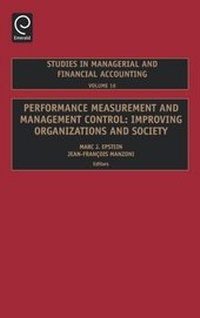
Performance Measurement and Management Control
Improving Organizations and Society
1st Edition
Published on 18. August 2006
524 pages
978-0-08-046357-5 (ISBN)
Description

The previous conference in Nice in 2003 focused on the determination of the specific actions that lead to superior organizational performance. This included the characteristics of superior performance and the identifiable features of management control and performance measurement systems that drive improved performance along with relevant performance measures. But, there are often dysfunctional consequences of the drive for superior organizational performance. Numerous stakeholders are often impacted both positively and negatively by the drive for superior organizational performance. These stakeholders often include employees, customers, suppliers, the community, and others. Much current research focuses on how organizations and managers can minimize negative internal impacts and externalities and use management control and performance measurement to improve both organizational performance and the impacts on employees and society. This book contains a compendium of some of the excellent papers presented at a workshop on Performance Measurement and Management Control: Improving Organizations and Society in September, 2005 in Nice, France. Sponsored by the European Institute for the Advanced Study in Management (EIASM) and EDHEC School of Management, this workshop attracted leading scholars on management control and performance measurement from around the world. The primary questions addressed at the conference relate to the specific managerial actions that can be taken to drive superior organizational performance and the determination of the most appropriate measures of long term success in organizational performance. Many papers also addressed the social impacts of these actions. The papers in this volume approach these questions using a variety of research methods. Some are more theory based and most include some empirical research including interviews, surveys, and field studies. These methods are used to explain how management control and performance measurement can aid in the implementation of strategy and the improvement of organizational and societal performance. The approaches are used in both for-profit and not-for-profit organizations. The answers are not yet clear. But it is hoped that the papers included in this volume contribute to this growing body of knowledge and lead us to an improved understanding of how to build better organizations and evaluate and understand their performance. This work discusses how superior organizational performance affects employees and society. It is based on a workshop on Performance Measurement & Management Control (Nice, France - Sep 2005). Content includes some empirical research including interviews, surveys, and field studies.
More details
Series
Language
English
Place of publication
London
United Kingdom
Publishing group
Elsevier Science & Technology
Target group
Professional and scholarly
File size
4,67 MB
ISBN-13
978-0-08-046357-5 (9780080463575)
Copyright in bibliographic data and cover images is held by Nielsen Book Services Limited or by the publishers or by their respective licensors: all rights reserved.
Schweitzer Classification
Other editions
Additional editions
Marc J. Epstein | Jean-Francois Manzoni
Performance Measurement and Management Control
Improving Organizations and Society
Book
08/2006
JAI Press Inc.
€170.40
Article not available at the moment
Content
- Cover
- Performance Measurement and Management Control: Improving Organizations and Society
- Copyright page
- Contents
- List of contributors
- Introduction
- Preface
- Part I: Improving Organizations and Society
- Chapter 1. Improving Organizations and Society: The Role of Performance Measurement and Management Control
- Microfinance in Ghana
- Social and Environmental Impacts in Wyoming
- Locating Manufacturing Facilities
- A Management Control and Performance Measurement Model for Corporate Social Impacts
- The Challenge of Sustainability Strategy Implementation: Two Additional Examples
- Improving Sustainability Strategy Implementation: The Critical Role of Management Control and Performance Measurement Research
- References
- Chapter 2. Reflections on the Human Implications of the Search for Corporate Performance
- Stress at Work
- High-Performance Positive Work Environments
- Concluding Thoughts
- Notes
- References
- Appendix: Nine Questions to Guide Managerial Attention when Leading Change
- Part II: The Impact of Organizations on Internal and External Stakeholders
- Chapter 3. A Performance Measurement System for Sustainability
- Introduction
- A Business Approach for Sustainable Development
- A Multidimensional and Multilevel Framework for Planning and Control of Sustainability
- The Public Utilities' Business Case
- Conclusion and Future Aims
- Notes
- Acknowledgments
- References
- Chapter 4. Are We Really Measuring Corporate Social Responsibility?
- Introduction
- The Business Case for Corporate Social Responsibility
- Sustainability Performance Measurement Systems
- The Ethical Ratings
- The Research Project
- CSR, Firm's Competitiveness and Value Creation: The Opinion of Managers
- CSR Performance Measurement Systems and Rating Systems: A Close Relation?
- Do Rating Systems really Measure the Degree of Social Responsibility of a Firm?
- Conclusions
- References
- Chapter 5. An Exploration of the Effects of Procedural Justice Perceptions of a Gainsharing Plan on Motivation and Work Effort
- Introduction
- Theoretical Development
- Organizational Background
- The Gainsharing Program
- Research Method
- Results
- Discussion
- Limitations and Future Directions
- Notes
- References
- Chapter 6. Understanding the Drivers of Corporate Performance and Customer Value
- Introduction
- The Resource-Based View
- Market Orientation
- Organizational Learning
- Hypotheses
- Method
- Results
- Discussion
- References
- Part III: Role of Performance Measurement in Improving Organizational Performance I
- Chapter 7. Towards ''Integrated Governance'': The Role of Performance Measurement Systems
- Introduction
- The Methodology
- Beyond Compliance: The Integrated Governance Framework
- Implementing the Three Dimensions of Governance: The Role of Performance Measurement Systems
- Re-Shaping Governance and Accountability: The Role of Finance in Integrated Governance
- Conclusions
- Note
- Acknowledgments
- References
- Chapter 8. How to Measure R&D Performance: A Design Framework and an Empirical Study
- Introduction
- Research Method
- A Literature Review and a Framework for the PMS Design
- The Case Study
- Conclusions and Managerial Implications
- References
- Chapter 9. Enhancing the Measurement Balance: Generating Business Measures for a Performance Appraisal System
- Introduction
- The Performance Appraisal System
- Generating Business Measures for Corporate Functional Groups
- Method
- Sample
- Procedure and Data Collection
- Data Analysis
- Results
- Discussion
- Finance
- Planning and Engineering
- Human Resources
- Information Technology
- The Translation Process
- Conclusions
- References
- Further Reading
- Chapter 10. Strategy and Integrated Financial Ratio Performance Measures: Further Evidence of the Financial Performance Scorecard and High-Performance Companies
- Introduction
- Previous Research
- Empirical Objectives
- Empirical Sample
- Test Periods
- Replication of the 1997-2001 Tests - Total Asset Management, Profitability, Financial Risk, and Cash Flow Efficiency Drivers and Measures
- Extension of Tests to 2002-2003: Total Asset Management, Profitability, Financial Risk, and Cash Flow Efficiency Drivers and Measures
- Effect of Outliers
- Operating Asset Management: 1997-2001
- Cash Flow Yield and Free Cash Flows
- Conclusion
- Acknowledgment
- References
- Appendix A. Formulas for Ratio Computations
- Appendix B. High-Performance Companies
- Chapter 11. Management Control and Value-Based Management: Compatible or Not?
- Introduction
- Introduction to Case Companies
- Reasons for Implementing Value-Based Management
- Implementation of Value-Based Management
- Value-Based Management and the Management Control system
- Effects on Behavior, Decision making and Performance
- Conclusions and Directions for Future Research
- Notes
- Acknowledgments
- References
- Appendix 1. Reasons for Implementing Value-Based Management
- Appendix 2. Implementation of Value-Based Management
- Appendix 3. Adapted Diamond for Schiphol Group
- Appendix 4. Characteristics of Value-Based Management and Management Control System
- Appendix 5. Effects of Value-Based Management
- Part IV: Role of Performance Measurement in Improving Organizational Performance II
- Chapter 12. The Contemporary Performance Measurement Techniques in Egypt: A Contingency Approach
- Introduction
- Contingency Theory
- Performance Measurement Literature
- Egypt: The Context of the Study
- Research Methodology
- Research Analysis
- Results and Conclusion
- References
- Chapter 13. Characteristics of the Performance Measures in External Reporting: Non-Financial Information used by French Companies in their Communication
- Introduction
- Preliminary Fieldwork
- Research Hypotheses
- Research Method and Results
- Conclusion
- Notes
- Acknowledgments
- References
- Chapter 14. Balanced Scorecard and Results-Based Management: Convergent Performance Management Systems
- Introduction
- Background
- Evolution of Balanced Scorecard
- Emergence of Results Based Management
- Comparison of Balanced Scorecard and RBM
- Case Material
- Discussion
- Conclusions
- References
- Chapter 15. Performance Measurement in Universities: The Case of Knowledge Balance Sheets Analyzed from a new Institutionalist Perspective
- Introduction
- The Perspective of New Institutionalism in Sociology
- Knowledge Balance Sheets in Austrian Universities
- Knowledge Balance Sheets in Austrian Universities: Interpretations from a Sociological New Institutionalist Point of View
- Conclusions
- References
- Part V: Effect of Compensation, Incentives, and Organizational Design in Improving Organizational Performance
- Chapter 16. Empirical Research on Performance-Based Compensation Contracts
- Introduction
- Compensation Contracts
- Performance Effects
- Pay-Performance Sensitivity
- Performance Measures
- Performance Standards
- Subjectivity in Compensation Contracts
- CEO Power
- Conclusion and Directions for Future Research
- Notes
- Acknowledgments
- References
- Chapter 17. The Design and Change of Management Control Systems in Dynamic Environments: Results from Case Study Research
- Introduction
- Insights from Case Studies
- Interaction Impact between Strategic Priorities and MCS-Initiatives
- Conclusion
- References
- Chapter 18. Strategic Performance Management in For-Profit and Not-For-Profit Organizations: What's the difference and what can they learn from each other?
- Introduction
- The (Shareholder) Value-Based Management Model
- A Stakeholder Model of Organizations and Stakeholder-Based Performance Management
- Blurring Boundaries in Strategic Performance Management: Differences and Relationships between For-Profit and Nonprofit Organizations
- References
- Chapter 19. Aligning Performance Measurement and Incentive Systems to Improve Financial Performance
- Introduction
- Literature Review and Research Questions
- Research Methodology and Sample Companies
- Results and Discussion
- Conclusions and Limitations
- References
- Appendix
