

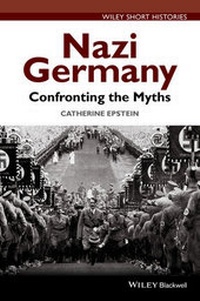
Nazi Germany
Description

Reviews / Votes
"Among the many textbooks on Nazi Germany Catherine Epstein's stands out both because of its persuasive combination of the most recent research on this subject interwoven with judicious discussions of continuing debates on unresolved historiographical questions and because of the skillful ways in which she draws the reader into this complex field. Students and teachers in advanced secondary as well as higher education will also find this book to be the best short guide to the history of the Nazi Holocaust." --V.R. Berghahn, Columbia University "Drawing on the very latest scholarship, Catherine Epstein offers a lucidly written, accessible, engaging account of Hitler and the Third Reich. Nazi Germany: Confronting the Myths is an ideal choice for the undergraduate classroom and will likely be the text that introduces many, many students to this most troubling chapter of modern German history." --Robert Moeller, University of California, IrvineMore details
Other editions
Additional editions
Person
Content
1
Germany before 1933
On January 30, 1933, Adolf Hitler was appointed chancellor of Germany. That evening, the Nazis celebrated their coming to power with a raucous torchlight parade in Berlin. They passed government buildings, their bright torches lighting up swastika banners. They paused before the Chancellory. There, Hitler and the man who had made him chancellor, President Paul von Hindenburg, greeted the jubilant crowds. While some Germans shared the Nazi euphoria at Hitler's appointment, others feared this latest turn in German politics. Few, however, could possibly have imagined the day's true outcome. In just a few short years, Hitler would unleash World War II. Before it was all over, some 55 million individuals would lose their lives, including almost six million Jews. The war would dramatically transform Germany, Europe, and the world.
The day after Hitler's appointment, his propaganda chief, Joseph Goebbels, noted in his diary, "Hitler is Reich Chancellor. Just like a fairy-tale." Many observers then and since have wondered just how the "fairy-tale" could have happened. Misperceptions on the matter abound. These include the notions that Hitler was the logical culmination of all German history; that the Nazi rise to power was a result of Germany following a "special path" to modernity; and that the Treaty of Versailles, imposed by the Allies on defeated Germany after World War I, brought the Nazis to power.
In fact, Hitler's appointment as chancellor was the immediate result of a series of intrigues surrounding the eighty-five-year-old President Hindenburg (see Chapter 2). There was nothing inevitable in Hitler's coming to power. As this chapter shows, though, there were long-term developments in German history that favored the rise of Nazism. World War I and its aftermath also helped to make Hitler's assumption of power possible, if hardly certain.
Germany before World War I
Germany could have taken many different paths in the twentieth century. Nazism was only one, and hardly the most likely, German trajectory. Some observers, however, such as Robert Vansittart, a British diplomat before and during World War II, and the historian A.J.P. Taylor, have argued that Nazism was the logical conclusion to all of German history. They believed that Germany was by nature aggressive and militaristic, and given to authoritarian leadership. This national character trait (or flaw) allegedly explained why Germans supported the Protestant reformer Martin Luther and the Prussian King Frederick the Great in earlier centuries, and Chancellor Otto von Bismarck and Adolf Hitler in modern times. But one should be wary of any argument that claims that a nation (or a race) has some essential attributes - reasoning in essentialist categories comes perilously close to Nazi thinking. Instead, one should look to political, economic, or ideological reasons for why German history unfolded as it did.
A case in point involves the unification of Germany in the nineteenth century. Before 1870, there were many German-speaking lands but there existed no united Germany. Between 1864 and 1870, Chancellor Otto von Bismarck, on behalf of the Prussian king, William I, initiated three wars so as to achieve German unification under Prussian aegis. In January 1871, shortly after the Franco-Prussian War, Germany annexed Alsace-Lorraine and proclaimed the second German Reich (empire) in the Hall of Mirrors at the Palace of Versailles (the first German Reich, or Holy Roman Empire, lasted from 962 to 1806). German unification was very popular among German elites. German liberals, in particular, were willing to sacrifice civic freedoms so as to advance national unification. Not least, unification promised them economic benefit. Their support of Bismarck had nothing to do with an alleged German penchant for authority.
The "special path" thesis
Following German unification, the Iron Chancellor, as Bismarck was dubbed, created political and constitutional arrangements for the new empire. These gave rise to another interpretation of why the Nazis came to power, the "special path" (Sonderweg) thesis. According to this argument, Germany never had a bourgeois (middle-class) revolution - such as the French Revolution - to send it down the path toward liberal democracy. In alleged contrast to Britain and France, Germany thus failed to develop either democratic institutions or a liberal political culture.
For the new German Empire, Bismarck created a set of constitutional arrangements. The Reichstag (parliament) was elected by universal male suffrage, but it had very little real power. The chancellor was responsible not to the Reichstag but to the emperor. The emperor controlled military and foreign affairs. In addition, the Reichstag had little budgetary power since provincial states (such as Prussia) controlled most government monies.
Sonderweg proponents claimed that German leaders pursued aggressive policies because there was a mismatch between Germany's rapid industrialization and its backward political and social order. Bismarck sought ways to unite Germany's divided elites - agrarian estate owners, known as Junkers, had very different interests from industrialists - in support of the monarchy. Among other strategies, he pitted Germany's ruling classes against alleged "enemies" who threatened elite interests. He initiated a nasty campaign against Catholics, including against the minority Polish Catholic population. He also hounded the Social Democratic Party (SPD), the nascent socialist party, which supported political liberalization and the more equitable distribution of economic goods. The Iron Chancellor bequeathed a legacy of intolerant polarization to German politics.
In 1888, William II came to power and, soon thereafter, dismissed Bismarck. William ruled a society undergoing rapid industrialization. Germans poured into urban areas in search of factory or mining work. Conservatives decried the social ills - disease, poverty, immorality, urban crowding, and personal alienation - that accompanied modernization. Workers, in turn, were eager to better their lot; they voted for the SPD in the hope of securing a share of political power. William faced a dilemma. In an era of mass politics, he wished to legitimize his rule. But he was unwilling to limit his autocratic powers by democratizing the political system. Instead, he fastened on an aggressive foreign policy to win popularity from both German elites and workers. As we shall see, this proved disastrous.
Today, the Sonderweg thesis has been largely discredited. As its most prominent critics, David Blackbourn and Geoff Eley, argue, the western path from which Germany supposedly departed was only a perceived norm, not reality. Britain and France were less democratic polities than Sonderweg enthusiasts claimed. The German middle classes also asserted their political influence in arenas other than Reichstag politics. The Sonderweg thesis nonetheless retains some value. William II did pursue an aggressive foreign policy, rather than constitutional reform, to legitimize his monarchy. This led to World War I and, indirectly, to Hitler. And Germans did have little experience with democracy - a deficit that would have pernicious consequences.
Nationalism
Nineteenth-century Europe saw the rise of nationalism, scientific racism, and antisemitism. Germany was hardly unique in this regard. Take nationalism. Many liberals and conservatives across Europe came to share a set of beliefs about the "nation." They argued that one's supreme loyalty should be to the nation (rather than to town, region, class, or religion). To them, the nation was an organic entity with its own unique characteristics. At the same time, nationalists believed that a nation's members should be united in a nation-state, that nations needed overseas colonies to prosper, and that nations were locked in a zero-sum struggle in which one nation's gain was another's loss.
German nationalists drew on romantic myths of past German heroism and sacrifice. They harked back to the saga of Frederick Barbarossa, the crusading medieval Holy Roman Emperor who united warring Germanic factions and established peace in the German lands. Barbarossa was said to be sleeping in a mountain awaiting the rebirth of German glory. German nationalists also linked Germanness to the notion of Volk (variously translated as "nation," "people," or "race"). They championed a "blood-and-soil" (Blut und Boden) ideology: the notion that peasants ("blood") who farmed the countryside ("soil") were the true repository of traditional German values and authentic folk culture. In addition, some nationalists claimed a superior German "essence" that was rooted in the cosmic nature of the German forest landscape. Dark, mysterious, and profound, the forest was the alleged wellspring of German creativity, depth of feeling, and unity with other members of the Volk. German nationalists also believed that the German people cultivated profound inner values such as spirituality, idealism, and heroism. (The French, by contrast, supposedly fostered superficial values such as materialism and...
