

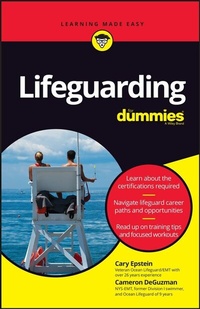
Lifeguarding For Dummies
Description

Lifeguarding For Dummies will give you insight into what it takes to be a lifeguard, and how to train and prepare to be a lifesaver. Lifeguarding is a fun, challenging, and rewarding job that gives you the unique ability to provide your community with a safe place to swim. It also requires quick decision-making and provides you with valuable lifelong skills, such as CPR and first aid, leadership, strong communication, and teamwork. This book walks you through the process of training, preparing for certification, and finding a job as a lifeguard. Good lifeguards are in high demand right now--check out this great job with the help of Dummies.
* Learn about the essential skills that are needed to become a lifeguard
* Decide whether lifeguarding is the right job for you
* Understand the basic types of lifeguarding jobs and how to get certified
* Try fun swimming workouts to get you prepared for lifeguarding tests
This fun book is perfect for anyone who wants to explore the possibility of becoming a lifeguard, gain some basic knowledge and prep for tests, and learn about the lifestyle of the lifeguarding community.
More details
Other editions
Additional editions
Persons
Cameron DeGuzman works in clinical research at the Memorial Sloan Kettering Cancer Center and has been a Jones Beach Ocean Lifeguard since 2016.
Content
Part 1: Getting Started with Lifeguarding 7
Chapter 1: Lifeguarding 101 9
Chapter 2: The Elements of Lifeguarding 31
Chapter 3: The History of Lifeguarding 59
Part 2: Lifeguarding in the Different Facilities 73
Chapter 4: The Pool and Waterpark Lifeguard 75
Chapter 5: The Stillwater Lifeguard 97
Chapter 6: The Ocean Rescue Lifeguard 109
Chapter 7: Lifeguarding as a Career 131
Part 3: Training and Preparation 145
Chapter 8: Diving into Training Workouts 147
Chapter 9: Staying in Shape All Year 169
Chapter 10: Working on In-Service Training and Drills 177
Part 4: Exploring Other Lifeguarding Activities 203
Chapter 11: Working Outside of Your Lifeguard Facility 205
Chapter 12: The Sport of Surf Lifesaving 221
Chapter 13: Starting Early: Junior Lifeguard Programs 237
Chapter 14: Joining a Professional Organization 249
Part 5: The Part of Tens 257
Chapter 15: The Lifeguard's Ten Commandments 259
Chapter 16: Ten Tools You Need in Your Backpack 267
Chapter 17: Ten Reasons to Dive into Lifeguarding 275
Chapter 18: Ten Reasons To GO (On the Rescue!) 281
Chapter 19: Words of Wisdom from Ten Lifeguards Near and Far 289
Index 293
Chapter 1
Lifeguarding 101
IN THIS CHAPTER
Understanding the importance of lifeguarding
Discovering the basics about water rescue and safety
Following a day in the life of a lifeguard
Welcome to the world of lifeguarding, "the best job you will ever have." While we admit that is a pretty bold statement to start off with, ask anyone you know who has spent any amount of time lifeguarding and see what they have to say. This lifeguard world is filled with culture and tradition that goes back decades, and we are very excited to share it all with you in this book.
While stereotypically you might think of lifeguarding as a teenager's job, across the United States and around the world, there are dedicated people (including some who have given their lives to save others) who are proud to call themselves professional lifeguards. Think of Aquaman . but a realistic day-to-day version! We cordially invite you to kick off your shoes, grab your most appropriate bathing suit, and dive right in!
The Importance of Lifeguarding
Drowning is one of the leading causes of death across the United States and around the world. It is considered one of the most avoidable ways to die. How is it avoidable, you might ask? By simply swimming and recreating in waters protected by lifeguards, swimmers greatly reduce their risk. The majority of drownings are avoidable, but human nature just can't resist the temptation of getting wet. Did you know that 74 percent of fatal pool drownings happen residentially? When no lifeguards are present, public pools and beaches post signs that read "Swim at your own risk," yet people ignore the posted warnings and tragedies happen. Everyone thinks bad things can't happen to them. If that were the case, then bad things wouldn't happen to anyone. Frankly, this attitude can get you in a lot of trouble!
At the end of the day, if there are no lifeguards on duty, you really shouldn't be swimming . and yes that goes for people who are good swimmers too!
The Perks of Lifeguarding
Although there are waaaaay too many perks of the job to list in one chapter, we figured we would share some of our favorites!
- The beach, pool, or park is your office. When you are told to report to work, this is where you are going! This couldn't be any more atypical. Your views of the sunset (if you're not working indoors) will be way better than your friends' who work typical 9-5 jobs at their desks, guaranteed!
- You have the best seat in the house. People actually pay to come to your job, but you get paid and get the best seat in the house! Everyone wants to sit up on the lifeguard stand, chair, or tower . but they don't get to visit the Royal Palace and sit on the throne! Being high above the ground looking down on all brings both pride and power.
- No shoes, no shirt . no problem! Try showing up to a traditional office and stripping down to a speedo or your favorite bathing suit. You'll never have a problem deciding what to wear either, since as a lifeguard you need to be in uniform at all times (no heels, no laces, no ties, no briefcases, no belts . no problem!).
- Being outdoors (unless you're indoors!) While there most certainly are indoor lifeguarding jobs, we think that one of the best perks is getting to work outside. The warm blanket of sun covering you from head to toe, the gentle breeze that slightly blows your hair, the sweet scent of sunscreen infiltrating your nose, ending with a gorgeous sunset. And yes . you get paid for all of that!
- When the ocean is closed to the public for big surf, it is open to you. This is a great opportunity for you and the lifeguard team to train. While we recognize the hazards of getting in the water during a high surf advisory, this is how ocean lifeguards fully prepare for the worst! Each agency has its own rules and regulations when it comes to putting guards in the water on these hazardous training days.
- Use of all the fancy equipment. All the toys! Each specialized piece of equipment has a purpose and the only way to get proficient with them is to take them out. Grab a kayak, surfski, or rescue board! Get trained to row or operate the jet ski or motorized lifeguard boat!
- You get paid to work out! Staying in shape is an important part of this job, as we will discuss in Part 3, but not many jobs pay you to work out. Yes, you read that correctly. Go to the gym on your own time or work out on the clock! In many cases, lifeguard shacks and areas have a variety of workout equipment to help you maintain your lifeguard physique.
- You develop lasting friendships. It is not uncommon to make lifelong friends on the job. Due to the close-knit nature of the work, coupled with trainings and teamwork, you will quickly find yourself developing friendships with fellow lifeguards that can last a lifetime. These may be the people in your wedding party and at your children's first birthdays. Crazy as it sounds, you might even meet your future partner on the job (trust us, it has happened on more than one occasion)! P.S. Lifeguard weddings get wild!
Developing skills that will benefit you beyond the water
Being a lifeguard, you get much more than just a lifesaving skill set. There are many, many benefits that you develop from working as a lifeguard that transition into other jobs and industries.
Increased self confidence
Self-confidence and self-esteem take time to build up, especially for teenagers. Some of us never get our self-confidence up to a level we are happy with, even into our adult lives. Lifeguarding is an extremely serious job that requires making life and death decisions. At the end of the day, knowing that the decisions and actions you made helped keep people safe will absolutely lead to a boost in your own self-confidence!
Communication skills
Working in this role requires you to speak to all kinds of people, including your fellow coworkers, and adult and juvenile patrons visiting your facility. You need to be able to clearly express your thoughts and communicate with the public. Sometimes people just want to walk up to your lifeguard stand or chair to chat or ask a question. But in more serious situations, being able to delegate tasks with clarity and efficiency goes a long way when the clock is ticking.
Leadership qualities
Leaders are made, not born! Let's face it . some of us are better at leading than others. That doesn't mean that you can't learn to be a good leader. Leadership qualities take time to develop. As a lifeguard, there is no doubt you will find yourself in situations where you need to use these skills! Lifeguards who possess this skill set may find themselves being offered leadership positions or administrative titles, such as aquatics director, coordinator, captain, lieutenant, boatswain, and so on. These positions not only earn you more responsibility but also more money.
You do not need to be in an administrative or leadership position to be a leader. Some of the best lifeguards we know display incredible leadership skills. They are not bosses or administrators . just plain old salty lifeguards. Be the best version of yourself, and, in time, your leadership qualities will grow.
Teamwork
In almost all circumstances in this job, you need the rest of your crew to help you out. Whether you find yourself in a multi-person rescue or simply need backup to cover your chair when you jump in, you must be able to rely on your coworkers. You also need to be reliable in any situation that arises. Lifeguards often work closely together with the common goal of executing a rescue and saving someone's life. Without the ability to work as a team, the likelihood of a successful outcome significantly decreases.
Teamwork makes the dream work!
Problem-solving skills
Some lifeguards might say that no two rescues are the same. Many certainly are similar, but when it comes down to it, you were tasked with a situation at hand and it was ultimately you who had to make the decision. This builds off the point about self-confidence. As you become more comfortable making autonomous decisions for the safety of others, you will realize that all this time you were dissecting the problem and coming up with the most efficient and sensible way to bring a swimmer or patron out of danger.
Handling stress
Stress is part of everyday life. However, as a first responder, levels of stress can be elevated, based on what you saw or actions you took while administering medical aid or performing a water rescue. Professional lifeguards learn that it is healthy and okay to feel stressed. You will learn not to compartmentalize your feelings and learn that there are ways you can express how you feel without being afraid of looking weak. Learning how to handle and recognize post-traumatic stress disorder will help you tremendously - not just as a lifeguard, but in everyday life as well. Critical incident stress debriefings (CISDs) are common practices after a serious rescue, especially when there is loss of life.
A critical incident stress debriefing, or CISD, is a process that occurs soon after a traumatic incident, typically 24 to 72 hours after the event. It is led by a designated facilitator...
