

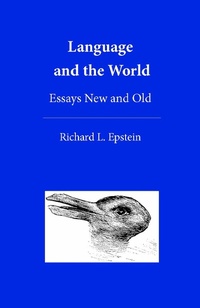
Language and the World
Essays New and Old
1st Edition
Published on 9. July 2021
307 pages
978-1-938421-57-0 (ISBN)
Description

This book presents a new perspective on ways we encounter the world with our languages.
There are two kinds of languages. Some direct speakers to encounter the world as made up of things. Others direct speakers to encounter the world as the flow of all with no idea of change, for there is no thing to change, only differing descriptions of the flow. The essays by Richard L. Epstein set out this division of languages and explore its significance for linguistics, metaphysics, thought, meaning, logic, and ethics. The other essays, by Dorothy Lee, Benjamin Lee Whorf, M. Dale Kinkade, Friedrich Nietzsche, and Benson Mates, extend, or contradict, or support those ideas, leading to a large view of how we talk and understand, and how that affects how we live.
There are two kinds of languages. Some direct speakers to encounter the world as made up of things. Others direct speakers to encounter the world as the flow of all with no idea of change, for there is no thing to change, only differing descriptions of the flow. The essays by Richard L. Epstein set out this division of languages and explore its significance for linguistics, metaphysics, thought, meaning, logic, and ethics. The other essays, by Dorothy Lee, Benjamin Lee Whorf, M. Dale Kinkade, Friedrich Nietzsche, and Benson Mates, extend, or contradict, or support those ideas, leading to a large view of how we talk and understand, and how that affects how we live.
More details
Other editions
Additional editions
Book
06/2021
Advanced Reasoning Forum
€26.30
Shipment within 3-4 weeks
Person
Richard L. Epstein (1947-) received his Ph.D. in mathematics from the University of California, Berkeley. He began studies in philosophy as a postdoctoral fellow at Victoria University of Wellington, New Zealand. His mentors in philosophy were George Hughes and Benson Mates. He has published books on mathematical logic, formal logic, logic as the art of reasoning well, and linguistics. He has translated and edited for publication the stories in The BARK of DOG. He is now Head of the Advanced Reasoning Forum and director of The BARK of DOG Foundation in Socorro, New Mexico.
Content
Essays New (Richard L. Epstein)
The World as the Flow of All
Language and the World
Language-Thought-Meaning
Why Event-Talk Is a Problem
On the Genesis of the Concept of Object in Children
A New Turing Test
The Thing-Basis of Western Philosophy
The Metaphysical Basis of Logic: Things and Masses
Languages and Logics
Essays Old
(Dorothy Lee)
Conceptual Implications of an Indian Language
Categories of the Generic and Particular in Wintu
Linguistic Reflections of Wintu Thought
Symbolization and Value
(Benjamin Lee Whorf)
Grammatical Categories
Science and Linguistics
The Relation of Habitual Thought and Behavior to Language
Languages and Logic
(M. Dale Kinkade)
Salish Evidence Against the Universality of 'Noun' and 'Verb'
(Friedrich Nietzsche)
"Reason" in Philosophy
(Benson Mates)
Metaphysics and Linguistic Relativity
Index
The World as the Flow of All
Language and the World
Language-Thought-Meaning
Why Event-Talk Is a Problem
On the Genesis of the Concept of Object in Children
A New Turing Test
The Thing-Basis of Western Philosophy
The Metaphysical Basis of Logic: Things and Masses
Languages and Logics
Essays Old
(Dorothy Lee)
Conceptual Implications of an Indian Language
Categories of the Generic and Particular in Wintu
Linguistic Reflections of Wintu Thought
Symbolization and Value
(Benjamin Lee Whorf)
Grammatical Categories
Science and Linguistics
The Relation of Habitual Thought and Behavior to Language
Languages and Logic
(M. Dale Kinkade)
Salish Evidence Against the Universality of 'Noun' and 'Verb'
(Friedrich Nietzsche)
"Reason" in Philosophy
(Benson Mates)
Metaphysics and Linguistic Relativity
Index
