

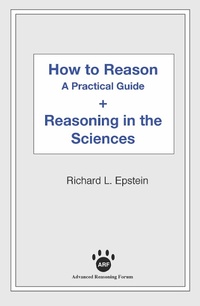
How to Reason + Reasoning in the Sciences
A Practical Guide
1st Edition
Published on 5. February 2019
244 pages
978-1-938421-41-9 (ISBN)
Description

Too often we're guided by what we last heard, by our friends' approval, by impulse-our desires, our fears. Without reflection. Without even stopping to think. ** In this book you'll learn how to reason and find your way better in life. You'll learn to see the consequences of what you and others say and do. You'll learn to see the assumptions that you and others make. You'll learn how to judge what you should believe. These are the skills we all need to make good decisions. ** Claims. Arguments. Fallacies. Analogies. Generalizing. Cause and Effect. Explanations. These are clearly set out with hundreds of examples from daily life showing how to use them. Illustrations using a cast of cartoon characters make the concepts memorable. And many exercises will help you to check your understanding. ** Truly a book for all-from high school to graduate school, from auto repair to managing a company. How to Reason will help you find a way in life that is clearer and not buffetted by the winds of nonsense and fear. ******* In Reasoning in the Sciences, you'll learn how to use your reasoning skills to understand how scientists make definitions, what an experiment is, what can go wrong with an experiment, how scientists reason with models and theories, what counts as a good explanation in science, and how to distinguish science from magic, religion, and fraud. No background in science is needed, just a healthy appetitite for learning.
All prices
More details
Other editions
Additional editions
Richard L. Epstein
How to Reason + Reasoning in the Sciences
Book
01/2019
Advanced Reasoning Forum
€19.90
Shipment within 3-4 weeks
Persons
Richard L. Epstein received his B.A. from the University of Pennsylvania and his Ph.D. from the University of California, Berkeley. He was a Fulbright Fellow to Brazil and a National Academy of Sciences
scholar to Poland. He is the author of "An Introduction to Formal Logic", "Propositional Logics", "Predicate Logic" and the series of books "Essays on Logic as the Art of Reasoning Well". Since 1999 he
has been the head of the Advanced Reasoning Forum in Socorro, New Mexico. He has also translated and edited "The BARK of DOG", and directs The BARK of DOG Foundation.
scholar to Poland. He is the author of "An Introduction to Formal Logic", "Propositional Logics", "Predicate Logic" and the series of books "Essays on Logic as the Art of Reasoning Well". Since 1999 he
has been the head of the Advanced Reasoning Forum in Socorro, New Mexico. He has also translated and edited "The BARK of DOG", and directs The BARK of DOG Foundation.
Content
Preface
Claims
1 Claims
2 Definitions
3 Subjective Claims
4 Prescriptive Claims
5 Concealed Claims
Arguments
6 Arguments
7 What's a Good Argument?
8 Evaluating Premises
9 Common Mistakes in Evaluating Claims
10 Repairing Arguments
11 Too Much Emotion
12 Reasoning with Prescriptive Claims
13 Counterarguments
The Form of an Argument
14 Compound Claims
15 Valid Forms of Arguments using Conditionals
16 General Claims
Numbers and Graphs
17 Numbers
18 Graphs
Reasoning from Experience
19 Analogies
20 Generalizing
21 Cause and Effect
22 Cause in Populations
23 Inferential Explanations
24 Functional Explanations
Making Decisions
25 Evaluating Risk
26 Making Decisions
Writing Well
Reasoning in the Sciences
27 Some Examples to Start
28 The Scientific Method
29 Experiments
30 What Can Go Wrong with an Experiment
31 Models and Theories
32 Explanations in Science
33 Ways of Knowing
Index
Claims
1 Claims
2 Definitions
3 Subjective Claims
4 Prescriptive Claims
5 Concealed Claims
Arguments
6 Arguments
7 What's a Good Argument?
8 Evaluating Premises
9 Common Mistakes in Evaluating Claims
10 Repairing Arguments
11 Too Much Emotion
12 Reasoning with Prescriptive Claims
13 Counterarguments
The Form of an Argument
14 Compound Claims
15 Valid Forms of Arguments using Conditionals
16 General Claims
Numbers and Graphs
17 Numbers
18 Graphs
Reasoning from Experience
19 Analogies
20 Generalizing
21 Cause and Effect
22 Cause in Populations
23 Inferential Explanations
24 Functional Explanations
Making Decisions
25 Evaluating Risk
26 Making Decisions
Writing Well
Reasoning in the Sciences
27 Some Examples to Start
28 The Scientific Method
29 Experiments
30 What Can Go Wrong with an Experiment
31 Models and Theories
32 Explanations in Science
33 Ways of Knowing
Index
