

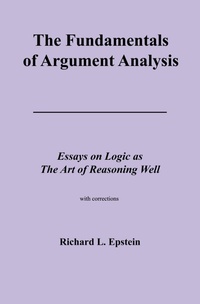
The Fundamentals of Argument Analysis
1st Edition
Published on 5. November 2018
228 pages
978-1-938421-06-8 (ISBN)
Description

This series of books presents the fundamentals of logic in a style accessible to both students and scholars. The text of each essay presents a story, the main line of development of the ideas, while the notes and appendices place the research within a larger scholarly context. The essays overlap, forming a unified analysis of logic as the art of reasoning well, yet each essay is designed so that it may be read independently.
The question addressed in this volume is how we can justify our beliefs through reasoning. The first essay, "Arguments," investigates what it is that we call true or false and how we reason toward truths through arguments. A general theory of argument analysis is set out on the basis of what we can assume about those with whom we reason. The next essay, "Fallacies," explains how the classification of an argument as a fallacy can be used within that general approach. In contrast, there is no agreement on what the terms "induction" and "deduction" mean, and they are not useful in evaluating arguments, as shown in "Induction and Deduction." In reasoning to truths, in the end we must take some claims as basic, not requiring any justification for accepting them. How we choose those claims and how they affect our reasoning is examined in "Base Claims." The essay "Analogies" considers how comparisons can be used as the basis of arguments, arguing from similar situations to similar conclusions. An important use of analogies is in reasoning about the mental life of other people and things, which is examined in "Subjective Claims," written with Fred Kroon and William S. Robinson. "Generalizing" examines how to argue from part of a collection or mass to the whole or a larger part. The question there is whether we are ever justified in accepting such an argument as good. "Probabilities" sets out the three main ways probability statements have been interpreted: the logical relation view, the frequency view, and the subjective degree of belief view. Each of those is shown to be inadequate to make precise the scale of plausibility of claims and the scale of the likelihood of a possibility. Many discussions of how to reason well and what counts as good reason are given in terms of who or what is rational. In the final essay, "Rationality," it's shown that what we mean by the idea of someone being rational is of very little use in evaluating reasoning or actions. This volume is meant to give a clearer idea of how to reason well, setting out methods of evaluation that are motivated in terms of our abilities and interests. At the ground of our reasoning, though, are metaphysical assumptions, too basic and too much needed in our reasoning for us to justify them through reasoning. But we can try to uncover those assumptions to see how they are important and what depends on them.
The question addressed in this volume is how we can justify our beliefs through reasoning. The first essay, "Arguments," investigates what it is that we call true or false and how we reason toward truths through arguments. A general theory of argument analysis is set out on the basis of what we can assume about those with whom we reason. The next essay, "Fallacies," explains how the classification of an argument as a fallacy can be used within that general approach. In contrast, there is no agreement on what the terms "induction" and "deduction" mean, and they are not useful in evaluating arguments, as shown in "Induction and Deduction." In reasoning to truths, in the end we must take some claims as basic, not requiring any justification for accepting them. How we choose those claims and how they affect our reasoning is examined in "Base Claims." The essay "Analogies" considers how comparisons can be used as the basis of arguments, arguing from similar situations to similar conclusions. An important use of analogies is in reasoning about the mental life of other people and things, which is examined in "Subjective Claims," written with Fred Kroon and William S. Robinson. "Generalizing" examines how to argue from part of a collection or mass to the whole or a larger part. The question there is whether we are ever justified in accepting such an argument as good. "Probabilities" sets out the three main ways probability statements have been interpreted: the logical relation view, the frequency view, and the subjective degree of belief view. Each of those is shown to be inadequate to make precise the scale of plausibility of claims and the scale of the likelihood of a possibility. Many discussions of how to reason well and what counts as good reason are given in terms of who or what is rational. In the final essay, "Rationality," it's shown that what we mean by the idea of someone being rational is of very little use in evaluating reasoning or actions. This volume is meant to give a clearer idea of how to reason well, setting out methods of evaluation that are motivated in terms of our abilities and interests. At the ground of our reasoning, though, are metaphysical assumptions, too basic and too much needed in our reasoning for us to justify them through reasoning. But we can try to uncover those assumptions to see how they are important and what depends on them.
All prices
More details
Other editions
Additional editions
Richard L. Epstein
The Fundamentals of Argument Analysis
Book
02/2013
Advanced Reasoning Forum
€19.30
Shipment within 3-4 weeks
Person
Richard L Epstein received his B.A. summa cum laude from the University of Pennsylvania, and his Ph.D. from the University of California, Berkeley. He was a post-doctoral fellow in mathematics and philosophy at Victoria University of Wellington, New Zealand. a Fulbright Fellow to Brazil. and a National Academy of Sciences Scholar to Poland. He is the author of the series of books "Essays on Logic as the Art of Reasoning Well", and the textbooks "Critical Thinking" and "The Pocket Guide to Critical Thinking". He is now the Head of the Advanced Reasoning Forum.
Content
Arguments
Fallacies
Induction and Deduction
Base Claims
Analogies
Subjective Claims
Generalizing
Probabilities
Rationality
Bibliography
Index
Fallacies
Induction and Deduction
Base Claims
Analogies
Subjective Claims
Generalizing
Probabilities
Rationality
Bibliography
Index
