

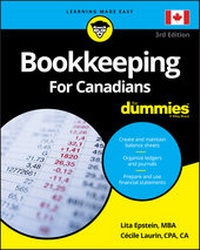
Bookkeeping For Canadians For Dummies
Description

Bookkeeping is an essential skill required in every industry, with a certain concentration in wholesale and retail trade, manufacturing, payroll services, accounting and tax preparation. If you're a small business owner looking for clear and concise instructions on keeping the books, tracking transactions, recognizing assets and liabilities and keeping ledgers and journals, this book is your one-stop guide to making it easier!
Bookkeeping For Canadians For Dummies covers how to create financial statements and also shows how to operate accounts for businesses. In addition, it teaches you how to recognize the assets and liabilities to the business.
* Keep the books
* Track transactions
* Compete against larger competitors
* Stay on top of journals
Small business owners keeping their own books will rejoice to have this handy guide by their side!
More details
Other editions
Additional editions
Persons
Lita Epstein, MBA designs and teaches online courses on investing for retirement, getting ready for tax time, and finance and investing for women.
Cécile Laurin, CPA, CA is a Chartered Professional Accountant and teacher based in Ottawa.
Content
Chapter 1
So You Want to Do the Books
IN THIS CHAPTER
Introducing bookkeeping and its basic purpose
Maintaining an electronic or paper trail
Managing daily business finances
Making sure everything's accurate
Putting on a financial show
Getting ready to report to the government
Few small-business owners hire accountants to work full time for them because that expense is probably excessive for a small business. Instead, the owner hires a bookkeeper who serves as the business accountant's eyes and ears. In return, the accountant helps the bookkeeper develop good bookkeeping practices and reviews his or her work periodically (usually monthly).
In this chapter, we provide an overview of a bookkeeper's work. If you're just starting a business, you may be your own bookkeeper for a while until you can afford to hire one, so think of this chapter as your to-do list.
Delving into Bookkeeping Basics
Like most businesspeople, you probably have great ideas for running your own business and just want to get started. You don't want to sweat the small stuff, such as keeping detailed records of every penny spent; you just want to quickly build a business that can make a lot of money.
Well, slow down - starting a business isn't a race! If you don't carefully plan your bookkeeping operation and figure out exactly what financial detail you want to track, and how, you will have absolutely no way to measure the success (or failure, unfortunately) of your business efforts.
Bookkeeping, when done properly, gives you an excellent gauge of how well your business is doing. When done in a timely manner, bookkeeping gives you quick feedback on how your business is doing. It also provides you with a lot of information throughout the year so that you can test the financial success of your business strategies and make course corrections as soon as possible, if and when necessary, to ensure that you reach your year-end profit goals.
Bookkeeping can become your best friend when it comes to managing your financial assets, meeting your obligations, and testing your business strategies, so don't short-change it. Take the time to develop your bookkeeping system with your accountant before you even open your business's doors and make your first sale.
Choosing your accounting method
You can't keep books unless you know how you want to go about doing so. The two basic accounting methods you have to choose from are cash-basis accounting and accrual accounting. The key difference between these two accounting methods is the point at which you record sales and purchases in your books. If you choose cash-basis accounting, you record transactions only when cash changes hands. (Only a very limited number of Canadian businesses are allowed to use cash-basis accounting to report taxes.) If you use accrual accounting, you record a transaction when the products are delivered or services are provided, even if cash doesn't change hands.
For example, suppose your business buys products to sell from a vendor but doesn't pay for those products for 30 days. If you're using cash-basis accounting, you don't record the purchase until you lay out the cash to the vendor. If you're using accrual accounting, you record the purchase when you receive the products, and you also record the obligation to pay the vendor in an account called Accounts Payable.
We talk about the pros and cons of each type of accounting method in Chapter 2.
Understanding assets, liabilities, and equity
Every business has three key financial parts that you must keep in balance: assets, liabilities, and equity. Assets include everything the business owns and uses, such as cash, inventory, buildings, equipment, and vehicles. Liabilities include everything the business owes to others, such as vendor bills, credit card balances, and bank loans. Equity includes the claims that owners have on the assets, based on each owner's portion of ownership in the business.
These three elements make up the formula for keeping your books in balance:
Assets = Liabilities + Equity
Because balancing your books is so important, we talk a lot about how to keep your books and accounting records in balance throughout this book. You can find an introduction to this concept in Chapter 2.
Introducing debits and credits
To keep the books, you need to revise your thinking about two common financial terms: debits and credits. Most non-bookkeepers and non-accountants think of debits as subtractions from their bank accounts and credits as additions to their accounts (in most cases, in the form of refunds or corrections in favour of the account holders).
Well, forget all you thought you knew about debits and credits. Debits and credits are different animals in the world of bookkeeping. Because keeping the books involves a method called double-entry bookkeeping, you have to make a least two entries - a debit and a credit - into your bookkeeping system for every transaction. Whether that debit or credit adds or subtracts from an account depends solely on the type of account.
We know that all this debit, credit, and double-entry stuff sounds confusing, but we promise you can understand it if you work through this book. We start explaining this critical, yet somewhat confusing, concept in Chapter 2.
Charting your bookkeeping course
You can't just enter transactions in the books willy-nilly. You need to know exactly where those transactions fit into the larger bookkeeping system. This is where your Chart of Accounts comes in; it's essentially a list of all the accounts your business has and what types of transactions go into each account.
We talk more about the Chart of Accounts in Chapter 3.
Recognizing the Importance of an Accurate Electronic or Paper Trail
To keep the books, you need to create an accurate electronic or paper trail. You want to track all your business's financial transactions so that if a question comes up at a later date, you can turn to the books to figure out what went wrong or answer a query about an amount or a balance reported in your books.
An accurate electronic or paper trail is the only way to track your financial successes and review your financial failures, tasks that are vitally important to grow your business. You need to know what works successfully so that you can repeat it in the future and build on your success. On the other hand, you need to know what failed so that you can correct it and prevent making the same mistake again.
In the general ledger, you summarize all your business's financial transactions, and you use journals to keep track of the tiniest details of each transaction. You can make your information-gathering more effective by using a computerized accounting system, which gives you access to your financial information in many different formats. Controlling who enters this financial information into your books and who can access it afterwards is smart business and involves critical planning on your part. We address all these concepts in the following sections.
Maintaining a ledger
The granddaddy of your bookkeeping system is the general ledger. In this ledger, you keep a summary of all your accounts and the financial activities that took place involving those accounts throughout the year.
You draw upon the general ledger's account balances to develop your financial statements and reports on a monthly, quarterly, or annual basis. You can also use these account balances to develop internal reports that help you make key business decisions. We talk more about developing and maintaining the general ledger in Chapter 4.
Keeping journals
Small businesses conduct hundreds, if not thousands, of transactions each year. If you recorded every transaction in the general ledger, that record would become unwieldy and difficult to use. Instead, most businesses keep a series of journals that detail activity in their most active accounts.
For example, almost every business has a Cash Receipts journal in which to keep the detail for all incoming cash and a Cash Disbursements journal in which to keep the detail for all outgoing cash. Other journals can detail sales, purchases, customer accounts, vendor accounts, and any other key accounts that see significant activity.
You decide which accounts for which you want to create journals based on your business operation and your need for information about key financial transactions. We talk more about the importance of journals, the accounts commonly journalized, and the process of maintaining journals in Chapter 5.
Considering computerizing
Most businesses today use computerized accounting systems to keep their books. You should consider using one of these systems, rather than trying to keep your books on paper. Your bookkeeping takes less time and is probably more accurate with a computerized system, as compared to the old pen-and-paper method.
In addition to increasing accuracy and cutting the time it takes to do your bookkeeping, computerized accounting also makes designing reports easier. You can then use these reports to help make business decisions. Your computerized...
