

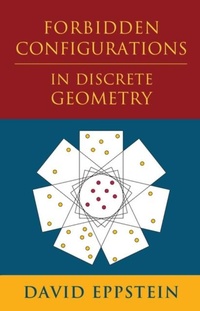
Forbidden Configurations in Discrete Geometry
Published on 11. April 2018
978-1-108-54297-5 (ISBN)
Description

This book surveys the mathematical and computational properties of finite sets of points in the plane, covering recent breakthroughs on important problems in discrete geometry, and listing many open problems. It unifies these mathematical and computational views using forbidden configurations, which are patterns that cannot appear in sets with a given property, and explores the implications of this unified view. Written with minimal prerequisites and featuring plenty of figures, this engaging book will be of interest to undergraduate students and researchers in mathematics and computer science. Most topics are introduced with a related puzzle or brain-teaser. The topics range from abstract issues of collinearity, convexity, and general position to more applied areas including robust statistical estimation and network visualization, with connections to related areas of mathematics including number theory, graph theory, and the theory of permutation patterns. Pseudocode is included for many algorithms that compute properties of point sets.
Reviews / Votes
'David Eppstein has managed to unify a huge swath of research on planar point sets through monotone properties and forbidden configurations. For example, finding grid points that avoid the obstacle of a 3-point line is a century-old problem still not entirely resolved. The author's unification naturally uncovers research lacuna, several of which he fills, while others are formulated as sharp new open problems. This rare synthesis of previous work will reinvigorate and redirect the field.' Joseph O'Rourke, Smith College, Massachusetts 'David Eppstein takes us on an adventure tour to the study of point configurations in Discrete Geometry. It visits many different topics, connected by the original viewpoint of 'forbidden configurations'. This is interesting, instructive - and fun!' Guenter M. Ziegler, Freie Universitaet Berlin 'This unique volume collects and unifies almost a century of work on point configurations on the plane, and their properties that depend on whether each subset of three points is oriented clockwise, oriented counterclockwise, or collinear. Beginning with the Happy Ending Theorem, the author takes us through entertaining problems and into computational geometry. A delight to read as well as a persuasive case for the method of forbidden configurations, the book will be a valuable addition to the library of any discrete or computational geometer.' Peter Winkler, Dartmouth College, New Hampshire 'This is a fun read on certain topics in discrete and computational geometry. It begins with 'A Happy Ending' and ends with 'Only the Beginning'. Eppstein's journey through various problems of pointset configurations offers a new view of the subject even to experts of the field. Recommended to everyone who likes geometry and computer science.' Jozsef Solymosi, University of British Columbia 'David Eppstein has brought the weight of his formidable expertise and expositional talents on the simplest of shapes: points and lines. He gently guides the reader through a vast array of fascinating topics, their greatest hits to the state-of-the-art. This lovely book will be found on the shelves of mathematicians and computer scientists for many years to come.' Satyan Devadoss, University of San Diego 'Erdos's many beautiful, notoriously difficult geometric problems on finite point configurations led to the birth of a new discipline: combinatorial geometry. The field gained additional significance in the 1980s, when it was discovered to be relevant to basic questions in computational geometry. Eppstein's elegantly written and illustrated book takes a fresh algorithmic look at the theory of forbidden geometric patterns. It can be read by specialists as a survey, but it can also serve as an excellent textbook for an introductory course on point configurations.' Janos Pach, Ecole Polytechnique Federale de Lausanne and Renyi Institute, Budapest 'There is a lot to like about this book, as Eppstein does a good job of introducing the material to his readers ... A reader who sticks with Eppstein will learn a lot about this exciting area that lies on the border of mathematics and computer science.' Darren Glass, MAA Reviews 'The result is a first-class treatment: Eppstein deftly sells the subject to the uninitiated, yet carries it to depths experts will appreciate. A generous supply of diagrams gracefully projects many ideas, and the professional-quality design makes the reading experience a pleasure. Summing Up: Highly recommended.' D. V. Feldman, Choice 'The book is a great read. It is a valuable addition to the library of any discrete or computational geometer. Moreover, it can also serve as an excellent textbook for an introductory course on point configurations.' Laszlo Szabo, MathSciNet 'This book is distinguished by a number of attractive features. Perhaps most prominent is its strong unity of approach. The first 7 chapters establish a coherent foundation and language for expressing and investigating the subjects studied in the remaining 10 ... Another is its clarity of presentation and reader-friendliness. In most chapters the author adopts the strategy of introducing the topic in terms of an easily-understood problem that is accessible to virtually any reader ... If you have any interest in learning about this field, I highly recommend this book.' Frederic Green, SIGACT NewsMore details
Language
English
Place of publication
Cambridge
United Kingdom
Target group
College/higher education
Professional and scholarly
Illustrations
Worked examples or Exercises
File size
4,03 MB
ISBN-13
978-1-108-54297-5 (9781108542975)
Copyright in bibliographic data and cover images is held by Nielsen Book Services Limited or by the publishers or by their respective licensors: all rights reserved.
Schweitzer Classification
Other editions
Additional editions
David Eppstein
Forbidden Configurations in Discrete Geometry
Book
05/2018
Cambridge University Press
€47.00
Shipment within 15-20 days
David Eppstein
Forbidden Configurations in Discrete Geometry
Book
05/2018
Cambridge University Press
€155.50
Shipment within 15-20 days
Person
David Eppstein is Chancellor's Professor of Computer Science at the University of California, Irvine. He has over 350 publications on subjects including discrete and computational geometry, graph theory, graph algorithms, data structures, robust statistics, social network analysis and visualization, mesh generation, biosequence comparison, exponential algorithms, and recreational mathematics. He has been the moderator for data structures and algorithms on arXiv.org since 2006, and is a major contributor to Wikipedia's articles on mathematics and theoretical computer science. He was elected as an ACM fellow in 2012.
Content
1. A happy ending; 2. Overview; 3. Configurations; 4. Subconfigurations; 5. Properties, parameters, and obstacles; 6. Computing with configurations; 7. Complexity theory; 8. Collinearity; 9. General position; 10. General-position partitions; 11. Convexity; 12. More on convexity; 13. Integer realizations; 14. Stretched permutations; 15. Configurations from graphs; 16. Universality; 17. Stabbing; 18. The big picture.
