

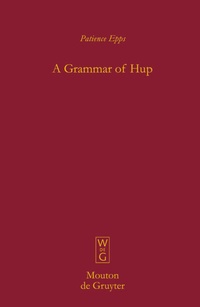
A Grammar of Hup
Description

This work is a reference grammar of Hup, a member of the Nadahup family (also known as Makú or Vaupés-Japura), which is spoken in the fascinatingly multilingual Vaupés region of the northwest Amazon. This detailed description and analysis is informed by a functional-typological perspective, with particular reference to areal contact and grammaticalization. The grammar begins with an introduction to the cultural and linguistic background of Hup speakers, gives an overview of the phonology, and follows this with chapters on morphosyntax (nominal morphology, verbs and verb compounding, tense, aspect, modality, evidentiality, etc.); it concludes with discussions of negation, the simple clause, and clause combining.
A number of features of Hup grammar are typologically significant, such as its strategy of inversion in question formation, its system of Differential Object Marking, and its treatment of possession. Hup also exhibits several highly unusual paths of grammaticalization, such as the development of a verbal future suffix from the noun
'stick, tree'.
The book also includes a selection of texts and a CD-ROM with audio files.
Reviews / Votes
"In summary, this grammar is an outstanding reference work, with an impressive breadth of coverage and depth of analysis. It gives the impression that every part of Hup grammar, from phonology to morphosyntax and semantics, receives the comprehensive treatment it deserves, and it is thus a valuable source for typologists. But it is also highly recommended not only to readers interested in Amazonian languages and cultures, but to anyone who relies on, or simply enjoys, sophisticated linguistic descriptions."
Frank Seifart in: Anthropological Linguistics 2/2009
More details
Other editions
Additional editions
Person
Content
2 - Contents [Seite 9]
3 - Chapter 1Hup and its speakers [Seite 25]
4 - Chapter 2 Phonology [Seite 65]
5 - Chapter 3 The architecture of the word: parts of speech and formatives [Seite 134]
6 - Chapter 4 The noun and nominal morphology [Seite 182]
7 - Chapter 5 The complex noun: compounding, possession, and noun classification [Seite 237]
8 - Chapter 6 The noun phrase: modification and definiteness [Seite 308]
9 - Chapter 7 Nominal discourse-marking morphology [Seite 360]
10 - Chapter 8 The verb word [Seite 395]
11 - Chapter 9 The compound verb [Seite 412]
12 - Chapter 10 Adjectives and adverbial expressions [Seite 465]
13 - Chapter 11 Adjusting valency [Seite 497]
14 - Chapter 12 Aspect [Seite 544]
15 - Chapter 13 Tense and related forms [Seite 611]
16 - Chapter 14 Modality and evidentiality [Seite 633]
17 - Chapter 15 Sentence-level affect marking [Seite 689]
18 - Chapter 16 Negation [Seite 749]
19 - Chapter 17 Simple clauses [Seite 772]
20 - Chapter 18 Clause combining [Seite 827]
21 - Backmatter [Seite 897]
