

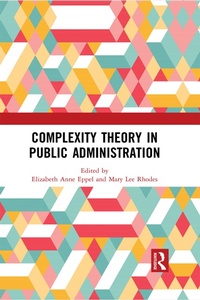
Complexity Theory in Public Administration
1st Edition
Published on 21. May 2020
172 pages
978-1-000-57682-5 (ISBN)
Description

This book reframes theoretical, methodological and practical approaches to public administration by drawing on complexity theory concepts.
It aims to provide alternative perspectives on the theory, research and practice of public administration, avoiding assumptions of traditional theory-building. The contributors explain both how ongoing non-linear interactions result in macro patterns becoming established in a complexity-informed world view, and the implications of these dynamics. Complexity theory explains the way in which many repeated non-linear interactions among elements within a whole can result in processes and patterns emerging without design or direction, thus necessitating a reconsideration of the predictability and controllability of many aspects of public administration.
As well as illustrating how complexity theory informs new research methods for studying this field, the book also shines a light on the different practices required of public administrators to cope with the complexity encountered in the public policy and public management fields. This book was originally published as a special issue of the Public Management Review journal.
It aims to provide alternative perspectives on the theory, research and practice of public administration, avoiding assumptions of traditional theory-building. The contributors explain both how ongoing non-linear interactions result in macro patterns becoming established in a complexity-informed world view, and the implications of these dynamics. Complexity theory explains the way in which many repeated non-linear interactions among elements within a whole can result in processes and patterns emerging without design or direction, thus necessitating a reconsideration of the predictability and controllability of many aspects of public administration.
As well as illustrating how complexity theory informs new research methods for studying this field, the book also shines a light on the different practices required of public administrators to cope with the complexity encountered in the public policy and public management fields. This book was originally published as a special issue of the Public Management Review journal.
More details
Edition
1. Auflage
Language
English
Place of publication
London
United Kingdom
Publishing group
Taylor & Francis Ltd
Target group
College/higher education
ISBN-13
978-1-000-57682-5 (9781000576825)
Copyright in bibliographic data and cover images is held by Nielsen Book Services Limited or by the publishers or by their respective licensors: all rights reserved.
Schweitzer Classification
Other editions
Additional editions
Elizabeth Anne Eppel | Mary Lee Rhodes
Complexity Theory in Public Administration
Book
06/2021
1st Edition
Routledge
€64.80
Shipment within 10-20 days
Elizabeth Anne Eppel | Mary Lee Rhodes
Complexity Theory in Public Administration
Book
10/2019
1st Edition
Routledge
€205.90
Shipment within 15-20 days
Persons
Elizabeth Anne Eppel is a Senior Research and Teaching Fellow in the School of Government at Victoria University of Wellington, New Zealand. Her research interests are complexity in public policy processes, governance networks, and collaborative governance.
Mary Lee Rhodes is Associate Professor of Public Management at Trinity College Dublin, Ireland. Her research is focused on complex public service systems and the dynamics of performance. Her current research is on the nature and dynamics of social innovation and impact, and she is developing research on social finance, and resilience of urban systems.
Mary Lee Rhodes is Associate Professor of Public Management at Trinity College Dublin, Ireland. Her research is focused on complex public service systems and the dynamics of performance. Her current research is on the nature and dynamics of social innovation and impact, and she is developing research on social finance, and resilience of urban systems.
Content
Introduction - Complexity theory and public management: a 'becoming' field 1. Association between decisions: experiments with coupled two-person games 2. Understanding the influence of values in complex systems-based approaches to public policy and management 3. 'What insights do fitness landscape models provide for theory and practice in public administration?' 4. Engaging with complexity in a public programme implementation 5. Bridging complexity theory and hierarchies, markets, networks, communities: a 'population genetics' framework for understanding institutional change from within 6. Utilizing complexity theory to explore sustainable responses to intimate partner violence in health care 7. Sustainability of collaborative networks in higher education research projects: why complexity? Why now? 8. Cultivating resiliency through system shock: the Southern California metropolitan water management system as a complex adaptive system
