

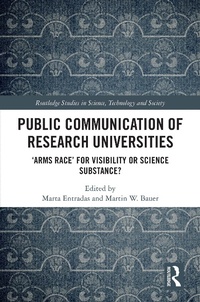
Public Communication of Research Universities
'Arms Race' for Visibility or Science Substance?
1st Edition
Published on 5. May 2022
320 pages
978-1-000-58054-9 (ISBN)
Description

This book analyses communication of university research institutes, with a focus on science communication. Advancing the 'decentralisation hypothesis', it asserts that communication structures are increasingly built also at 'subordinate unit' levels of research universities.
The book presents a cross-country systematic comparison of institutes' communication activities showing ongoing transformations in their communication capabilities and practices. It considers a potential 'arms race' in activities, professionalisation, motivations, and evaluation. Based on empirical evidence from an international study carried out in various countries across Europe, the Americas, and Asia, the book examines the possibilities for civic science communication in this new context.
It will be of interest to scholars and students of Communication Studies, STS, and Science Communication as well as to those taking or leading courses in the fields of Sociology, Public Relations, Marketing, Environmental and Risk Communication, Innovation Studies, and Social Psychology. It is an essential resource for funders, practitioners, teachers, and students dealing with science communication and the position of science in society.
The book presents a cross-country systematic comparison of institutes' communication activities showing ongoing transformations in their communication capabilities and practices. It considers a potential 'arms race' in activities, professionalisation, motivations, and evaluation. Based on empirical evidence from an international study carried out in various countries across Europe, the Americas, and Asia, the book examines the possibilities for civic science communication in this new context.
It will be of interest to scholars and students of Communication Studies, STS, and Science Communication as well as to those taking or leading courses in the fields of Sociology, Public Relations, Marketing, Environmental and Risk Communication, Innovation Studies, and Social Psychology. It is an essential resource for funders, practitioners, teachers, and students dealing with science communication and the position of science in society.
More details
Series
Edition
1. Auflage
Language
English
Place of publication
London
United Kingdom
Publishing group
Taylor & Francis Ltd
Target group
College/higher education
Illustrations
58 Tables, black and white; 43 Line drawings, black and white; 43 Illustrations, black and white
ISBN-13
978-1-000-58054-9 (9781000580549)
Copyright in bibliographic data and cover images is held by Nielsen Book Services Limited or by the publishers or by their respective licensors: all rights reserved.
Schweitzer Classification
Other editions
Additional editions
Marta Entradas | Martin W. Bauer
Public Communication of Research Universities
'Arms Race' for Visibility or Science Substance?
Book
01/2024
1st Edition
Routledge
€65.60
Shipment within 15-20 days
Marta Entradas | Martin W. Bauer
Public Communication of Research Universities
'Arms Race' for Visibility or Science Substance?
Book
05/2022
1st Edition
Routledge
€206.90
Shipment within 15-20 days
Marta Entradas | Martin W. Bauer
Public Communication of Research Universities
Arms Race' for Visibility or Science Substance?
Book
03/2022
Routledge
Unfortunately, price unknown
Available (delivery time upon request)
Persons
Marta Entradas is Assistant Professor at the Department of Sociology at Iscte-Lisbon University Institute and Visiting Fellow at the London School of Economics and Political Science (LSE). She is a former Marie Curie Fellow at LSE (2016-18), and Fulbright Scholar at Cornell University (2015-16). In a current FCT-funded project (grant PTDC/COM-OUT/30022/2017), she is leading a cross-national study examining public communication at central communication offices at research universities. She received her Ph.D. in Science and Technology Studies (STS) from UCL in 2011. She is the 'European Young Researcher (EYRA) Award' 2016 winner (Euroscience).
Martin W. Bauer read Psychology and Economic History (Bern, Zurich and London) and joined London School of Economics and Political Science LSE in the mid-1990s, after a post-doctoral fellowship at the Science Museum London. Professor of Social Psychology and a former Head of the LSE Methodology Department (2008-2010), he currently directs the Msc Social & Public Communication. He is a former Editor-in-Chief of the international journal Public Understanding of Science (2009-2016) and a regular academic visitor in Brazil (Porto Alegre, Campinas and Rio) and recently also to China, where he co-directs the Centre for Study of Science Cultures, an LSE-NAIS-Tsinghua University venture in Beijing.
Martin W. Bauer read Psychology and Economic History (Bern, Zurich and London) and joined London School of Economics and Political Science LSE in the mid-1990s, after a post-doctoral fellowship at the Science Museum London. Professor of Social Psychology and a former Head of the LSE Methodology Department (2008-2010), he currently directs the Msc Social & Public Communication. He is a former Editor-in-Chief of the international journal Public Understanding of Science (2009-2016) and a regular academic visitor in Brazil (Porto Alegre, Campinas and Rio) and recently also to China, where he co-directs the Centre for Study of Science Cultures, an LSE-NAIS-Tsinghua University venture in Beijing.
Content
PART I: INTRODUCTION AND OVERVIEW
1. Public Communication Activities of Research Institutes: Setting the Stage with the Decentralisation Hypothesis
2. Why and How to Sample Research Institutes: Methodological Challenges
PART II: CROSS-NATIONAL COMPARISONS
3. Professionalizing the Communication of Research Institutes
4. Public Duty or Self-Interest? Public Communication of University-Based Research Institutes after an Era of Governance Reforms in Europe
5. Perceived Successfulness of Public Engagement at Research Institutes
6. An Emerging "Arms Race": Resourcing the Public Communication Effort
7. Public Engagement Profiles and Types of Research Institutes
PART III: NATIONAL SITUATION AND PROFILES
8. The Communication of Research in Italy: The Efforts of Academia and Research Institutes
9. Public Engagement at Research Institutes in the Netherlands: Fertile Territory or Terra Nullius?
10. US American Scholars are Finding Paths to Engagement through their Research Institutes and Centers
11. Public Communication in Japanese Research Institutes: Still Dark or Sunrise?
12. Communicative Dispositions of British Research Institutes
13. Public Engagement Activities of German Research Institutes: A Tale of Two Worlds
14. 'Research Excellence' and Public Communication in Portugal
PART IV: METHODOLOGICAL CONSIDERATIONS
15. Studying Public Communication of Research Institutes: Sample Design and Data Collection
16. Framework and Indicators of Public Communication of Research Institutes
1. Public Communication Activities of Research Institutes: Setting the Stage with the Decentralisation Hypothesis
2. Why and How to Sample Research Institutes: Methodological Challenges
PART II: CROSS-NATIONAL COMPARISONS
3. Professionalizing the Communication of Research Institutes
4. Public Duty or Self-Interest? Public Communication of University-Based Research Institutes after an Era of Governance Reforms in Europe
5. Perceived Successfulness of Public Engagement at Research Institutes
6. An Emerging "Arms Race": Resourcing the Public Communication Effort
7. Public Engagement Profiles and Types of Research Institutes
PART III: NATIONAL SITUATION AND PROFILES
8. The Communication of Research in Italy: The Efforts of Academia and Research Institutes
9. Public Engagement at Research Institutes in the Netherlands: Fertile Territory or Terra Nullius?
10. US American Scholars are Finding Paths to Engagement through their Research Institutes and Centers
11. Public Communication in Japanese Research Institutes: Still Dark or Sunrise?
12. Communicative Dispositions of British Research Institutes
13. Public Engagement Activities of German Research Institutes: A Tale of Two Worlds
14. 'Research Excellence' and Public Communication in Portugal
PART IV: METHODOLOGICAL CONSIDERATIONS
15. Studying Public Communication of Research Institutes: Sample Design and Data Collection
16. Framework and Indicators of Public Communication of Research Institutes
