

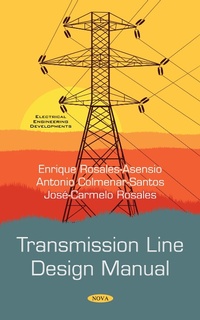
Transmission Line Design Manual
Published on 9. June 2020
359 pages
978-1-5361-7856-2 (ISBN)
Description

This book covers structural and foundation systems used in high-voltage transmission lines, conductors, insulators, hardware and component assembly. Furthermore, this text provides the essential fundamentals of transmission line design. It is a good blend of fundamental theory with practical design guidelines for overhead transmission lines, providing the basic groundwork for students as well as practicing power engineers, with material generally not found in one convenient book. Featuring design problems with solutions for students, the book is aimed at students, practicing engineers, researchers and academics. It contains beneficial information for those involved in the design and maintenance of transmission line structures and foundations. For those in academia, it will be an adequate text-book/design guide for graduate-level courses on the topic. Engineers and managers at utilities and electrical corporations will find the book to be a useful reference at work. This book presents the current state of electrical technology applied to the calculation and design of high voltage power lines, both aerial and underground, by means of an original approach based on the simple exposure of theoretical bases that allow the reader to apply them in the subsequent resolution of numerous real engineering examples. The examples in each chapter are developed in detail and have been selected in order to address the diversity of electrical and mechanical calculations required by the design of high voltage power lines. The book consists of chapters dedicated to the electrical design of lines, mechanical calculation of conductors, supports and foundations, design of grounding facilities and calculation of underground lines. There is no other book that gathers, in such a detailed way and with a focus eminently practical, all aspects related to the design of high voltage lines.
More details
Other editions
Additional editions
Antonio Colmenar-Santos
Transmission Line Design Manual
Book
07/2020
Nova Science Publishers Inc
€303.55
Shipment within 15-20 days
Content
- Intro
- Contents
- Part 1: Theoretical Framework
- Chapter 1
- Electrical Calculation of Lines
- 1.1. General Comments
- Chapter 2
- Mechanical Calculation of Conductors
- 2.1. Introduction
- 2.1.1. Flexible Cables
- 2.1.2. Cables with Concentrated Loads
- 2.1.3. Cables with Uniformly Distributed Loads
- Suspension Bridges
- Determination of , - . and , - .
- Parabola Length
- 2.1.4. Parabolic Cable with Anchors at Different Heights
- Lowest Point Traction and Maximum Traction ,, - . , - ..
- 2.1.5. Cables Subjected to Their Own Weight (Catenary)
- 2.1.6. Notation for the Mechanical Calculation of Overhead Power Lines
- 2.1.7. Condition Change Equation
- 2.1.7.1. Initial Conditions
- 1.1.7.2. Final Conditions
- 2.2. Overloads on Bare Conductors: Wind Pressure and Weight of the Ice Sleeve
- 2.2.1. Wind Overload
- 2.2.2. Ice Overload
- 2.2.3. Combined Wind and Ice Overload
- 2.3. Dynamic Limit Tensioning (CHS) or Cold Hour Tensioning
- 2.4. Maximum Permissible Deflection and Maximum Permissible Span
- 2.4.1. Maximum Arrow
- a) Wind Hypothesis
- b) Temperature Hypothesis
- c) Ice Hypothesis
- 2.4.2. Maximum Span
- 2.5. Safety Distances
- 2.5.1. Distance of Drivers to the Terrain, Paths and Non-Navigable Courses
- 2.5.2. Distance between Conductors
- 2.5.3. Distance between Conductors and Earthed Parts
- 2.6. Expressions for the Calculation of High Voltage Overhead Lines
- 2.6.1. Relationship between the Voltage at the Mid-Point and at the Driver's Lashing Points
- 2.6.2. Relationship between Mid-Point Stress and Horizontal Stress
- 2.6.3. 2nd Relationship between the Voltage at the Mid-Point and at the Driver's Lashing Points
- 2.6.4. Estimation of Dynamic wind Pressure According to Wind Speed
- 2.6.5. Equation for Change of Conditions in a Line (ECC)
- 2.6.6. CCP Constants
- 2.6.7. General Equation for Calculating Catenary Deflection
- 2.6.8. Catenary Parameter
- 2.6.9. Midpoint Abscissa by Catenary
- 2.6.10. Equation for Calculating Catenary Deflection: Level Spans ,, - .= .
- 2.6.11. Serial Development of Cosh and Senh
- 2.6.12. Equation for Calculating the Arrow by Parabola Approximation. SPANS at Level
- 2.6.13. Equation for Calculating the Arrow by parAbola Approximation. Inclined Spans. Approximation of Truxá
- 2.6.14. Equation for Calculating the Arrow by Parabola Approximation. Very Long and/or Inclined Spans. Approximation of Truxá
- 2.6.15. Midpoint Abscissa by Parabola
- 2.6.16. Relationship between the Abscissa of the Feet of Support, the Projected Length of the Span and the Abscissa of the Midpoint of the Span
- 2.6.17. Catenary Equation
- 2.6.18. Length of the Catenary arc between Points V and X
- 2.6.19. Stress at an X Point on the Curve (Tangent at that Point to it)
- 2.6.20. Relationship between the Stresses at the Support Mooring Points
- 2.6.21. Weight of the Catenary arc between Points V and X, and Total Weight of the Conductor Lying between the Supports
- 2.6.22. Relationship between the Voltage at Vertex Point V, between the Voltage at One of the MOORING points (Support B) and the Weight of the Arc between V and that Point
- 2.6.23. Equation of the Cable Curve by Parabola Approach
- 2.6.24. Cable Length by Parabola Approach
- 2.6.25. Vertical Weights due to Conductors on Supports in Zone A
- 2.6.26. Vertical Weights due to Conductors on Supports in Zones B and C
- 2.6.27. Regulation Span for Level Span Assumptions
- 2.6.28. Adjustment Span for Assumed Uneven Spans
- 2.6.29. Relationship between Span Arrow and That of the Regulation Span for Span Assumptions at the Level
- 2.6.30. Relationship between Span Arrow and the Regulation Span for Inclined Spans
- Chapter 3
- Calculation of Foundations
- 3.1. Foundations for Alignment Supports
- 3.2. Height of the Support
- Chapter 4
- Design, Calculation and Verification of Grounding Systems
- 4.1. Introduction
- 4.2. Soil Characteristics
- 4.3. Maximum Earthing Currents
- 4.4. Preliminary Grounding Design
- 4.5. Calculation of the Resistance of the Earthing System
- 4.6. Calculation of Step and Contact Voltages
- 4.7. Check That the Pitch and Contact Voltages Are Below the Maximum Values
- 4.8. Voltages Transferable to the Outside
- 4.9. Correction and Adjustment of the Initial Design Using Additional Measures
- 4.10. On-Site Checks and Verifications after Completion of the Installation
- Part 2: Proposed Exercises
- Chapter 5
- Electrical Calculation of Lines
- Proposed Exercises
- Exercise 1.1. MV Insulated Cable Selection by Rated Voltage , - ./
- Exercise 1.2. Selection of Insulated MV Cable by Short-Circuit Criterion
- Exercise 1.3. Design for Load REGIME and Short Circuit of Insulated Cable for an MV Network
- Exercise 1.4. Selection of Insulator Chain for Overhead Line AT
- Exercise 1.5. Design by Conductor Load Regime for HV Overhead Line
- Exercise 1.6. Induction and Capability in Single Circuit Overhead line Design
- Exercise 1.7. Induction and Capacity in Dual Circuit Overhead Line Design
- Exercise 1.8. The Corona Effect in the MV Overhead Line Design
- Exercise 1.9. The Physical Constants of an MV airline
- Exercise 1.10. Electrical Conductor Selection
- Exercise 1.11. Choice of Transport Voltage
- Exercise 1.12. Maximum Power to Be Transported and Maximum Line Length
- Chapter 6
- Mechanical Calculation of Conductors
- Proposed Exercises
- Exercise 2.1. Calculation of a Span
- Exercise 2.2. Calculation of Maximum Allowable Tractions
- Exercise 2.3. Calculation of Dynamic and Static Limits
- Exercise 2.4. Calculation of Maximum and Minimum Deflections
- Exercise 2.5. Calculation of Weights and Tensions: Support Distribution Templates
- Exercise 2.6. Calculation of Safety Distances
- Exercise 2.7. Calculation of the Regulation Span. Laying Tables
- Chapter 7
- Support Calculation
- Proposed Exercises
- Calculation of Stresses and Post Heights. support Calculation
- Chapter 8
- Calculation of Foundations
- Proposed Exercises
- Calculation of Stresses and Post Heights. Calculation of Foundations for Supports
- Chapter 9
- Calculation of High Voltage Underground Lines
- Proposed Exercises
- Calculation of an Underground Medium-Voltage Line: Choice of Conductor
- Exercise Comments
- Chapter 10
- Design, Calculation and Verification of Grounding Systems
- Proposed Exercises
- Grounding Design of a Support Belonging to an Overhead Line without Ground Wire
- Transformer Substation Grounding Design (Impedant Neutral)
- Transformer Substation Grounding Design (Isolated Neutral)
- Chapter 11
- Execution of Installations
- Proposed Exercises
- Multiple Choice Questions
- Part 3: Step-by-Step Solutions
- Chapter 12
- Electrical Calculation of Lines
- Exercises Resolved
- Exercise 1.1. Selection of MV Insulated Cable by Rated Voltage , - ./
- Exercise 1.2. Selection of Insulated MV Cable by Short-Circuit Criterion
- Exercise 1.3. Design for Load Regime and Short Circuit of Insulated Cable for an MV Network
- Exercise 1.4. Selection of Insulator Chain for Overhead Line AT
- Choice of the Type of Glass Insulator according to the Maximum Mechanical Stress it Has to Withstand
- Determination of the Number of Glass Insulators as a Function of the Total Length of the Creepage Distance
- Determination of Minimum safety Distance of Discharge from the Insulator Chain
- Exercise 1.5. Design by Conductor Load Regime for HV Overhead Line
- Exercise 1.6. Induction and Capability in Single Circuit Overhead Line Design
- Analysis of Arming Interdistances
- 1. Calculation of the Induction Coefficient , - . and the LINE Reactance , - . per Phase and km of Line
- 2. Calculation of the Capacity Coefficient , - . and Line Susceptance , - . per Phase and km of Line
- Exercise 1.7. Induction and Capacity in the Design of Dual-Circuit Overhead Line
- DMG Calculation
- Calculation of the GMR and the GMR
- Calculation of the Induction Coefficient , - . and the Line Reactance , - . per Phase and Km of Line
- Calculation of the Capacity Coefficient , - . and Line Susceptance , - . per Phase and km of Line
- Exercise 1.8. The Corona Effect in the MV Overhead Line Design
- Exercise 1.9. The Physical Constants of an MT Airline
- Exercise 1.10. Electrical Conductor Selection
- Exercise 1.11. Choice of Transport Voltage
- Exercise 1.12. Maximum Power to Be Transported and Maximum Line Length
- Chapter 13
- Mechanical Calculation of Conductors
- Exercises Resolved
- Exercise 2.1. Calculation of a span
- 2.1.1. Maximum Cable Pull Hypothesis
- 2.1.2. Maximum Arrow Hypothesis
- 2.1.3. Hypothesis for the Study of Vibratory Phenomena (Sections 3.2.2 and 4.3.2 of RD 223/08)
- 2.1.4. Hypothesis of Minimum Vertical Arrow, without Overload and Temperature of -20ºC
- 2.1.5. Cable Laying Table
- 2.1.6. Safety Distance
- 2.1.7. Calculation of Earth Cables
- Exercise 2.2. Calculation of Maximum Allowable Tractions
- Exercise 2.3. Calculation of Dynamic and Static Limits
- Exercise 2.4. Calculation of Maximum and Minimum Deflections
- Exercise 2.5. Calculation of Weights and Tensions: Support Distribution Templates
- Case 1: Tense Set by the Static limit. Maximum Permissible Traction
- a) Study Adopting Catenary
- Equation of the Conductor Curve
- Conductor Length
- b) Study Adopting Parable
- Equation of the Conductor Curve
- Conductor Length
- Case 2: Tense Corresponding to a Day without Overload and with 12ºC of Temperature
- Support Distribution Templates
- Exercise 2.6. Calculation of Safety Distances
- Exercise 2.7. Calculation of the Regulation Span. Laying Tables
- Chapter 14
- Support Calculation
- Exercises Resolved
- Calculation of Stresses and Post Heights. Support Calculation
- Chapter 15
- Calculation of Foundations
- Exercises Resolved
- Calculation of Stresses and Post Heights. Calculation of Foundations for Supports
- Chapter 16
- Calculation of High Voltage Underground Lines
- Exercises Resolved
- Calculation of an Underground Medium-Voltage Line: Choice of conductor
- Chapter 17
- Design, Calculation and Verification of Grounding Systems
- Exercises Resolved
- Grounding Design of a Support Belonging to an Overhead Line without Ground Wire
- Transformer Substation Grounding Design (Impedant Neutral)
- Transformer Substation Grounding Design (Isolated Neutral)
- Chapter 18
- Execution of Installations
- Exercises Resolved
- Multiple Choice Questions
- About the Authors
- Index
- Blank Page
