

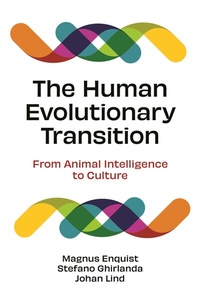
The Human Evolutionary Transition
From Animal Intelligence to Culture
1st Edition
Published on 10. November 2022
296 pages
978-0-691-24076-3 (ISBN)
Description

A major new theory of why human intelligence has not evolved in other species
The Human Evolutionary Transition offers a unified view of the evolution of intelligence, presenting a bold and provocative new account of how animals and humans have followed two powerful yet very different evolutionary paths to intelligence. This incisive book shows how animals rely on robust associative mechanisms that are guided by genetic information, which enable animals to sidestep complex problems in learning and decision making but ultimately limit what they can learn. Humans embody an evolutionary transition to a different kind of intelligence, one that relies on behavioral and mental flexibility. The book argues that flexibility is useless to most animals because they lack sufficient opportunities to learn new behavioral and mental skills. Humans find these opportunities in lengthy childhoods and through culture.
Blending the latest findings in fields ranging from psychology to evolutionary anthropology, The Human Evolutionary Transition draws on computational analyses of the problems organisms face, extensive overviews of empirical data on animal and human learning, and mathematical modeling and computer simulations of hypotheses about intelligence. This compelling book demonstrates that animal and human intelligence evolved from similar selection pressures while identifying bottlenecks in evolution that may explain why human-like intelligence is so rare.
The Human Evolutionary Transition offers a unified view of the evolution of intelligence, presenting a bold and provocative new account of how animals and humans have followed two powerful yet very different evolutionary paths to intelligence. This incisive book shows how animals rely on robust associative mechanisms that are guided by genetic information, which enable animals to sidestep complex problems in learning and decision making but ultimately limit what they can learn. Humans embody an evolutionary transition to a different kind of intelligence, one that relies on behavioral and mental flexibility. The book argues that flexibility is useless to most animals because they lack sufficient opportunities to learn new behavioral and mental skills. Humans find these opportunities in lengthy childhoods and through culture.
Blending the latest findings in fields ranging from psychology to evolutionary anthropology, The Human Evolutionary Transition draws on computational analyses of the problems organisms face, extensive overviews of empirical data on animal and human learning, and mathematical modeling and computer simulations of hypotheses about intelligence. This compelling book demonstrates that animal and human intelligence evolved from similar selection pressures while identifying bottlenecks in evolution that may explain why human-like intelligence is so rare.
More details
Other editions
Additional editions
Magnus Enquist | Stefano Ghirlanda | Johan Lind
The Human Evolutionary Transition
From Animal Intelligence to Culture
Book
02/2023
Princeton University Press
€37.50
Shipment within 10-20 days
Magnus Enquist | Stefano Ghirlanda | Johan Lind
The Human Evolutionary Transition
From Animal Intelligence to Culture
Book
02/2023
Princeton University Press
€123.80
Shipment within 10-20 days
Persons
Magnus Enquist is professor of ethology and director of the Centre for Cultural Evolution at Stockholm University. Stefano Ghirlanda is professor of psychology at Brooklyn College and the Graduate Center, City University of New York. Johan Lind is associate professor of ethology and deputy director of the Centre for Cultural Evolution at Stockholm University.
Content
- Cover
- Contents
- Acknowledgments
- 1. Challenges to the Evolution of Intelligence
- 2. Seven Hypotheses
- 3. Learning Behavioral Sequences
- 4. Genetic Guidance of Learning
- 5. Sources of Information
- 6. Social Learning
- 7. Can Animals Think?
- 8. The Nature of Animal Intelligence
- 9. Uniquely Human
- 10. The Transition
- 11. How and Why Does Thinking Work?
- 12. Acquisition and Transmission of Sequential Information
- 13. Social Transmission of Mental Skills
- 14. Cooperation
- 15. The Power of Cultural Evolution
- 16. Why Only Humans?
- References
- Index
