

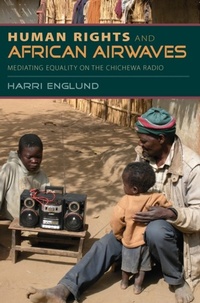
Human Rights and African Airwaves
Mediating Equality on the Chichewa Radio
1st Edition
Published on 3. October 2011
308 pages
978-0-253-00543-4 (ISBN)
Description

Human Rights and African Airwaves focuses on Nkhani Zam'maboma, a popular Chichewa news bulletin broadcast on Malawi's public radio. The program often takes authorities to task and questions much of the human rights rhetoric that comes from international organizations. Highlighting obligation and mutual dependence, the program expresses, in popular idioms and local narrative forms, grievances and injustices that are closest to Malawi's impoverished public. Harri Englund reveals broadcasters' everyday struggles with state-sponsored biases and a listening public with strong views and a critical ear. This fresh look at African-language media shows how Africans effectively confront inequality, exploitation, and poverty.
Reviews / Votes
A valuable addition to any collection on human rights or media studies. . . . Highly recommended. Upper-division undergraduates and above.(Choice) This book will certainly inspire anthropologists working on popular culture. And, because of its thorough theoretical discussions and claims, the monograph will help us not only to disentangle the complexity of Africa's public culture, but it will push us to reflect on methodological and epistemological traditions within the discipline.
(Research in African Literatures) Englund offers a richly textured, descriptive account of knowledge production on air. Although the main aim of Englund's book is to add to ongoing debates on liberalism and human rights, it offers a number of other important contributions to both media anthropology and MCCS. The book's focus on an African language medium . . . , its detailed analysis of both the media production and consumption process . . . and its descriptive rather than normative method result in a fresh approach to media and communication in Africa, an approach that will hopefully provoke similarly oriented studies in the near future.
(Journal of Southern African Studies) Harri Englund's [title] is a humble yet potent book, one that does not proclaim its intentions but allows them to seep into you gradually and indirectly. The slow progression of this book is the result of Englund's laudable strategy to derive the theoretical significance of his arguments from the particulars of his ethnography . . . .August 2013
(American Ethnologist) Harri Englund's latest book is a challenging synthesis of theory and ethnography . . . Anyone interested in African media and politics . . . will want to read this serious work for the originality both of its case study of a single long-running programme, and of its construction through a variety of questions . . . .August 2013
(Africa) [E]thnographic analysis of radio is relatively underrepresented in the anthropology of media as well as in anthropology of human rights. Englund's book is a welcome addition to both of these growing fields, and will be of use to any critics of liberalism.Nov. 2014
(PoLAR) Harri Englund reveals broadcasters' everyday struggles with state-sponsored biases and a listening public with strong views and a critical ear. This fresh look at African-language media shows how Africans effectively confront inequality, exploitation, and poverty.Feb. 2014
(Allegra) All will find in this book, much that is familiar but set in new contexts, some to dispute or qualify, but considerable to generate conversation and enhance understanding. It is a thoughtful and fascinating work that urges us to be aware of different media, their reception and uses, and the myriad ways in which they speak to and about our worlds.
(Intl. Journal African Historical Studies) Scholars interested in internationalizing media and journalism history will find this book a challenging provocation as Englund makes a compelling case for the need for more studies of media production and reception in the global South . . . April 2013
(Jhistory) Human rights and African Airwaves is a must read for students and scholars of Africa, human rights, and media studies. . . . At its best, the book is a fierce, grounded commentary-through the lens of a radio program-of the rich imaginations, powerful insights, and wry critiques of everyday Malawians as they try to live their lives as moral beings in the face of poverty, corruption, and injustice.
The author's intellectual rigor and analysis provide strong support for his arguments, which may be contentious to some but demonstrate the value of anthropological methods in investigating society. . . . A valuable addition to any collection on human rights or media studies. . . . Highly recommended.
(Journal of African History)
All prices
More details
Language
English
Place of publication
Bloomington, IN
United States
Target group
Professional and scholarly
Product notice
Reflowable
Illustrations
9 b&w illus.
ISBN-13
978-0-253-00543-4 (9780253005434)
Copyright in bibliographic data and cover images is held by Nielsen Book Services Limited or by the publishers or by their respective licensors: all rights reserved.
Schweitzer Classification
Other editions
Additional editions
Book
10/2011
Indiana University Press
€28.50
Shipment within 10-20 days
Book
10/2011
Indiana University Press
€65.00
Article not available at the moment
Person
Harri Englund is Reader in Social Anthropology at the University of Cambridge. He is author of Prisoners of Freedom: Human Rights and the African Poor, winner of the 2006 Amaury Talbot Prize of the Royal Anthropological Institute.
Content
Acknowledgments
Introduction
Part 1. Human Rights, African Alternatives
1. Rights and Wrongs on the Radio
2. Obligations to Dogs: Between Liberal and Illiberal Analytics
3. Against the Occult: Journalists and Scholars in Search of Alternatives
Part 2. The Ethos of Equality
4. A Nameless Genre: Newsreading as Storytelling
5. Inequality Is Old News: Editors as Authors
6. Stories Become Persons: Producing Knowledge about Injustice
Part 3. The Aesthetic of Claims
7. Cries and Whispers: Shaming without Naming
8. Christian Critics: An Illiberal Public?
9. Beyond the Parity Principle
Appendix 1. Presidential News
Appendix 2. Graveyard Visit
Appendix 3. Drunken Children
Appendix 4. Giant Rat
Appendix 5. Reclaiming Virginity
Appendix 6. The Truth about Porridge
Appendix 7. "Makiyolobasi Must Stop Bewitching at Night"
Notes
Bibliography
Index
Introduction
Part 1. Human Rights, African Alternatives
1. Rights and Wrongs on the Radio
2. Obligations to Dogs: Between Liberal and Illiberal Analytics
3. Against the Occult: Journalists and Scholars in Search of Alternatives
Part 2. The Ethos of Equality
4. A Nameless Genre: Newsreading as Storytelling
5. Inequality Is Old News: Editors as Authors
6. Stories Become Persons: Producing Knowledge about Injustice
Part 3. The Aesthetic of Claims
7. Cries and Whispers: Shaming without Naming
8. Christian Critics: An Illiberal Public?
9. Beyond the Parity Principle
Appendix 1. Presidential News
Appendix 2. Graveyard Visit
Appendix 3. Drunken Children
Appendix 4. Giant Rat
Appendix 5. Reclaiming Virginity
Appendix 6. The Truth about Porridge
Appendix 7. "Makiyolobasi Must Stop Bewitching at Night"
Notes
Bibliography
Index

