

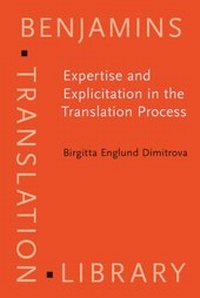
Expertise and Explicitation in the Translation Process
1st Edition
Published on 22. September 2005
XX, 295 pages
978-90-272-9426-5 (ISBN)
Description

This book addresses the complexities of the translation process. Informed by theoretical and methodological advances in translation studies, research on writing and the expertise paradigm, it explores translation as a text reproduction task. With triangulation of data from Russian-Swedish translation - think-aloud-methodology and computer logging of the writing process - it makes a cross-sectional comparison of subjects with different amounts of translation experience, highlighting crucial aspects of professional competence and expertise in translation. The book also elaborates a method for a combined product and process analysis, applying it to the study of one type of explicitation: increased cohesive explicitness of the target text. The results have implications for translation theory and pedagogy. This volume will be of interest to translation scholars and translator trainers, irrespective of language combination, as well as to specialists in Russian and Swedish. It will also appeal to researchers on expertise in other domains.
More details
Other editions
Additional editions
Birgitta Englund Dimitrova
Expertise and Explicitation in the Translation Process
Book
09/2005
John Benjamins Publishing Co
€132.50
Shipment within 10-15 days
Person
Content
- Expertise and Explicitation in the Translation Process
- Editorial page
- Title page
- LCC data
- Dedication
- Table of contents
- List of tables, figures, and charts
- Tables
- Figures
- Charts
- List of abbreviations
- Acknowledgements
- Introduction
- Translation as text (re)production
- 2.1. Theoretical context
- 2.2. Ability, competence and expertise in translation
- 2.2.1. Translation ability
- 2.2.2. Translator competence
- 2.2.3. Expertise in translation and other domains
- 2.3. Performing a translation task
- 2.3.1. Modelling the translation process as a text production process
- 2.3.2. Overall time: The phases of the task and process profiles
- 2.3.3. Planning the task
- 2.3.4. Writing the translated text
- 2.3.5. Revising the text
- 2.4. The text in the process
- 2.4.1. Explicitation in translation
- 2.4.2. Explicitness of cohesion
- 2.4.3. Translation norms
- 2.4.4. Processing the text
- 2.5. Research design
- Notes
- Methods and data
- 3.1. Methodological considerations
- 3.2. Concurrent verbalizations or think-aloud protocols (TAPs)
- 3.2.1. The theory and the method
- 3.2.2. The validity of the method
- 3.3. Computer logging of the writing process
- 3.4. The data for the study
- 3.4.1. Participants
- 3.4.2. Source text and translation brief
- 3.4.3. Procedure and data collection
- 3.5. Coding and analyzing the data and reporting the results
- Notes
- Performing the translation task
- 4.1. Overall research questions
- 4.2. Task performance: Temporal characteristics
- 4.2.1. Research questions, data and methods
- 4.2.2. Results
- 4.3. Initial planning of the task
- 4.3.1. Research questions, data and methods
- 4.3.2. Results
- 4.4. Segmentation of the writing process
- 4.4.1. Hypotheses, data and method
- 4.4.2. Results
- 4.5. Revising - evaluating and making changes in the target text
- 4.5.1. Research questions
- 4.5.2. Task definition of revising
- 4.5.3. Revisions from a product perspective
- 4.5.4. Problem representations in revising
- 4.6. Summary and conclusions
- 4.6.1. Time, overall approach and distribution into phases
- 4.6.2. Initial planning
- 4.6.3. Text generation: Segmentation of the writing process
- 4.6.4. Revising
- 4.6.5. Norms in the process
- 4.6.6. Process profiles
- Notes
- Explicitation in the translation process
- 5.1. Research questions, data and methods
- 5.2. Russian and Swedish text connectives
- 5.2.1. Cohesion in Russian and Swedish
- 5.2.2. Implicit (asyndetic) additive coordination in Russian and Swedish
- 5.2.3. Implicit contrasts in Russian and Swedish
- 5.2.4. Expressing anteriority in Russian and Swedish and implicit temporal and causal linking
- 5.2.5. Textual characteristics of the Russian ST
- 5.3. Implicit additive links in the ST
- 5.3.1. The ST segments
- 5.3.2. Analysis of product data
- 5.3.3. Analysis of process data
- 5.4. Implicit contrastive links in the ST
- 5.4.1. The ST segments
- 5.4.2. Analysis of product data
- 5.4.3. Analysis of process data
- 5.4.4. No connective - no contrast expressed?
- 5.5. Temporal and causal links
- 5.5.1. The ST segments
- 5.5.2. Analysis of product data
- 5.5.3. Analysis of process data
- 5.6. Summary and conclusions
- Notes
- Summing up and discussing the implications
- 6.1. Summing up
- 6.2. Features of expertise in the translation process
- 6.2.1. Planning, text generation and revision
- 6.2.2. Literal and non-literal translation procedures in the process
- 6.2.3. Learning by doing
- 6.3. Explicitation - a universal in translation?
- 6.4. The validity and generalizability of the results
- 6.5. Implications for teaching translation
- The Russian source text
- English translation of the Russian source text
- The target texts of the participants
- Anna's (PR) target text
- SLUT
- Berit's (PR) target text
- Christian's (PR) target text
- Daniel's (PR) target text
- Ellinor's (TS) target text
- Fredrik's (TS) target text
- Gabriella's (LS) target text
- Harald's (TS) target text
- Isak's (TS) target text
- TT versions analyzed in Chapter 5
- Additive coordination
- Sentence A4
- Sentence C11
- Sentence C13
- Sentence C15
- Implicit contrasts
- Sentences B7-B8
- Sentences D20-D21
- Temporal/causal relations
- Sentences D17-D18
- Sentences E22-E23
- References
- Index
- the series Benjamins Translation Library
