

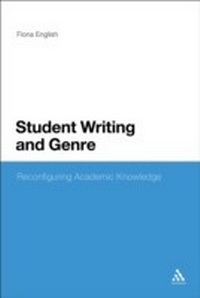
Student Writing and Genre
Reconfiguring Academic Knowledge
1st Edition
Published on 14. April 2011
240 pages
978-1-4411-4668-7 (ISBN)
Description

This book is about how genres affect the ways students understand and engage with their disciplines, offering a fresh approach to genre by using affordances as a key aspect in exploring the work of first year undergraduates who were given the task of reworking an essay by using a different genre.
Working within a social semiotic frame of reference, it uses the notion of genre as a clear, articulated tool for discussing the relationship between knowledge and representation. It provides pedagogical solutions to contentions around 'genres', 'disciplines', 'academic discourses' and their relation to student learning, identity and power, showing that, given the opportunity to work with different genres, students develop new ways of understanding and engaging with their disciplines.
Providing a strong argument for why a wider repertoire of genres is desirable at university, this study opens up new possibilities for student writing, learning and assessment. It will appeal to teachers, subject specialists, researchers and postgraduates interested in higher education studies, academic literacies, writing in the disciplines and applied linguistics.
Working within a social semiotic frame of reference, it uses the notion of genre as a clear, articulated tool for discussing the relationship between knowledge and representation. It provides pedagogical solutions to contentions around 'genres', 'disciplines', 'academic discourses' and their relation to student learning, identity and power, showing that, given the opportunity to work with different genres, students develop new ways of understanding and engaging with their disciplines.
Providing a strong argument for why a wider repertoire of genres is desirable at university, this study opens up new possibilities for student writing, learning and assessment. It will appeal to teachers, subject specialists, researchers and postgraduates interested in higher education studies, academic literacies, writing in the disciplines and applied linguistics.
Reviews / Votes
Student Writing and Genre: Reconfiguring Academic Knowledge is an engaging and theoretically sound book, which raises the question, 'how do genres affect the ways students understand and engage with their disciplines?' * Applied Linguistics * Secondary English teachers who read Fiona English's (2011) Student Writing and Genre will marvel at the freedom she has, working in the university system, to devise assignment tasks that draw on the existing strengths and linguistic capabilities of her students. Frustrated by what she feels are the unnecessary limitations placed on undergraduates when they are constantly required to demonstrate knowledge in conventional essay form, she explores the transformation that takes place when they are encouraged to rewrite - to 're-genre' - their work in forms of their own choosing. Her book ... offers a fascinating opportunity to reflect on the nature of writing required of young people in classrooms and, more exactly, on the role of the critical essay and possible alternatives to its dominance. * Teaching English * This book made me want to be braver with the kind of assignments I set for student, despite the resistances they and I might have to 'unconventional' requirements ... We spend a lot of our lives working through student work so it is in their and our interests to create tasks which allow students to show what they can do and which make marking more pleasurable. This book is an invaluable resource in thinking through how to do that. * Studies in Higher Education * The book is very well written and provides a wide range of inspiring ideas and theoretical discussions substantiated by examples and analyses of students' writing. It can provide an invaluable resource for teachers across disciplines and in academic writing courses who attempt to create alternative forms of communication and interaction that allow active appropriation and construction of knowledge among their students. * Journal of Academic Writing * Fiona English has written a book that is path-breaking, theoretically and practically. Authoritative and solidly based on the achievements of work in academic literacies, she treats genre as a flexible instrument for the shaping and re-shaping of writing and knowledge in the disciplines. The approach will have far-reaching, transformative effects both on the potentials of students' engagement with disciplinary knowledge and writing, as much as on practices of teaching in the different disciplines. This is a cutting edge book which will make a major contribution to driving forward theoretical and pedagogical debates surrounding student writing, learning and assessment.More details
Edition
1. Auflage
Language
English
Place of publication
New York
United States
Target group
Professional and scholarly
ISBN-13
978-1-4411-4668-7 (9781441146687)
Copyright in bibliographic data and cover images is held by Nielsen Book Services Limited or by the publishers or by their respective licensors: all rights reserved.
Schweitzer Classification
Other editions
Additional editions
Book
11/2012
Bloomsbury Academic USA
€55.40
Shipment within 15-20 days
Person
Fiona English is a Visiting Fellow at the Centre for Multimodal Research, Department of Culture, Media and Communication, Institute of Education, University of London, UK.
Content
1. Introduction
2. Shadow Writing
3. The Communicative Landscape
4. The Affordances of Genres
5. A Framework for Analysis
6. Repositioning the Writer
7. Reconfiguring Information
8. From 'Read' Experience to 'Lived' Experience
9. Genre as a Pedagogical Resource
Bibliography
Index
2. Shadow Writing
3. The Communicative Landscape
4. The Affordances of Genres
5. A Framework for Analysis
6. Repositioning the Writer
7. Reconfiguring Information
8. From 'Read' Experience to 'Lived' Experience
9. Genre as a Pedagogical Resource
Bibliography
Index
