

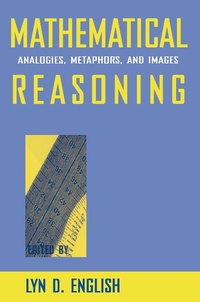
Mathematical Reasoning
Analogies, Metaphors, and Images
1st Edition
Published on 3. April 2013
392 pages
978-1-136-49114-6 (ISBN)
Description

How we reason with mathematical ideas continues to be a fascinating and challenging topic of research--particularly with the rapid and diverse developments in the field of cognitive science that have taken place in recent years. Because it draws on multiple disciplines, including psychology, philosophy, computer science, linguistics, and anthropology, cognitive science provides rich scope for addressing issues that are at the core of mathematical learning.
Drawing upon the interdisciplinary nature of cognitive science, this book presents a broadened perspective on mathematics and mathematical reasoning. It represents a move away from the traditional notion of reasoning as "abstract" and "disembodied", to the contemporary view that it is "embodied" and "imaginative." From this perspective, mathematical reasoning involves reasoning with structures that emerge from our bodily experiences as we interact with the environment; these structures extend beyond finitary propositional representations. Mathematical reasoning is imaginative in the sense that it utilizes a number of powerful, illuminating devices that structure these concrete experiences and transform them into models for abstract thought. These "thinking tools"--analogy, metaphor, metonymy, and imagery--play an important role in mathematical reasoning, as the chapters in this book demonstrate, yet their potential for enhancing learning in the domain has received little recognition.
This book is an attempt to fill this void. Drawing upon backgrounds in mathematics education, educational psychology, philosophy, linguistics, and cognitive science, the chapter authors provide a rich and comprehensive analysis of mathematical reasoning. New and exciting perspectives are presented on the nature of mathematics (e.g., "mind-based mathematics"), on the array of powerful cognitive tools for reasoning (e.g., "analogy and metaphor"), and on the different ways these tools can facilitate mathematical reasoning. Examples are drawn from the reasoning of the preschool child to that of the adult learner.
Drawing upon the interdisciplinary nature of cognitive science, this book presents a broadened perspective on mathematics and mathematical reasoning. It represents a move away from the traditional notion of reasoning as "abstract" and "disembodied", to the contemporary view that it is "embodied" and "imaginative." From this perspective, mathematical reasoning involves reasoning with structures that emerge from our bodily experiences as we interact with the environment; these structures extend beyond finitary propositional representations. Mathematical reasoning is imaginative in the sense that it utilizes a number of powerful, illuminating devices that structure these concrete experiences and transform them into models for abstract thought. These "thinking tools"--analogy, metaphor, metonymy, and imagery--play an important role in mathematical reasoning, as the chapters in this book demonstrate, yet their potential for enhancing learning in the domain has received little recognition.
This book is an attempt to fill this void. Drawing upon backgrounds in mathematics education, educational psychology, philosophy, linguistics, and cognitive science, the chapter authors provide a rich and comprehensive analysis of mathematical reasoning. New and exciting perspectives are presented on the nature of mathematics (e.g., "mind-based mathematics"), on the array of powerful cognitive tools for reasoning (e.g., "analogy and metaphor"), and on the different ways these tools can facilitate mathematical reasoning. Examples are drawn from the reasoning of the preschool child to that of the adult learner.
Reviews / Votes
"The topic addressed by this book is an important one both practically and theoretically....This book provides a relatively easy introduction to the relativist view that mathematical systems are culturally constructed rather than objectively real."-The British Journal of Educational Psychology
"I found this book to be an excellent catalyst for furthering my own understanding as well as my graduate students' understanding of mathematical reasoning. A collection of thoughtful articles challenged us to reconsider the nature of mathematics and mathematical thought."
-Mathematics Teaching in the Middle School
"Together, the contributed articles form a rich and provocative collection, challenging some widely held ideas. They deserve careful reading by psychologists, mathematics educators, and philosophers of mathematics. Lyn English has done an outstanding job organizing varied viewpoints into a volume that is readable and well structured."
-Contemporary Psychology
More details
Series
Language
English
Place of publication
London
United Kingdom
Publishing group
Taylor & Francis Ltd
Target group
Professional and scholarly
Product notice
Reflowable
File size
7,09 MB
ISBN-13
978-1-136-49114-6 (9781136491146)
Copyright in bibliographic data and cover images is held by Nielsen Book Services Limited or by the publishers or by their respective licensors: all rights reserved.
Schweitzer Classification
Other editions
Additional editions
Book
07/1997
Routledge
€207.40
Shipment within 10-20 days
Book
07/1997
Routledge
€89.60
Shipment within 10-20 days
Person
Lyn D. English
Content
Contents: Preface. Part I: Introduction.L.D. English, Analogies, Metaphors, and Images: Vehicles for Mathematical Reasoning. Part II: Cognitive Foundations for a Mind-Based Mathematics.G. Lakoff, R.E. Nunez, The Metaphorical Structure of Mathematics: Sketching Out Cognitive Foundations for a Mind-Based Mathematics. Part III: Mathematical Reasoning: Analogies.R.B. Davis, C.A. Maher, How Students Think: The Role of Representations. P.A. Alexander, C.S. White, M. Daugherty, Analogical Reasoning and Early Mathematics Learning. B. Gholson, D. Smither, A. Buhrman, M.K. Duncan, K.A. Pierce, Children's Development of Analogical Problem-Solving Skill. L.D. English, Children's Reasoning Processes in Classifying and Solving Computational Word Problems. M. Bassok, Two Types of Reliance on Correlations Between Content and Structure in Reasoning About Word Problems. M.J. Rattermann, Commentary: Mathematical Reasoning and Analogy. Part IV: Mathematical Reasoning: Metaphors, Metonymies, and Images.N.C. Presmeg, Reasoning With Metaphors and Metonymies in Mathematics Learning. G.H. Wheatley, Reasoning With Images in Mathematical Activity. N.C. Presmeg, Generalization Using Imagery in Mathematics. D.H. Clements, J. Sarama, Children's Mathematical Reasoning With the Turtle Programming Metaphor. A. Sfard, Commentary: On Metaphorical Roots of Conceptual Growth.
