

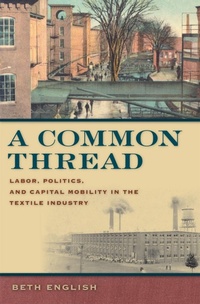
A Common Thread
Description

With important ramifications for studies relating to industrialization and the impact of globalization, A Common Thread examines the relocation of the New England textile industry to the piedmont South between 1880 and 1959. Through the example of the Massachusetts-based Dwight Manufacturing Company, the book provides an informative historic reference point to current debates about the continuous relocation of capital to low-wage, largely unregulated labor markets worldwide.
In 1896, to confront the effects of increasing state regulations, labor militancy, and competition from southern mills, the Dwight Company became one of the first New England cotton textile companies to open a subsidiary mill in the South. Dwight closed its Massachusetts operations completely in 1927, but its southern subsidiary lasted three more decades. In 1959, the branch factory Dwight had opened in Alabama became one of the first textile mills in the South to close in the face of post-World War II foreign competition.
Beth English explains why and how New England cotton manufacturing companies pursued relocation to the South as a key strategy for economic survival, why and how southern states attracted northern textile capital, and how textile mill owners, labor unions, the state, manufacturers' associations, and reform groups shaped the ongoing movement of cotton-mill money, machinery, and jobs. A Common Thread is a case study that helps provide clues and predictors about the processes of attracting and moving industrial capital to developing economies throughout the world.
More details
Other editions
Additional editions
Person
Content
- Intro
- Contents
- List of Illustrations
- Acknowledgments
- Introduction
- ONE. "Positively Alarming": Southern Boosters, Piedmont Mills, and New England Responses
- TWO. "Manufacturers Surely Cannot Be Expected to Continue": Legislation, Labor, and Depression
- THREE. "A Model Manufacturing Town": Moving to Alabama City
- FOUR. "Small Help": Unionization, Capital Mobility, and Child-Labor Laws in Alabama
- FIVE. "A General Demoralization of Business": The Textile Depression of the 1920s
- SIX. "Dissatisfaction among Labor": The 1934 General Strike
- SEVEN. "We Kept Right on Organizin' ": From Defeat to Victory and Back Again
- Conclusion
- Notes
- Bibliography
- Index
- A
- B
- C
- D
- E
- F
- G
- H
- I
- J
- K
- L
- M
- N
- O
- P
- R
- S
- T
- U
- V
- W
