

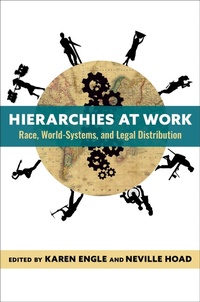
Hierarchies at Work
Description

Hierarchies at Work features powerful, grounded studies of the dynamics of work and livelihood in sites ranging from garment factories in Jordan and palm oil fields in Colombia to dairy farms in the United States. These studies underscore the necessity of thinking about the future of work and livelihoods through their racialized past and present and recognizing the systemic role of law in unequal distribution. Highlighting alternative imaginaries that contest systems of domination and subordination, this timely book offers resources to spur more just futures across local and global levels.
More details
Other editions
Additional editions
Persons
Karen Engle is Minerva House Drysdale Regents Chair in Law and codirector of the Bernard and Audre Rapoport Center for Human Rights and Justice at the University of Texas at Austin. Her books include The Grip of Sexual Violence in Conflict: Feminist Interventions in International Law (2020) and The Elusive Promise of Indigenous Development: Rights, Culture, Strategy (2010).
Neville Hoad is associate professor of English and codirector of the Bernard and Audre Rapoport Center for Human Rights and Justice at the University of Texas at Austin. His books include Pandemic Genres: Imagining Politics in a Time of AIDS (2025) and African Intimacies: Race, Homosexuality, and Globalization (2007).
Content
Acknowledgments
Introduction, by Karen Engle and Neville Hoad
Part I. Global Hierarchies: Racial Capitalism, World-Systems, and Legal Distributional Analyses
1. Neville Alexander: Racial Capitalism South African Style, by Dennis Davis
2. Walter Rodney, World-Systems Theory, and Racial Capitalism, by Nicole Burrowes
3. Critical System Analysis and the Great Disparities, by David Kennedy
4. Law Distributes: Ricardo, Marx, CLS, by Duncan Kennedy
5. Distributional Analytics and the TWAIL Tradition, by Vasuki Nesiah
Part II. The Future of Work: Challenges to Dominant Framings
6. The Future of Work from a Victorian Past, by Neville Hoad
7. Recovering the Past and the Outside: Sites for New Imaginaries of the Future of Work, by Kerry Rittich
8. Financialization, Fissuring, and Global Futures of Work, by Jennifer Bair
Part III. Global Hierarchies at Work: Grounded Accounts
9. Labors in Time and Subjectivity: Gender Nonconformity and Racial Capitalism in the Making of Eighteenth-Century New Orleans, by Vanja Hamzic
10. Garment Work, Refugees, and Resistance: The Jordan Compact, by Jennifer Gordon
11. Distributional Analysis and Supply Chain Interventions: Migrant Worker Organization in Vermont's Dairy Industry, by Jennifer Bair
12. Beyond Essential: Growth, a Pandemic, and the Future of Expendable Workers in a "Progressive" Texas Boomtown, by Karen Engle and Samuel Tabory
13. Land and Labor in the Colombian Palm Oil Industry, by Helena Alviar García and Jorge González Jácome
14. Dead Ends and Blind Alleys in the Future of Work: Notes from Italy, by Jorge L. Esquirol
List of Contributors
Index
