

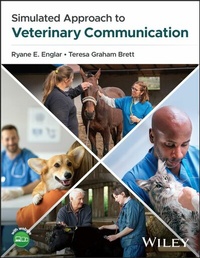
Simulated Approach to Veterinary Communication
Description

Empowers veterinary educators to design from scratch, modify, or adopt the authors' own comprehensive, simulation-based communication curriculum, combining andragogical principles, evidence-based practice, and practical tools to enhance the delivery of relationship-centered care.
Simulated Approach to Veterinary Communication tracks the evolution of communication training and relational practice in healthcare. Readers are introduced to foundational communication theories and models, as well as the growing evidence that effective communication enhances healthcare delivery and patient outcomes through improved information exchange and stronger veterinary client-healthcare provider relationships. The book translates theory into practical application exercises, offering 30 simulated client encounters for veterinary curricula. This debut of an entire curriculum provides educators with a complete, evidence-based framework for integrating communication training across all species and practice settings.
This one-of-a-kind resource offers practical implementation that is unparalleled. The book presents fifteen chapters covering communication theory, models, and client communication preferences as well as strategies for simulation design. A companion website delivers all components of all 30 simulations, including preparatory materials, simulation scripts, door charts, rubrics, and post-encounter reflection prompts. In addition, the companion website offers over 150 ready-to-implement clinical case vignettes for in-class use. The modular design allows the content to be adapted to a wide variety of needs:
- Species-specific communication guidance for canine, feline, equine, ruminant, and exotic animal practitioners and student doctors in training
- Evidence-based frameworks for building reflective practice. This requires providers to deepen their exploration of self as they learn to integrate personal, social, and professional identities to build capacity for their own unique delivery of relationship-centered care
- Application of the Calgary-Cambridge consultation model and associated communication skills to simulation experiences
- Complete scripts, preparatory work, and reflection assignments for 30 simulations that span the breadth and depth of clinical practice, including wellness visits, sick and emergency visits, end-of-life, economic euthanasia, mandatory animal cruelty reporting, and conflict within the veterinary team
Designed for anyone involved in teaching or learning communication skills in veterinary medicine, including veterinary faculty, veterinary technician educators, curriculum developers, clinical and professional skills course coordinators, and veterinary and veterinary technician students, Simulated Approach to Veterinary Communication provides the blueprint for communication curricular design. This text allows for rapid implementation of effective, reproducible training for the interpersonal demands of modern veterinary practice
More details
Other editions
Additional editions
Persons
Ryane E. Englar, DVM, DABVP (Canine and Feline Practice), is Professor of Practice and Executive Director of Clinical and Professional Skills at the University of Arizona College of Veterinary Medicine in Oro Valley, Arizona, USA.
Teresa Graham Brett, JD, is Senior Associate Dean for Student and Community Engagement at the University of Arizona College of Veterinary Medicine in Oro Valley, Arizona, USA.
Content
Acknowledgment v
Ryane E. Englar, DVM, DABVP (Canine and Feline Practice) and Teresa Graham Brett, JD
Dedication vii
Ryane E. Englar, DVM, DABVP (Canine and Feline Practice) and Teresa Graham Brett, JD
About the Authors xxv
Ryane E. Englar, DVM, DABVP (Canine and Feline Practice) and Teresa Graham Brett, JD
Preface xxvii
Ryane E. Englar, DVM, DABVP (Canine and Feline Practice) and Teresa Graham Brett, JD
About the Companion Website xxxii
[PRINTED BOOK]
PART 1 BUILDING A CASE FOR COMMUNICATION SKILLS TRAINING IN VETERINARY CURRICULA
1 Tracking the Perceived Need for Clinical Communication Training in Veterinary Medicine Over Time: Bridging the Gaps Between Education and Practice 3
1.1 The Case for Communication in Human Healthcare Curricula, 3
1.2 Pushback Against the Introduction of Communication Training to Veterinary Medical Education, 4
1.3 Turning the Tide: The Pew Report, 4
1.4 Acknowledging and Addressing Income Stagnation: The Brakke Study, 5
1.5 The State of the Veterinary Profession's Economic Health: The KPMG Study, 5
1.6 The Establishment of the National Commission on Veterinary Economic Issues, 6
1.7 Actions Taken by Other Stakeholders, 6
1.8 Additional Evidence for Communication Training in Veterinary Education, 9
1.9 The Roadmap for Veterinary Education, 10
1.10 The Push for Outcomes Assessment Gets Stronger, 10
1.11 Concerns About New Graduates' Lack of Confidence Persist: Reactions and Actions Taken, 10
1.12 Multiple Accrediting Bodies Accept the Evidence and Require Communication Training, 11
1.13 What's Next in Veterinary Medical Education?, 14
2 Understanding Self Before Understanding Others: Developing Awareness of Personal and Professional Identities 19
2.1 Relationship-centered Care in Veterinary Medicine, 20
2.2 Frames of Reference, 21
2.3 Identity as a Whole, 24
2.4 The Role of Professional Identity Formation in Understanding Self, 24
2.5 Integrating Personal, Social, and Professional Identities to Build Capacity for Culturally Responsive Care, 26
3 Interacting With Others in Healthcare: Mitigating Bias and Acknowledging the Effects of Expectations, Perceptions, and Assumptions on Framing Care and Forward Planning 32
3.1 Interpersonal Communication, Dialogic Communication, and Intergroup Interactions in Healthcare, 32
3.2 Adaptive Unconscious and Implicit/Explicit Learning, 42
3.3 Implicit Assumptions, Categorization, and Bias in Healthcare, 45
3.4 Malleability of Implicit Bias, 46
3.5 Moving From Reaction to Response, 50
3.6 Intent and Impact Are Not Always the Same, 51
3.7 Intent and Impact in Healthcare Settings, 53
3.8 A Brief Examination of Feedback, 54
3.9 Post-simulation Feedback and the Potential for Discrepancies Between the Learner's Experience and the Simulated Client's, 54
4 Viewing Communication Through Another's Lens: Which Communication Skills Do Canine and Feline Caregivers Prioritize? 62
Ryane E. Englar, DVM, DABVP (Canine and Feline Practice)
4.1 The Evolving Human-Animal Bond, 62
4.2 Four Foundational Communication Skills: RENO, 64
4.3 Expanding the Communication Toolbox: TONERR, 72
4.4 Towards a Deeper Understanding of Dog-owner and Cat-owner Communication Preferences, 75
4.5 Cost of Care-related Communication Preferences, 79
4.6 Communication Preferences of Cat and Dog Breeders, 81
4.7 Concluding Thoughts, 84
5 Viewing Communication Through Another's Lens: Which Communication Skills Do Equine Caregivers Prioritize? 93
Ryane E. Englar, DVM, DABVP (Canine and Feline Practice)
5.1 Establishing Elements That Are Foundational to Success in Equine Practice from the Client's Perspective, 93
5.2 Building Upon the Foundation of Successful Veterinarian-Client Relationships, 94
5.3 Additional Considerations on Partnership and the Need for Veterinarians to Assess Clients' Knowledge, 96
5.4 Expectations Surrounding Decision-making and Financing Care, 97
5.5 Concluding Thoughts, 98
6 Viewing Communication Through Another's Lens: Considerations for Communicating With Bovine Producers 101
Ryane E. Englar, DVM, DABVP (Canine and Feline Practice)
6.1 The Shift in Role from Reactive Expert-in-charge to Proactive Guide-on-the-side, 101
6.2 Lessons from Motivational Interviewing, 103
6.3 Diving Deeper into Motivation: What Drives the Dairy Farmer?, 107
6.4 Beyond Motivation: Considering Differences in Learning Styles, 109
6.5 The "Hard-to-reach Farmer", 111
6.6 Other Stakeholders and Associated Challenges, 113
6.7 Motivations and Barriers from the Veterinarian's Perspective, 114
6.8 Applications: Communication About Biosecurity, 115
6.9 Applications: Communication About Antibiotic Use, 116
6.10 Applications: Communication About Lameness, 117
6.11 Applications: Communication About Calf-rearing, 117
6.12 Concluding Thoughts, 118
7 Viewing Communication Through Another's Lens: Considerations for Communicating With Exotic Animal Caregivers 124
Ryane E. Englar, DVM, DABVP (Canine and Feline Practice)
7.1 Communicating With Caregivers of Amphibians, 129
7.2 Communicating With Caregivers of Reptiles, 132
7.3 Communicating With Caregivers of Avian Species, 146
7.4 Communicating With Caregivers of Exotic Companion Mammals (ECMs), 153
7.5 Concluding Thoughts, 161
8 Communication Models: Integrating Theory Into Practice 166
8.1 The Development of Consultation Models, 168
8.2 The Calgary-Cambridge Model, 171
8.3 The Revised Calgary-Cambridge Model for Veterinary Patients, 174
8.4 Limitations of Consultation Models, 175
8.5 Englar-Brett Adaptations of the Calgary-Cambridge Consultation Model, 177
9 Incorporating Communication Into Curricula: Learning Through Engaging 182
9.1 The Emergence of Skills Training in Healthcare Programs, 182
9.2 Where Does Communication Fit?, 184
9.3 Redefining Learners, 185
9.4 Optimizing Our Approach to Learning, 187
9.5 Curricular Integration of Communication Training, 190
9.6 Concluding Thoughts, 193
10 Structuring Simulated Client Encounters 198
10.1 Prior to Simulation: The Realm of Authentic Interactions, 198
10.2 The Shift Toward Simulation, 202
10.3 Simulation Decision-making: What Is Required to Invest in Simulations for Communication Training?, 203
10.4 Simulation Decision-making: Who Is Required for Communication Simulations?, 208
10.5 Simulation Decision-making: How Are Communication Simulations Structured?, 216
10.6 Additional Considerations with Respect to Assessment, 222
10.7 Other Simulation Options, 223
11 Scripting Simulated Client Encounters 226
11.1 Planning for Simulation, 226
11.2 How Real Is Real?, 228
11.3 Defining a Scenario, 230
11.4 Selecting a Scriptwriting Team, 233
11.5 Developing Overarching Goals of the Simulation, 234
11.6 Formulating Learning Objectives, 237
11.7 Establishing Case Logistics, 239
11.8 Detailing the Client: Character Development, 239
11.9 Detailing the Patient(s): Character Development, 244
11.10 Establishing the Rules of the Simulation (From the Perspective of the SC), 248
11.11 Establishing the Opening Statement, 249
11.12 Providing Special Instructions or Prompts, 249
11.13 Providing Rubrics for SC Written Feedback, 252
11.14 What Learners Are Given in Advance of the Encounter?, 253
11.15 SC Training, 253
11.16 Piloting and Revising, 254
11.17 Concluding Thoughts, 254
12 Preparing the Learner for Simulated Client Encounters: Investing in Preparatory Work 257
12.1 Toward a Shared Definition of Preparatory Work, 259
12.2 Differing Perspectives on Prework: The Educator's Point of View, 261
12.3 Differing Perspectives on Prework: The Learner's Point of View, 263
12.4 Prework for Simulations at the University of Arizona College of Veterinary Medicine, 264
12.5 Same-day on-site Briefing for Simulations at the University of Arizona College of Veterinary Medicine, 269
12.6 Concluding Thoughts on Preparatory Work for Simulations, 273
13 Becoming a Reflective Practitioner: Building Value into Post-encounter Reflections 276
13.1 Toward a Working Definition of What It Means to Be Reflective, 278
13.2 Reflective Practitioners Must First Become Reflective Learners, 283
13.3 Reflective Practice Is a Learned Skill: Making Meaning of Learning, 286
13.4 Models of Reflective Practice, 290
13.5 Strategies for Incorporating Reflective Practice into Curricula, 303
13.6 Our Process for Incorporating Reflective Practice into Our Simulation Program Within Professional Skills Coursework at the University of Arizona College of Veterinary Medicine, 311
13.7 Concluding Thoughts, 319
14 The Path Forward: Making the Simulation Experience More Inclusive 325
15 Technological Advances in Communications Training: The Emergence of Veterinary DialogueTrainer as a Leading Interactive Teaching Tool 328
Quintie Stoel (MSc), Saskia Nab (DVM) and Jolanda Jansen (PhD, MSc)
15.1 The Relevance of Simulation-based Training (SBT), 328
15.2 The Next Level of Simulation-based Training (SBT): The Veterinary DialogueTrainer (VDT), 328
15.3 What Does a VDT Role-play Look Like?, 329
15.4 Veterinary DialogueTrainer Dashboard and Data Collection, 330
15.5 How Is Each VDT Virtual Role-play Customized?, 331
15.6 Current Users of the Veterinary DialogueTrainer, 333
15.7 Embedding VDT Simulations into a Comprehensive E-learning, 333
15.8 Current Topics and Species Coverage in VDT Role-plays, 334
15.9 Evidence for the VDT as an Innovative Tool to Improve the Efficacy of Communication Skills Training, 335
15.10 The Endless Possibilities of Veterinary DialogueTrainer, 335
15.11 Ready to Try a VDT Demo? Developed in Partnership with the University of Arizona College of Veterinary Medicine: Intra-team Conflict, 336
15.12 Customizing the Veterinary DialogueTrainer to Meet Your Needs: Contact the Team Today!, 336
Appendix A What the Current Literature Tells Us About Simulation-based Education (SBE) in Veterinary Curricula 338
Appendix B The Englar-Brett Communication Consultation Models 443
Index 453
[COMPANION WEBSITE]
PART 2 Case Vignettes for Role-play and In-class Discussion
16 Clinical Case Vignettes: Canine/Feline 16-1
Ryane E. Englar, DVM, DABVP (Canine and Feline Practice)
17 Clinical Case Vignettes: Equine 17-1
Sarah Eaton, DVM, DACT, CVA, DABVP-Equine
18 Clinical Case Vignettes: Small Ruminant 18-1
Skyler Bentley and Ryane E. Englar, DVM, DABVP (Canine and Feline Practice)
19 Clinical Case Vignettes: Bovine 19-1
Ryane E. Englar, DVM, DABVP (Canine and Feline Practice)
Jennifer Koziol, DVM, MS, DACT
Appendix C Integrative Assignments C-1
Ryane E. Englar, DVM, DABVP (Canine and Feline Practice)
Teresa Graham Brett, JD
Appendix D Overview of Simulations at the University of Arizona College of Veterinary Medicine (UA-CVM) D-1
Ryane E. Englar, DVM, DABVP (Canine and Feline Practice)
Teresa Graham Brett, JD
Appendix E Door Charts: What Information Learners Are Given Before They Enter the Simulated Exam Room E-1
Ryane E. Englar, DVM, DABVP (Canine and Feline Practice)
Teresa Graham Brett, JD
Appendix F Pre-encounter Assignments (PreWork): What the Learner Completes Prior to Engaging in the Simulation F-1
Ryane E. Englar, DVM, DABVP (Canine and Feline Practice)
Teresa Graham Brett, JD
Appendix G Post-encounter Reflection Assignments: What the Learner Completes After Engaging in the Simulation G-1
Ryane E. Englar, DVM, DABVP (Canine and Feline Practice)
Teresa Graham Brett, JD
Appendix H Scripts for Simulations H-1
Ryane E. Englar, DVM, DABVP (Canine and Feline Practice)
Teresa Graham Brett, JD
Appendix I Rubrics for Written Feedback I-1
Ryane E. Englar, DVM, DABVP (Canine and Feline Practice)
Teresa Graham Brett, JD
Preface
Ryane E. Englar, DVM, DABVP (Canine and Feline Practice) and Teresa Graham Brett, JD
"As we navigate an increasingly complex and rapidly changing world, it becomes crucial to reevaluate what knowledge is truly essential. The challenge lies in striking a balance between providing a broad foundation of knowledge and equipping students with skills that will serve them well in their personal and professional lives. This reflection isn't about dismissing academic rigor but rather about questioning whether our current educational priorities align with the realities of the world our students will inherit" [1].
~Thomas Frey
Curricular design is inherently unique. Each institution's curriculum is a construct created by people for people, and influenced by both external and internal forces (e.g., requirements outlined by accrediting bodies, learners' needs, demands for workforce preparedness, community expectations, societal issues, cultural values, public opinion, technological advancements, type of institution, current pedagogy, budget, core coursework, elective courses, subject matter, content, hidden curriculum, resources, program length, block scheduling, designated seat time, etc.).
Curricular evolution is imperative because all influencing factors have the capacity to change with the times. For example [2]:
"In 1991, the General Medical Council issued a consultation document about the need for reforms in . medical curriculum. The council expressed concern at the response of many students to the present course - 'it is distressing to see the progressive disenchantment of many of them as they work their way through the course. Imagination and curiosity are soon dulled .' - and highlighted the overburdened curriculum, with undue emphasis on the passive acquisition of facts that were soon forgotten, as a major area for reform. Instead, the council wants more promotion of self-learning skills and cultivation of the attitudes needed to keep up to date with a rapidly changing subject like medicine."
This push by accrediting bodies for educators to replace didactic sessions with experiential learning-based application exercises has not been unique to human healthcare training programs. Active learning has been trending in adult education in a variety of programs, including veterinary medicine. David Kolb, who is credited with developing our modern day understanding of experiential learning theory, explains why [3]:
"The experiential learning model pursues a framework for examining and strengthening the critical linkages among education, work, and personal development . It offers a system of competencies for describing job demands and corresponding educational objectives, and it emphasizes the critical linkages that can be developed between the classroom and the 'real world' with experiential learning methods. It pictures the workplace as a learning environment that can enhance and supplement formal education and can foster personal development through meaningful work and career-development opportunities."
Standing at the intersection of animal and human health as advocates, leaders, and role models, veterinarians play a vital role in the workforce. Each college of veterinary medicine is tasked with developing their learners into graduates who contribute positively to that workforce by being both competent and capable of advancing animal and human health.
What does it mean to produce a day-one ready graduate? Each college of veterinary medicine has its own definition of a career-ready veterinarian. Every institution must decide for itself how to produce a cohort of such individuals. This output in many ways hinges upon how the program's mission and vision relate to curricular design, and how visible those connections are.
A significant thread in veterinary curricula is communication skills training. Historically, communication was viewed as a nice-to-have, add-on skill that could be acquired after graduation. However, over the past three decades, extensive research has provided a wealth of evidence that curricular communication content significantly influences graduate success in clinical practice. Accordingly, the American Veterinary Medical Association (AVMA) Council on Education (COE) now requires that communication be built into the curriculum of all accredited colleges of veterinary medicine [4].
At the University of Arizona College of Veterinary Medicine, we have intentionally scaffolded communication content throughout our curriculum, believing that "students need to witness communication skills in use in and outside of the classroom, and throughout the clinic, to recognize how effective communication can facilitate clinical practice" [5]. This belief has come into being as six longitudinal preclinical semesters of Professional Skills coursework (VETM 802A, 802B, 802C, 802D 815A, and 815B). These mandatory courses were designed with horizontal and vertical integration to frame communication as an essential skill that transcends a single course of study.
Emphasis is placed on interpersonal skills, including professional behaviors, ethics, and communication with team members. Framed around relationship-centered care, our curriculum and its focus on dialogic communication prioritizes our most valuable, yet underrated team members: veterinary clients. Facilitated sessions as early as the first week of Fall Semester during the first year of the program introduce the Calgary-Cambridge Guide as a communication model. As learners become familiar with and gain practice wielding many foundational communication skills, they are companioned through an extensive simulation program. This program, encompassing a total of 30 simulations, requires our learners to engage real time with hired, trained community members (actors) in mock consultation rooms [6]. These simulated client (SC) experiences begin with making introductions (e.g., meeting and greeting a client), then build in intensity over the course of two preclinical years. Learners practice what it feels like to be in the driver's seat as attending clinicians. This requires them to navigate conversations that involve conflict (e.g., clinician-client, clinician-employer, clinician-technician), bad news delivery, death notification, goals of care (GOC), quality of life (QOL), and end-of-life decision-making. Such conversations require strategic planning so that learners receive appropriate preparatory work in advance of simulations that may provoke reactivity. Simultaneously, learners must be taught how to reflect upon their experiences so that they can move from reaction to response. This transition allows them to engage and stay engaged through the duration of the event, with guidance, in a safe, supportive environment.
As founding faculty, we had the privilege of designing a Professional Skills curriculum from scratch. This afforded us the luxury of advance planning, which ensured smooth transitions both within and outside of our coursework. In addition, we had the advantage of being on the ground floor of requesting and subsequently building in spatial and temporal resources as needed to allow our vision to take shape.
We recognize that not every program has a need for, a desire to implement, the space, budget, and/or the staffing to deliver 30 simulations. Even were all 30 desired, not every institution or teaching team might have the capacity to deliver them using the exact methodology that we outline here. Even so, we have provided the extent of our entire communication curriculum at your disposal. We hope that our delivery of content and its rationale for inclusion as outlined here can be of use internally to you in whatever way, shape, or form may suit your teaching and learner needs.
Each of you likely approaches this text with different needs.
For those among you who are in search of the evidence and rationale for a simulation-based program in veterinary medical education, with applications to other industries, please begin with Part 1 of our text: Building a Case for Communication Skills Training in Veterinary Curricula.
Chapter 1 of Part 1 introduces how the perceived need for clinical communication training in veterinary practice materialized in veterinary medical education.
Chapters 2 and 3 walk you through the process of understanding your own assumptions, beliefs, values, and experiences to enrich your understanding of self. A sense of self is required before learners like us can engage in perspective-taking and perspective-seeking to acknowledge, understand, accept, and bridge differences [6-10].
Chapters 4 through 7 showcase what is known from the veterinary medical literature with respect to client communication preferences. Preferences of canine/feline caregivers are often prominently on display within veterinary communication curricula. However, there is growing evidence that equine, ovine, caprine, bovine, and exotic animal owners have communication preferences as well. These cannot and should not be overlooked.
Chapters 8 and 9 integrate theory into practice and provide a comprehensive account of communication models in both human and veterinary healthcare and how they can be incorporated into curricula.
Chapters 10 through 15 outline what is required to design and debut a simulation-based communication curriculum, building upon the evidence for best practices.
For those who are in search of the tools for...
