

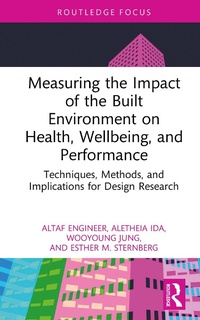
Measuring the Impact of the Built Environment on Health, Wellbeing, and Performance
Techniques, Methods, and Implications for Design Research
1st Edition
Published on 22. February 2024
138 pages
978-1-040-01500-1 (ISBN)
Description

This book reveals how subjective and objective data gathered by innovative methods of measurement give us the ability to quantify stress, health, performance, and wellbeing outcomes in different built environments. Design interventions informed by these measures, along with innovative integrated building materials, can shape the character of built environments for better health, productivity, and performance. These measures can help employers and managers calculate the return on investment (ROI) of various design interventions.
Areas of inquiry in health and the built environment are discussed in three parts: Part 1 - Fundamentals: Human, Environment, and Material Measures for Health and Wellbeing; Part 2 - Methods: Measurement Techniques, Tools, and Methods for Health and Wellbeing; and Part 3 - Applications: Case Studies and Future Directions. The rapid pace of technical innovation and entrepreneurship by interdisciplinary research teams in health and the built environment has created a need for more publications such as this book, which discuss latest tools and methods of measuring the effects of the built environment on human physiology and psychology. Emerging tools and techniques are introduced for this field of built environment design, including virtual reality immersive environments and fisheye lens photograph simulations for human wellbeing impact measures integral to the design process. The potentials and limitations of bio-responsive material systems and integrated sensing devices with wearable technologies linked to the Internet of Things are discussed in relation to human wellbeing performance improvements.
The book provides both the foundational knowledge and fundamentals for characterizing human health and wellbeing in the built environment as well as emerging trends and design research methods for innovations in this field. It will be of interest to researchers, educators, and students of architecture, interior design, and integrative medicine, as well as professionals working in health and the built environment.
Areas of inquiry in health and the built environment are discussed in three parts: Part 1 - Fundamentals: Human, Environment, and Material Measures for Health and Wellbeing; Part 2 - Methods: Measurement Techniques, Tools, and Methods for Health and Wellbeing; and Part 3 - Applications: Case Studies and Future Directions. The rapid pace of technical innovation and entrepreneurship by interdisciplinary research teams in health and the built environment has created a need for more publications such as this book, which discuss latest tools and methods of measuring the effects of the built environment on human physiology and psychology. Emerging tools and techniques are introduced for this field of built environment design, including virtual reality immersive environments and fisheye lens photograph simulations for human wellbeing impact measures integral to the design process. The potentials and limitations of bio-responsive material systems and integrated sensing devices with wearable technologies linked to the Internet of Things are discussed in relation to human wellbeing performance improvements.
The book provides both the foundational knowledge and fundamentals for characterizing human health and wellbeing in the built environment as well as emerging trends and design research methods for innovations in this field. It will be of interest to researchers, educators, and students of architecture, interior design, and integrative medicine, as well as professionals working in health and the built environment.
More details
Series
Edition
1. Auflage
Language
English
Place of publication
London
United Kingdom
Publishing group
Taylor & Francis Ltd
Target group
College/higher education
Professional and scholarly
Product notice
Reflowable
Illustrations
3 Line drawings, black and white; 5 Halftones, black and white; 8 Illustrations, black and white
ISBN-13
978-1-040-01500-1 (9781040015001)
Copyright in bibliographic data and cover images is held by Nielsen Book Services Limited or by the publishers or by their respective licensors: all rights reserved.
Schweitzer Classification
Other editions
Additional editions
Altaf Engineer | Aletheia Ida | Wooyoung Jung
Measuring the Impact of the Built Environment on Health, Wellbeing, and Performance
Techniques, Methods, and Implications for Design Research
Book
10/2025
1st Edition
Routledge
€33.60
Shipment within 10-20 days
Altaf Engineer | Aletheia Ida | Wooyoung Jung
Measuring the Impact of the Built Environment on Health, Wellbeing, and Performance
Techniques, Methods, and Implications for Design Research
Book
02/2024
1st Edition
Routledge
€73.50
Shipment within 15-20 days
Persons
Altaf Engineer is an architect and Associate Professor at the School of Architecture and University of Arizona Institute on Place, Wellbeing, and Performance (UA IPWP) - an interdisciplinary institute at the University of Arizona that links expertise of the UA College of Medicine - Tucson, the Arizona Center for Integrative Medicine (AzCIM), and the UA College of Architecture, Planning, and Landscape Architecture (CAPLA). Altaf has expertise in using wearable devices for measuring sleep, stress, activity, and light. He is Chair of the Master of Science in Architecture Health and Built Environment degree at the UA College of Architecture, Planning, and Landscape Architecture (CAPLA).
Aletheia Ida is an architect, designer, and technologist. She has over 15 years of experience in professional architecture practice and is fluent in building performance analytics. She holds a PhD in Architectural Sciences from the Center for Architecture, Science, and Ecology at Rensselaer Polytechnic Institute in New York. Aletheia develops interdisciplinary design theory to inform applied research in emerging building technologies with an emphasis on environmental performance, material innovations, and human wellbeing.
Wooyoung Jung is an architectural engineer and scientist, and Assistant Professor in the Department of Civil and Architectural Engineering and Mechanics at the University of Arizona, Tucson, Arizona. He has a holistic professional career, dedicated to the building sector, ranging from a practitioner in the construction industry to a researcher in academia and a couple of the Department of Energy-funded national laboratories.
Esther M. Sternberg is a physician and scientist, and internationally recognized pioneer in design and health and brain-immune (science of the mind-body connection). She is Research Director, Andrew Weil Center for Integrative Medicine, Founding Director of the University of Arizona's Institute on Place, Wellbeing, and Performance, founding member of the American Institute of Architects' Design and Health Leadership Group and AIA Design and Health Research Consortium. Previously NIH Senior Scientist and Section Chief (1986-2012), she has authored more than 240 scholarly articles, edited eight scholarly books, and authored three popular books including Healing Spaces: The Science of Place and Wellbeing (2009), which inspired the rebirth of the design and health movement 21st century style, and Well at Work, Creating Wellbeing in Any Workspace (2023), which brings that science into the post-COVID era.
Aletheia Ida is an architect, designer, and technologist. She has over 15 years of experience in professional architecture practice and is fluent in building performance analytics. She holds a PhD in Architectural Sciences from the Center for Architecture, Science, and Ecology at Rensselaer Polytechnic Institute in New York. Aletheia develops interdisciplinary design theory to inform applied research in emerging building technologies with an emphasis on environmental performance, material innovations, and human wellbeing.
Wooyoung Jung is an architectural engineer and scientist, and Assistant Professor in the Department of Civil and Architectural Engineering and Mechanics at the University of Arizona, Tucson, Arizona. He has a holistic professional career, dedicated to the building sector, ranging from a practitioner in the construction industry to a researcher in academia and a couple of the Department of Energy-funded national laboratories.
Esther M. Sternberg is a physician and scientist, and internationally recognized pioneer in design and health and brain-immune (science of the mind-body connection). She is Research Director, Andrew Weil Center for Integrative Medicine, Founding Director of the University of Arizona's Institute on Place, Wellbeing, and Performance, founding member of the American Institute of Architects' Design and Health Leadership Group and AIA Design and Health Research Consortium. Previously NIH Senior Scientist and Section Chief (1986-2012), she has authored more than 240 scholarly articles, edited eight scholarly books, and authored three popular books including Healing Spaces: The Science of Place and Wellbeing (2009), which inspired the rebirth of the design and health movement 21st century style, and Well at Work, Creating Wellbeing in Any Workspace (2023), which brings that science into the post-COVID era.
Content
Part 1 Fundamentals: Human, Environment, and Material Measures for Health and Wellbeing 1. Human Health and Wellbeing Measures 2. Environmental Measures 3. Material Measures Part 2 Methods: Measurement Techniques, Tools, and Methods for Health and Wellbeing 4. Sensing and Data Acquisition 5. Measurement Tools and Technologies 6. Design and Analysis Methods Part 3 Applications: Case Studies and Future Directions 7. Case Studies 8. Future Directions
