

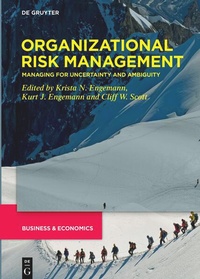
Developments in Managing and Exploiting Risk / Organizational Risk Management
Description

Every organization faces difficult decisions when managing risk and the potential consequences of its manifestation. For a more thorough outlook on risk, organizations should also evaluate and engage with its advantages. Organizational Risk Management: Managing for Uncertainty and Ambiguity covers a series of perspectives that represent both causal and interpretative frameworks. These perspectives shed light on how organizational structures and processes adapt amid a complex, dynamic organizational environment in an effort to manage and exploit the accompanying risks of that environment.
This volume will oftentimes challenge the expectation for and utility of clarity in crisis situations, thereby favoring uncertainty and ambiguity as the necessary conditions to exploit organizational risk and explore opportunities that rely on interpretation, learning, and knowledge among individuals.
The ultimate objective of Organizational Risk Management: Managing for Uncertainty and Ambiguity is to promote discussion among practitioners and organizational scholars who venture to understand organizational risk. Setting such a goal is to essentially practice what this volume shall inevitably preach: engage one another in order to proactively monitor and respond to risk. Strengthening ties along the bridge between practice and science will be a welcomed consequence of this volume.
More details
Other editions
Additional editions
Persons
Krista N. Engemann , University North Carolina, USA; Kurt J. Engemann , Iona College, USA; Cliff W. Scott, University North Carolina, USA
Content
- Intro
- Advances in organizational risk management
- Contents
- Part I: Fundamentals
- 1 Organizations helping their members manage risk
- 2 Optimizing interpersonal engagement for occupational safety: Practical practices from psychological science
- 3 To call or not to call: An analysis of whether, when, and how to hold after action reviews
- 4 High reliability reflexivity
- 5 Integrating dynamic modeling solutions towards a resilience model
- 6 Renovated leadership for the 21st century: Complexity, uncertainty and trust in the digital era
- Part II: Applications
- 7 Getting employees on board: Fostering perceived organizational support during organizational change
- 8 Understanding risk in high reliability organizations: How healthcare built environments shape communication, patient care, and staff wellbeing
- 9 Exploring coworker online sexual harassment and risk: Factors of uncertainty and ambiguity for employees and organizations
- 10 The risk of being too generous
- 11 The discursive construction of risk in gig work
- 12 Effective behavior-based safety coaching: Guidelines from numerous case studies
- Contributors
- Index
- Developments in Managing and Exploiting Risk
