

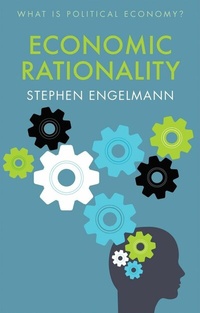
Economic Rationality
Description

Economics used to be called political economy, and the loss of the “political” tracks the ascendance of the idea of rational choice within the discipline. Where does this idea of economic rationality – choosing to maximize benefits and minimize costs – come from? What are the consequences of its rise?
In this new book, Stephen Engelmann assesses these questions through a consideration of the often-hidden links between choice and government, ranging from the Benthamic utilitarianism that inspired modern economics to the contemporary economic psychologists trying to nudge everyone to choose more rationally. Multiple global crises are exposing how deficient economic rationality is as a political theory, since a focus on choice turns actors away from relations in the common. Political economy once targeted aristocratic rule – heralding a politics and ethics of egalitarian self-command and spurring democratic reform – but economics allows domination and forecloses alternatives to it.
This accessible volume will be of interest to students and scholars of politics and economics, and to general readers concerned about the various ways that psychology and management have infiltrated our politics.
Stephen Engelmann is Associate Professor in the Department of Political Science at the University of Illinois at Chicago.
More details
Other editions
Additional editions
Person
Content
2 Textbook Rationality and the Behavioral Critique
3 Political Economy
4 Economics as Politics
5 Conclusion
1
Introduction
Rationality has a distinctive meaning in economics. Although economists have never quite agreed on what rationality is, they have converged for the most part on a technical definition for their teaching and research. The core idea is that the rational economic actor, for example a producing firm, or a consuming household, chooses to get what it defines as more for less, rather than to get less for more (which would be irrational). Defender of economics Lionel Robbins wrote that economics is "the science which studies human behavior as a relationship between ends and scarce means which have alternative uses."1 Critic Karl Polanyi wrote that economics "refers to a definite situation of choice, namely, that between different uses of means induced by an insufficiency of those means."2 Once one turns one's attention to this situation of choice, one realizes that any economic unit can make a rational choice by doing a better rather than a worse job of using the means at its disposal. To choose rationally is to choose what will yield more of what one considers benefit and suffer less of what one considers cost.
There are many other philosophical and common-sense ways to think about what is rational or reasonable. Here are just a few: Reason is what distinguishes a valid from an invalid argument. Reason is what distinguishes a consistent or coherent from an inconsistent or incoherent account. Reason is a process or mode involved in figuring out how to solve a puzzle, or figuring out how to build something from scratch, or figuring out how to fix something that is broken. Reason guides one to do the right thing. Reason is a social process, or a procedure, for people to do things like reach compromise or take advantage of the fact that many heads are better than one. To be reasonable is to be receptive and consistent, as opposed to rigid and arbitrary. Reason is what broadly distinguishes enlightenment or true religion from ignorance or superstition. Reason is a challenge to domination, or reason is a mask for domination. Reason is low cunning, or reason is high dispensation. Economic rationality overlaps with some of these and others but it is quite specific. Whether we speak of a part or a unit, or an individual or a collective, to be economically rational is to behave or act in such a way as to yield more benefits, suffer fewer costs, or both, of any kind, as determined by preferences and their satisfaction under given constraints. Economic rationality always looks to the future, and that future can present itself as alternative scenarios likely to result from more or less rational choices: more or less rational, that is, given preferences and given limited means to satisfy those preferences.3 Rationality, in an economic sense, is about allocative choice. The need to choose how to allocate is conditioned by scarcity. Economics points out, for example, that you only have so much time to do the things you want to do in this day, in this week, in this lifetime. How are you going to budget that time?
For most economists, one advantage of their approach to rationality is that it appears to be "value-free," unlike many of the alternatives listed above. Most critics agree, but they see this amorality as a vice. After all, the sinner might be just as rational, in an economic sense, as the saint, and both as rational as the prudent householder. Economic rationality on the dominant understanding is simply a vehicle one uses to take one, by the best route, wherever one wants to go. It does not seem to privilege any one way of life over another. Thus its more thoughtful defenders will point out that economic rationality flourishes in and is particularly appropriate to modern, complex, liberal societies, where people are rightly understood to have a plurality of ends, and a plurality of conceptions of the good life.
But economics cannot escape values any more than any other social science discipline can. As the American economist Frank Knight observed almost a century ago, economists are part of the social life that is their subject matter.4 Social life is made up of how people and things relate to one another; it is made up of what people do and how they talk about what they do. Economists are people too, and when they write and teach they necessarily affect the social life that they write and teach about. Their doing so isn't a problem - it's not some matter of personal "bias" getting in the way - it is instead how even or especially the most rigorous social science is done. Knight was the undergraduate and graduate teacher of several very prominent twentieth-century economists, including leading lights of the postwar American Right. Few would claim that their scientific practice left the world they studied unchanged.
Both defenders and detractors say that economic rationality selects means for given ends, that it is simply "instrumental." But that's not strictly speaking true. Instead, allocative choice means that ends are "traded off" with one another in light of the chooser's limited means; they are rendered commensurable, or somehow comparable, on a single scale. Do you want to read this book right now? How does it compare with something else you might be doing? You can't do both! (Or can you? What about those people at gyms reading on the StairMasterT?) Critics are right that something is seriously awry with thinking of allocative choice as a model for rational action, that the deployment of economic rationality can obscure and even transform relations that work according to other logics. But these critics and even the most stalwart defenders are insufficiently appreciative of the rich political history and meaning of economists' way of reasoning. Economic reason was once couched in a broader political theory that charted a clear-sighted course in opposition to dependence on, and domination by, aristocrats and churchmen. It worked as one department of a new democratic art and science of government. Today, however, economic rationality disenchants politics,5 and thus degrades responses to domination and other problems of the commons.
To behave in an economically rational way is to do more with less, or get more from less. To be more rational in this way is to economize, to make better use of what is available, whatever one's aims. Economy, or economic efficiency, yields utility: whatever counts as satisfaction of priorities or preferences for and from any individual or collective conduct. Efficiency fights waste: that which could have been yielded but wasn't, because of a correctable problem of misallocation. If that's how economic rationality guides us, says the economist, it seems there is some kind of ethics or politics involved here after all: an opposition to waste no matter what one's purposes, with waste defined strictly in accordance with those purposes. What could be wrong with that?
To make better use of what is available is to exploit. Critics target this exploitation. Consider that colonists over the centuries have seized indigenous lands and the very bodies of colonized individuals, justified in part by metrics claiming more efficient use than the colonized were making without their presence. This new use was seen as more pleasing to God and because, without being dispossessed or enslaved, the indigenous would, according to the metrics, remain in a state of underdevelopment, in everyone's interest. Consider that employers devise ingenious ways to get more out of employees in often despotic workplaces in the name of the contribution this makes to the health of the competitive firm, and to the prosperity of the economy as a whole, even as aggregate metrics of prosperity can efface effects on workers, often including whether they even share in this prosperity at all. Consider that economic prosperity gained by efficiency unconsciously exploits and often disrupts or reshuffles an invisible array of care work, some of it in the paid labor force, so partly accounted for by economic measures, but much of it not. Care work becomes more visible in times of crisis: essential work that is shirked by most men and by people of higher status and is primarily done by women and immigrants and members of other subaltern groups. And, consider that humans generally dominate, or attempt to dominate, other animals and the rest of nature, exploiting them for their own purposes. Humans don't even dominate nature efficiently, from another point of view, if losses from pollution, or in fresh water, habitat destruction, extinction, heightened disease risk, and outright climate catastrophe, aren't even priced as costs.
Defenders of economic rationality will point to this last possibility, the possibility of newly recognizing and revising estimates of the benefits and costs of our actions, in order to showcase the enormous flexibility and indispensability of their framework. All material culture amounts to exploitation in some form, much of it surely either innocuous or reducing of harm. If our aim is to expose and to confront all forms of unjust and otherwise problematic use and abuse, so be it! We will still need to do that rationally as opposed to irrationally; we will still want to oppose this exploitation as economically as possible. If the critics are concerned that economic rationality turns everything and everyone into an instrument for use, the defenders of economic rationality will point out that it itself is an instrument for use. It still is a vehicle to take us where we want to go, wherever that...
