

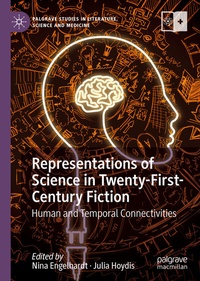
Representations of Science in Twenty-First-Century Fiction
Description

This collection of essays explores current thematic and aesthetic directions in fictional science narratives in different genres, predominantly novels, but also poetry, film, and drama. The ten case studies, covering a range of British and American texts from the late twentieth to the twenty-first centuries, reflect the diversity of representations of science in contemporary fiction, including psychopharmacology and neuropathology, quantum physics and mathematics, biotechnology, genetics, and chemical weaponry. This collection considers how texts engage with science and technology to explore relations between bodies and minds, how such connectivities shape conceptions and narrations of the human, and how the speculative view of science fiction features alongside realist engagements with the Victorian period and modernism. Utilizing an interdisciplinary approach, contributors offer new insights into narrative engagement with science and its place in life today, in times past, and intimes to come.
Chapter 1 is available open access under a Creative Commons Attribution 4.0 International License via link.springer.com.
Reviews / Votes
"In this exciting new volume of critical essays on the forms, histories, and interventions of twenty-first-century fictions of science, the editors and contributors draw our attention to a growing and vibrant field. The range and accessibility of the work is to be applauded, and it is likely to inspire other scholars to further excavate the rich examinations of science offered by our contemporary literary traditions." (Martin Willis, Professor of English Literature, Cardiff University, UK)More details
Other editions
Additional editions
Persons
Nina Engelhardt is Assistant Professor at the University of Stuttgart, Germany. She is author of Modernism, Fiction and Mathematics (2018) and has co-edited several special issues, including "Doing Science: Texts, Patterns, Practices" (2017) and "Above. Degrees of Elevation" (2020). She has previously held research and teaching positions at the University of Edinburgh, the Institute for Advanced Studies in the Humanities (Edinburgh) and the University of Cologne.
Julia Hoydis is Assistant Professor at the University of Cologne, Germany. She is author of Tackling the Morality of History: Ethics and Storytelling in the Works of Amitav Ghosh (2011). Co-edited volumes and special issues include "21 st Century Studies" (2015), "Doing Science: Texts, Patterns, Practices" (2017), and Teaching the Posthuman (2019). Her second monograph, Risk and the English Novel From Defoe to McEwan, is forthcoming (2019).
