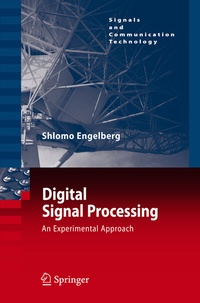
Digital Signal Processing
Description

A rigorous but accessible treatment of the subject intertwining theoretical techniques with hands-on laboratory instruction and divided into three parts, this book covers various aspects of the digital signal processing (DSP) "problem". It begins with analysis of discrete-time signals explaining sampling and the use of Fourier transforms. The second part of the book covering digital-analog and analog-digital conversion provides a practical interlude before Part III lays out the development of the z-transform and the pros and cons of finite and infinite impulse response filters.
MATLAB ® is employed to visualise the mathematics underlying this discipline, making clear its engineering relevance. The practical microprocessor-oriented parts of the book are introduced with special reference to the ADuC841, an lab manual for which is available. These labs can be transposed for other microprocessors. Problems are provided at the end of each chapter and an electronic solutions manual is available for tutors.
Reviews / Votes
From the reviews:
"The novelty of this book lies in providing the student the subsequent transforms in DSP in a concise manner, in an experimental way by a large use of MATLAB and SIMULINK. . The book is accessible to students familiar with the main facts from a Signals-and-Systems course." (Dumitru Stanomir, Zentralblatt MATH, Vol. 1141, 2008)
More details
Other editions
Additional editions