

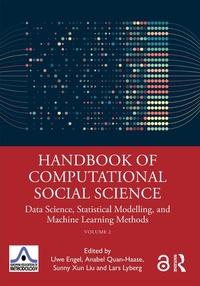
Handbook of Computational Social Science, Volume 2
Data Science, Statistical Modelling, and Machine Learning Methods
1st Edition
Published on 10. November 2021
434 pages
978-1-000-44862-7 (ISBN)
Description

The Handbook of Computational Social Science is a comprehensive reference source for scholars across multiple disciplines. It outlines key debates in the field, showcasing novel statistical modeling and machine learning methods, and draws from specific case studies to demonstrate the opportunities and challenges in CSS approaches.
The Handbook is divided into two volumes written by outstanding, internationally renowned scholars in the field. This second volume focuses on foundations and advances in data science, statistical modeling, and machine learning. It covers a range of key issues, including the management of big data in terms of record linkage, streaming, and missing data. Machine learning, agent-based and statistical modeling, as well as data quality in relation to digital trace and textual data, as well as probability, non-probability, and crowdsourced samples represent further foci. The volume not only makes major contributions to the consolidation of this growing research field, but also encourages growth into new directions.
With its broad coverage of perspectives (theoretical, methodological, computational), international scope, and interdisciplinary approach, this important resource is integral reading for advanced undergraduates, postgraduates, and researchers engaging with computational methods across the social sciences, as well as those within the scientific and engineering sectors.
The Handbook is divided into two volumes written by outstanding, internationally renowned scholars in the field. This second volume focuses on foundations and advances in data science, statistical modeling, and machine learning. It covers a range of key issues, including the management of big data in terms of record linkage, streaming, and missing data. Machine learning, agent-based and statistical modeling, as well as data quality in relation to digital trace and textual data, as well as probability, non-probability, and crowdsourced samples represent further foci. The volume not only makes major contributions to the consolidation of this growing research field, but also encourages growth into new directions.
With its broad coverage of perspectives (theoretical, methodological, computational), international scope, and interdisciplinary approach, this important resource is integral reading for advanced undergraduates, postgraduates, and researchers engaging with computational methods across the social sciences, as well as those within the scientific and engineering sectors.
More details
Series
Edition
1. Auflage
Language
English
Place of publication
London
United Kingdom
Publishing group
Taylor & Francis Ltd
Target group
College/higher education
Professional and scholarly
Product notice
Reflowable
Illustrations
33 Tables, black and white; 102 Line drawings, black and white; 102 Illustrations, black and white
ISBN-13
978-1-000-44862-7 (9781000448627)
Copyright in bibliographic data and cover images is held by Nielsen Book Services Limited or by the publishers or by their respective licensors: all rights reserved.
Schweitzer Classification
Other editions
Additional editions
Uwe Engel | Anabel Quan-Haase | Sunny Liu
Handbook of Computational Social Science, Volume 2
Data Science, Statistical Modelling, and Machine Learning Methods
Book
11/2021
1st Edition
Routledge
€86.90
Shipment within 10-20 days

Uwe Engel | Anabel Quan-Haase | Sunny Liu
Handbook of Computational Social Science, Volume 2
Data Science, Statistical Modelling, and Machine Learning Methods
Book
11/2021
1st Edition
Routledge
€263.40
Shipment within 15-20 days
Persons
Uwe Engel is Professor at the University of Bremen, Germany, where he held a chair in sociology from 2000 to 2020. From 2008 to 2013, Dr. Engel coordinated the Priority Programme on "Survey Methodology" of the German Research Foundation. His current research focuses on data science, human-robot interaction, and opinion dynamics.
Anabel Quan-Haase is Professor of Sociology and Information and Media Studies at Western University and Director of the SocioDigital Media Lab, London, Canada. Her research interests include social media, social networks, life course, social capital, computational social science, and digital inequality/inclusion.
Sunny Xun Liu is a research scientist at Stanford Social Media Lab, USA. Her research focuses on the social and psychological effects of social media and AI, social media and well-being, and how the design of social robots impact psychological perceptions.
Lars Lyberg was Head of the Research and Development Department at Statistics Sweden and Professor at Stockholm University. He was an elected member of the International Statistical Institute. In 2018, he received the AAPOR Award for Exceptionally Distinguished Achievement.
Anabel Quan-Haase is Professor of Sociology and Information and Media Studies at Western University and Director of the SocioDigital Media Lab, London, Canada. Her research interests include social media, social networks, life course, social capital, computational social science, and digital inequality/inclusion.
Sunny Xun Liu is a research scientist at Stanford Social Media Lab, USA. Her research focuses on the social and psychological effects of social media and AI, social media and well-being, and how the design of social robots impact psychological perceptions.
Lars Lyberg was Head of the Research and Development Department at Statistics Sweden and Professor at Stockholm University. He was an elected member of the International Statistical Institute. In 2018, he received the AAPOR Award for Exceptionally Distinguished Achievement.
Content
Preface
Introduction to the Handbook of Computational Social Science
Uwe Engel, Anabel Quan-Haase, Sunny Xun Liu and Lars Lyberg
Section I. Data in CSS: Collection, Management, and Cleaning
A Brief History of APIs: Limitations and Opportunities for Online Research
Jakob Juenger
Application Programming Interfaces and Web Data For Social Research
Dominic Nyhuis
Web Data Mining: Collecting Textual Data from Web Pages Using R
Stefan Bosse, Lena Dahlhaus and Uwe Engel
Analyzing Data Streams for Social Scientists
Lianne Ippel, Maurits Kaptein and Jeroen Vermunt
Handling Missing Data in Large Data Bases
Martin Spiess and Thomas Augustin
A Primer on Probabilistic Record Linkage
Ted Enamorado
Reproducibility and Principled Data Processing
John McLevey, Pierson Browne and Tyler Crick
Section II. Data Quality in CSS Research
Applying a Total Error Framework for Digital Traces to Social Media Research
Indira Sen, Fabian Floeck, Katrin Weller, Bernd Weiss and Claudia Wagner
Crowdsourcing in Observational and Experimental Research
Camilla Zallot, Gabriele Paolacci, Jesse Chandler and Itay Sisso
Inference from Probability and Nonprobability Samples
Rebecca Andridge and Richard Valliant
Challenges of Online Non-Probability Surveys
Jelke Bethlehem
Section III. Statistical Modelling and Simulation
Large-scale Agent-based Simulation and Crowd Sensing with Mobile Agents
Stefan Bosse
Agent-based Modelling for Cultural Networks: Tagging by Artificial Intelligent Cultural Agents
Fernando Sancho-Caparrini and Juan Luis Suarez
Using Subgroup Discovery and Latent Growth Curve Modeling to Identify Unusual Developmental Trajectories
Axel Mayer, Christoph Kiefer, Benedikt Langenberg and Florian Lemmerich
Disaggregation via Gaussian Regression for Robust Analysis of Heterogeneous Data
Nazanin Alipourfard, Keith Burghardt and Kristina Lerman
Section IV: Machine Learning Methods
Machine Learning Methods for Computational Social Science
Richard D. De Veaux and Adam Eck
Principal Component Analysis
Andreas Poege and Jost Reinecke
Unsupervised Methods: Clustering Methods
Johann Bacher, Andreas Poege and Knut Wenzig
Text Mining and Topic Modeling
Raphael H. Heiberger and Sebastian Munoz-Najar Galvez
From Frequency Counts to Contextualized Word Embeddings: The Saussurean Turn in Automatic Content Analysis
Gregor Wiedemann and Cornelia Fedtke
Automated Video Analysis for Social Science Research
Dominic Nyhuis, Tobias Ringwald, Oliver Rittmann, Thomas Gschwend and Rainer Stiefelhagen
Introduction to the Handbook of Computational Social Science
Uwe Engel, Anabel Quan-Haase, Sunny Xun Liu and Lars Lyberg
Section I. Data in CSS: Collection, Management, and Cleaning
A Brief History of APIs: Limitations and Opportunities for Online Research
Jakob Juenger
Application Programming Interfaces and Web Data For Social Research
Dominic Nyhuis
Web Data Mining: Collecting Textual Data from Web Pages Using R
Stefan Bosse, Lena Dahlhaus and Uwe Engel
Analyzing Data Streams for Social Scientists
Lianne Ippel, Maurits Kaptein and Jeroen Vermunt
Handling Missing Data in Large Data Bases
Martin Spiess and Thomas Augustin
A Primer on Probabilistic Record Linkage
Ted Enamorado
Reproducibility and Principled Data Processing
John McLevey, Pierson Browne and Tyler Crick
Section II. Data Quality in CSS Research
Applying a Total Error Framework for Digital Traces to Social Media Research
Indira Sen, Fabian Floeck, Katrin Weller, Bernd Weiss and Claudia Wagner
Crowdsourcing in Observational and Experimental Research
Camilla Zallot, Gabriele Paolacci, Jesse Chandler and Itay Sisso
Inference from Probability and Nonprobability Samples
Rebecca Andridge and Richard Valliant
Challenges of Online Non-Probability Surveys
Jelke Bethlehem
Section III. Statistical Modelling and Simulation
Large-scale Agent-based Simulation and Crowd Sensing with Mobile Agents
Stefan Bosse
Agent-based Modelling for Cultural Networks: Tagging by Artificial Intelligent Cultural Agents
Fernando Sancho-Caparrini and Juan Luis Suarez
Using Subgroup Discovery and Latent Growth Curve Modeling to Identify Unusual Developmental Trajectories
Axel Mayer, Christoph Kiefer, Benedikt Langenberg and Florian Lemmerich
Disaggregation via Gaussian Regression for Robust Analysis of Heterogeneous Data
Nazanin Alipourfard, Keith Burghardt and Kristina Lerman
Section IV: Machine Learning Methods
Machine Learning Methods for Computational Social Science
Richard D. De Veaux and Adam Eck
Principal Component Analysis
Andreas Poege and Jost Reinecke
Unsupervised Methods: Clustering Methods
Johann Bacher, Andreas Poege and Knut Wenzig
Text Mining and Topic Modeling
Raphael H. Heiberger and Sebastian Munoz-Najar Galvez
From Frequency Counts to Contextualized Word Embeddings: The Saussurean Turn in Automatic Content Analysis
Gregor Wiedemann and Cornelia Fedtke
Automated Video Analysis for Social Science Research
Dominic Nyhuis, Tobias Ringwald, Oliver Rittmann, Thomas Gschwend and Rainer Stiefelhagen
