

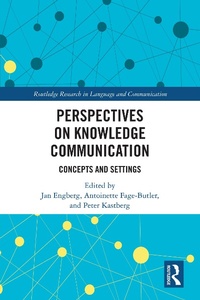
Perspectives on Knowledge Communication
Concepts and Settings
1st Edition
Published on 25. August 2023
262 pages
978-1-000-91613-3 (ISBN)
Description

This collection elaborates an innovative analytical framework for knowledge communication, bringing together insights from a range of professional settings to highlight how a cross-disciplinary approach can promote a new view of knowledge that emphasizes constructivist and cognitivist perspectives.
The volume seeks to draw connections between different disciplines' traditionally disparate studies of knowledge communication, defined here as the communication of domain knowledge between experts of the same discipline, experts of different disciplines, or non-experts with an interest in developing expert knowledge. Featuring work from scholars across linguistics, corporate communication, and sociology on diverse professional environments, chapters focus on one of three central aspects in the communication of expert knowledge: the textual carrier of the interaction, the roles and relationships between parties in these interactions, and the contexts in which the texts and communication occur. Taken together, the collection elucidates the value of an approach that supposes that expertise is co-created in interaction under the conditions of human cognitive systems and that knowledge asymmetries can offer both challenges and opportunities to better understand and generate new forms of communication and specialized knowledge.
This book will be of interest to scholars interested in language and communication, professional communication, organizational communication, and sociology of knowledge.
The volume seeks to draw connections between different disciplines' traditionally disparate studies of knowledge communication, defined here as the communication of domain knowledge between experts of the same discipline, experts of different disciplines, or non-experts with an interest in developing expert knowledge. Featuring work from scholars across linguistics, corporate communication, and sociology on diverse professional environments, chapters focus on one of three central aspects in the communication of expert knowledge: the textual carrier of the interaction, the roles and relationships between parties in these interactions, and the contexts in which the texts and communication occur. Taken together, the collection elucidates the value of an approach that supposes that expertise is co-created in interaction under the conditions of human cognitive systems and that knowledge asymmetries can offer both challenges and opportunities to better understand and generate new forms of communication and specialized knowledge.
This book will be of interest to scholars interested in language and communication, professional communication, organizational communication, and sociology of knowledge.
More details
Series
Edition
1. Auflage
Language
English
Place of publication
London
United Kingdom
Publishing group
Taylor & Francis Ltd
Target group
College/higher education
Illustrations
12 Tables, black and white; 11 Line drawings, black and white; 9 Halftones, black and white; 20 Illustrations, black and white
ISBN-13
978-1-000-91613-3 (9781000916133)
Copyright in bibliographic data and cover images is held by Nielsen Book Services Limited or by the publishers or by their respective licensors: all rights reserved.
Schweitzer Classification
Other editions
Additional editions
Jan Engberg | Antoinette Fage-Butler | Peter Kastberg
Perspectives on Knowledge Communication
Concepts and Settings
Book
12/2024
1st Edition
Routledge
€63.40
Shipment within 10-20 days
Jan Engberg | Antoinette Fage-Butler | Peter Kastberg
Perspectives on Knowledge Communication
Concepts and Settings
Book
08/2023
1st Edition
Routledge
€196.40
Shipment within 10-20 days
Persons
Jan Engberg is Professor of Knowledge Communication at the School of Communication and Culture, Section of German Business Communication, Aarhus University, Denmark. His main research interests are the study of texts and genres in the academic field, cognitive aspects of domain-specific discourse, and the relations between specialized knowledge and text formulation as well as basic aspects of communication in domain-specific settings. His research is focused upon communication, translation, and meaning in the field of law.
Antoinette Fage-Butler is Associate Professor at the Department of English, School of Communication and Culture, where she gained her PhD in Knowledge Communication. Her research interests lie primarily in discursive and cultural aspects of knowledge communication, with particular focus on the communication of risk and trust between authorities and the public. She is currently Principal Investigator of the (Mis)trust of Scientific Expertise research project at Aarhus University, Denmark.
Peter Kastberg is a full professor of organizational communication and the founding director of the Communicating Organizations research group at the Faculty of the Humanities, Aalborg University, Denmark. He is the founder and main organizer of the Dark Side conference series. He holds a BA and an MA degree in International Business Communication as well as a PhD in Applied Linguistics/Technical Communication. Among his current research interests are philosophy of communication, communication theory, as well as critical organizational communication.
Antoinette Fage-Butler is Associate Professor at the Department of English, School of Communication and Culture, where she gained her PhD in Knowledge Communication. Her research interests lie primarily in discursive and cultural aspects of knowledge communication, with particular focus on the communication of risk and trust between authorities and the public. She is currently Principal Investigator of the (Mis)trust of Scientific Expertise research project at Aarhus University, Denmark.
Peter Kastberg is a full professor of organizational communication and the founding director of the Communicating Organizations research group at the Faculty of the Humanities, Aalborg University, Denmark. He is the founder and main organizer of the Dark Side conference series. He holds a BA and an MA degree in International Business Communication as well as a PhD in Applied Linguistics/Technical Communication. Among his current research interests are philosophy of communication, communication theory, as well as critical organizational communication.
Content
List of Contributors
0 Jan Engberg / Antoinette Fage-Butler / Peter Kastberg: Introduction
1 Carmen Heine: Research methods to investigate knowledge types in professional text production
2 Alexander Holste: Knowledge Communication as an Imitation Game: About Conceptual and Empirical Boundaries of Co-Construction in Human-bot Interaction
3 Jan Engberg / Carmen Daniela Maier: The dynamics of knowledge and expertise in social media interactions: Knowledge types, processes of co-constructing knowledge and discursive reactions
4 Mia Thyregod Rasmussen: Communication Network Roles as Knowledge Communicative Positions
5 Ushma Chauhan Jacobsen: Knowledge Asymmetry, and Corvus Corax in Greenland/Denmark: Locating method
6 Peter Kastberg: Modelling Knowledge Communication as Co-Actional Communication
7 Antoinette Fage-Butler: Knowledge communication during the pandemic: Constructing the emergent knowledge of COVID-19 on Danish institutional webpages
8 Helle Dam Jensen / Anja Krogsgaard Vesterager: Students' activation, construction, and use of knowledge
9 Sae Oshima: Knowledge Work of Professional Clients
10 Christiane Zehrer: Knowledge Communication in Interdisciplinary Settings: Ontological Solutions and Conceptual Challenges
11 Klarissa Lueg / Jens Rennstam: How knowledge moves across social fields: a conceptual illustration of the antenarrative field of economic degrowth thinking
12 Patrizia Anesa: Language and Law in the Post-disciplinary Landscape: A Knowledge Communication Perspective
0 Jan Engberg / Antoinette Fage-Butler / Peter Kastberg: Introduction
1 Carmen Heine: Research methods to investigate knowledge types in professional text production
2 Alexander Holste: Knowledge Communication as an Imitation Game: About Conceptual and Empirical Boundaries of Co-Construction in Human-bot Interaction
3 Jan Engberg / Carmen Daniela Maier: The dynamics of knowledge and expertise in social media interactions: Knowledge types, processes of co-constructing knowledge and discursive reactions
4 Mia Thyregod Rasmussen: Communication Network Roles as Knowledge Communicative Positions
5 Ushma Chauhan Jacobsen: Knowledge Asymmetry, and Corvus Corax in Greenland/Denmark: Locating method
6 Peter Kastberg: Modelling Knowledge Communication as Co-Actional Communication
7 Antoinette Fage-Butler: Knowledge communication during the pandemic: Constructing the emergent knowledge of COVID-19 on Danish institutional webpages
8 Helle Dam Jensen / Anja Krogsgaard Vesterager: Students' activation, construction, and use of knowledge
9 Sae Oshima: Knowledge Work of Professional Clients
10 Christiane Zehrer: Knowledge Communication in Interdisciplinary Settings: Ontological Solutions and Conceptual Challenges
11 Klarissa Lueg / Jens Rennstam: How knowledge moves across social fields: a conceptual illustration of the antenarrative field of economic degrowth thinking
12 Patrizia Anesa: Language and Law in the Post-disciplinary Landscape: A Knowledge Communication Perspective
