

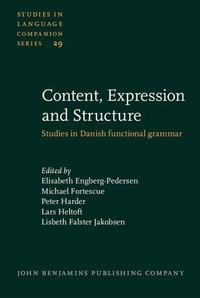
Content, Expression and Structure
Studies in Danish functional grammar
1st Edition
Published on 24. May 1996
XVI, 510 pages
978-90-272-8201-9 (ISBN)
Description

This collection of papers offers an alternative to mainstream functional linguistics on two points. Especially in American linguistics, function and structure are often viewed almost as polar opposites; in addition, structure is often understood as being only a matter of linguistic form - or expression - as opposed to content. The book tries to illustrate why function and structure must be understood as mutually dependent in relation to language - and why the most interesting aspect of language structure is the way it structures the content side of language. In this, the book represents a reaffirmation of traditional concerns in structural linguistics, especially with respect to the structural integrity of individual languages - but with a reversal of traditional priority: structure is not autonomous, but must be understood on the basis of function. Without being hostile to typological and universal generalizations, the articles suggest that similarities between languages can only be responsibly discussed on the basis of an understanding that includes a respect for language differences.
The book contains discussions of a number of different languages including Nahuatl, Danish Sign Language, French, and Tlapanec, and focuses on the way meaning is organized in the grammar of Danish. A final section sums up theoretical perspectives.
The book contains discussions of a number of different languages including Nahuatl, Danish Sign Language, French, and Tlapanec, and focuses on the way meaning is organized in the grammar of Danish. A final section sums up theoretical perspectives.
More details
Other editions
Additional editions
Elisabeth Engberg-Pedersen | Michael Fortescue | Peter Harder
Content, Expression and Structure
Studies in Danish functional grammar
Book
05/1996
John Benjamins Publishing Co
€143.10
Shipment within 10-15 days
Persons
Content
- CONTENT, EXPRESSION AND STRUCTURE STUDIES IN DANISH FUNCTIONAL GRAMMAR
- Editorial page
- Title page
- Copyright page
- Table of contents
- Introduction
- Notes
- References
- Is there a passive in Nahuatl?
- 1. Introduction
- 2. The situation in Nahuatl from the 16th century
- 3. Constructions traditionally called impersonals and passives
- 4. Conclusion
- References
- Grammaticalized focus in Yukagir. Is it really grammaticalized and is it really focus?
- 1. Introduction
- 2. The focus system of Tundra Yukagir
- 3. A closer look at 'verb focus' in Tundra Yukagir
- 5. Fitting Yukagir into the FG framework
- 6. The grammaticalization of pragmatic functions
- Notes
- Abbreviations
- References
- Iconic motivations in conflict. Language-specific structure and influence from the medium
- 1. Introduction
- 2. Signed languages as languages and the use of space in signing
- 3. Agreement in Danish Sign Language
- 4. The category of person in signed pronouns
- 5. Shifted reference, shifted attribution of expressive elements, and shifted locus
- 6. Generational differences in the use of locus-modified verbs
- 7. Competing factors
- 8. Equivalents in spoken languages
- 9. Iconicity, expressive means, and language-specific structure
- Notes
- References
- The syntax of Danish verbs. Lexical and syntactic transitivity
- 1. Introduction
- 2. The Danish verb lexicon
- 3. Danish clause structures and verb classes
- 4. Conclusion
- Notes
- References
- From lexical potential to syntactic realization. A Danish verb valency model
- 1. Introduction
- 2. The paradigmatic content potential of verbal lexemes
- 3. Valency: the syntagmatic potential of verbal lexemes
- 4. The relation between content and expression valency
- 5. Sentence structure
- 6. Conclusion
- Notes
- References
- Danish directional adverbs. Content syntax and complex predicates: A case for host and co-predicates
- 1. Introduction
- 2. Morphology: expression and content
- 3. Unit accentuation and complex predicate meanings
- 4. The structural category of 'predicatives' in Danish: dependency and topology
- 5. Perspectives and problems with the co-predicate analysis
- 6. Content-syntactic relations in motion verb constructions
- 7. The relation between adverb and prepositional phrase
- 8. A summary of semantic choices and relations
- Notes
- References
- Danish passives andsubjectpositions as a mood system. A content analysis
- 1. Introduction
- 2. Mood in Danish
- 3. The linear coding systems of Danish
- 4. Mood as a paradigm in Danish
- 5. Linear expression of mood and information structure
- 6. A final perspective
- Notes
- References
- Sources
- Informationstructure and the anatomy of noun phrases. The expression of subject and object in Danish noun phrases
- 1. Introduction
- 2. Pragmatic constraints determining the content of theme and rheme
- 3. Lexico-syntactic constraints on the position of subject and object
- 4. Conclusion
- Notes
- References
- Corpus
- Topiccontinuity and prosody. An experimental study in Danish
- 1. Introduction
- 2. Pronouns, reference-tracking, and prosody in Danish
- 3. Topic continuity and prosody
- 4. Topic identification and potential interference
- 5. Experimental setup and results
- Notes
- Appendix
- References
- Discourse particles in Danish
- 1. Introduction
- 2. Discourse markers
- 3. Polyphony
- 4. Grammaticalization
- 5. Modality
- 6. Scope
- 7. Combinations of particles
- 8. Conclusion
- Acknowledgment
- Notes
- References
- Sources
- Eh bien: Markerof comparison and contrast
- 1. Introduction
- 2. Previous descriptions
- 3. The function of eh bien in spoken discourse
- 4. Conclusion
- Notes
- References
- Sources
- The degrammaticalization of agentivity in Tlapanec
- 1. Introduction
- 2. Tlapanec and the theory and typology of agentivity
- 3. Agentivity in Tlapanec as a grammatical feature
- 4. The degrammaticalization of agentivity
- 5. Conclusion
- Notes
- References
- The functions of locative prepositions
- 1. Introduction
- 2. Conceptual functions
- 3. Communicative functions
- 4. A simple formalization
- Notes
- References
- Communicative function and language-specific structure in second language acquisition. A discussion of natural sequences of acquisition
- 1. Formalism and functionalism in second language acquisition
- 2. The acquisition of inversion
- 3. The acquisition of negation
- 4. The need for a functional approach in SLA
- Notes
- References
- Theoretical considerations
- Linguistic structure in a functional grammar
- 1. Structure and the ontological hierarchy
- 2. What is 'function'?
- 3. Function-based structure
- 4. Saussurean structuralism: a revised proposal
- 5. Langue and parole as a theory of institutions
- 6. The basic relations: expression vs. content, form vs. substance and syntagmatic vs. paradigmatic relations
- 7. Content in syntax: why an architecture based on content and expression should replace the tripartition into phonology, syntax and semantics
- 8. Two-sided syntax vs. underlying-to-surface description
- 9. Function and cognition in language
- 10. Arbitrariness and iconicity in language
- References
- Iconicity and arbitrariness
- 1. Saussure on arbitrariness and motivation
- 2. Peirce on iconicity
- 3. Linguistic diagrams and structure
- 4. Imaginai diagrams and diagrams based on analogy
- 5. Paradigmatic isomorphism
- 6. Conclusion
- Notes
- References
- Paradigmaticstructure, word order and grammaticalization
- 1. Overview
- 2. A wider concept of grammaticalization
- 3. The concept of a paradigm
- 4. Defining grammaticalization
- 5. Parameters of grammaticalization and the concept of a paradigm
- 6. The need for content analysis of paradigms
- 7. Functional explanations and content form
- 9. Synchronic and diachronic confusions in content analysis
- 10. Grammaticalization - synchrony and diachrony
- 11. Grammaticalization: generalization, reanalysis and content form
- 12. Conclusion
- Notes
- References
- Subject index
- Index of names
