

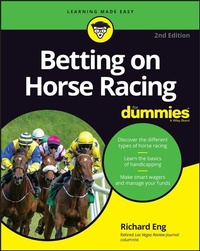
Betting on Horse Racing For Dummies
Description

* Learn about the different types of horse racing
* Discover and identify the best racing breeds
* Know your jockeys and trainers
* Make smart wagers and manage your funds
For beginning betters, Betting on Horse Racing For Dummies is your ticket to well informed wagers and a winning edge. Already know the ropes? You'll love the market trends and insider tips you'll find inside.
More details
Other editions
Additional editions
Person
Content
Part 1: And They're Off! Horse Racing and the Betting Scene 5
Chapter 1: Playing the Ponies for Pleasure and Profit 7
Chapter 2: All Horse Races Are Not Created Equal 15
Chapter 3: Getting a Handle on Parimutuel Wagering 29
Chapter 4: The Skinny on Betting 39
Chapter 5: Visiting the Racetrack 55
Part 2: How the Players and Factors Impact the Race 71
Chapter 6: Studying Horses in the Paddock and During the Post-Parade 73
Chapter 7: Riders up: The Importance of a Jockey 81
Chapter 8: Trainers and Owners: Calling the Shots 93
Chapter 9: Knowing the Track Surface and Conditions 103
Chapter 10: Zeroing In on Equipment Changes 119
Part 3: Gaining a Competitive Edge 131
Chapter 11: The Daily Racing Form: America's Turf Authority 133
Chapter 12: Trying Your Hand at Handicapping 147
Chapter 13: Planning Your Wagers 169
Chapter 14: Making the Most of Your Bankroll 175
Part 4: Risky Business: Tackling More Advanced Bets 185
Chapter 15: Betting Exotic Wagers 187
Chapter 16: Getting Into Sophisticated Handicapping 209
Chapter 17: Handicapping Tournaments 227
Chapter 18: The Race for the Triple Crown 237
Part 5: Playing Different Ponies and Different Venues 249
Chapter 19: Harness Racing: It Will Drive You Wild 251
Chapter 20: American Quarter Horse Racing: Don't Blink, or You'll Miss It 267
Chapter 21: Visiting Your Local OTB: Off-Track Betting 273
Chapter 22: Betting From Home 281
Chapter 23: Viva Las Vegas 295
Part 6: The Part of Tens 307
Chapter 24: Ten Best Racetracks to Visit 309
Chapter 25: Ten Best Track Announcers of All Time 317
Chapter 26: Ten Best Horse-Racing Movies 323
Appendix: A Glossary of Horse Racing Lingo 329
Index 339
Chapter 1
Playing the Ponies for Pleasure and Profit
IN THIS CHAPTER
Understanding the kinds of horse racing
Handicapping the races
Eliminating losers and shaping the race
Managing your money
Deciding where to bet
Horse racing is the most unique of spectator sports. In the "ball" sports, you spend hundreds, if not thousands, of dollars for good seats to a game. Then you sit and root for your team, which mostly consists of millionaire athletes, many of whom earn more money in one game than most Americans will make in a calendar year.
I'd rather take my $500 to $1,000 to the racetrack and really get my money's worth. You can go practically anywhere you want at the track, with few exceptions. You decide on your own level of involvement. A $2 bettor is just as welcome as a $1,000 bettor.
In this chapter, I introduce many horseracing elements, such as the types of horse racing, the parimutuel betting system, how to bet, and how racetracks are laid out. A visit to a racetrack can be a full day of enjoyment, so let's get started.
Differentiating the Types of Horse Racing
Horses have been part of our culture long before America was even a country. Where do you think the automotive term horsepower came from? That's right: Everybody used to own and ride a horse. So, what better measure of the power of an automobile engine was there than horsepower? Also, before there were tractors, horses pulled the plows on farms.
In this book, I touch on four types of horse racing, each of which has broad appeal to all kinds of horse lovers:
- Thoroughbred racing: By far, this form of racing is the most popular in the United States and throughout the world. When you think of horse racing in America, these Thoroughbred races likely come to mind: the Triple Crown and the Breeders' Cup. Most of this book focuses on Thoroughbreds.
- Steeplechase racing: For pure majesty, there's nothing like watching a steeplechase race. The Thoroughbred horses who compete have been trained to jump fences and/or hurdles in long-distance races.
- Standardbred or harness racing: In these styles of racing, a driver sits behind the horse in a cart called a sulky. The driver doesn't perch atop the horse like a jockey in Thoroughbred racing. Chapter 19 is devoted to harness racing.
- Quarter Horse racing: These horses are known for their breakneck speed out of the starting gate. The distances are typically100-870 yards. Chapter 20 introduces this type of racing.
Before You Bet: Handicapping the Races
Don't let anyone tell you that betting on horse racing is sheer luck. Sure, betting on your favorite number, name, or color may randomly win you a race, but that result falls into the category of blind luck. When it comes to horseracing handicapping, using your brains will help you win a lot more consistently than randomly sticking a pin into the Daily Racing Form.
Handicapping is the art and science of picking winners. There are many ways to do it, but whereas some people flip coins, throw darts, or rub a rabbit's foot, I prefer a more cerebral method.
Information is power in this sport. Unsurprisingly, the harder you work, the luckier you get. The most popular handicapping tool is the Daily Racing Form (DRF) - the industry's daily newspaper, known mostly for listing the past performances of the horses racing that day. The DRF also provides independent editorial copy and lots of free handicapping. Most horseplayers buy the DRF the night before the races to do their handicapping, so when they get to the track, they're prepared and ready to go.
Handicapping is complex and something you can't pick up fast. If you're new to the game, head to Chapters 11 and 12 for some basics. After you get comfortable, you can try the more-advanced methods discussed in Chapter 16.
Eliminating losers and developing the race shape
When I begin handicapping in the DRF, the first thing I don't do is go through the races and try to pick winners. Instead, I go through the races and eliminate the losers. The losers are those horses I think are too slow, overmatched classwise, or out of physical form to win that day's race. I'm probably right about those slowpokes about 95 percent of the time. Eliminating losers creates a smaller pool of horses I consider the primary contenders to win the race.
It's essential to visualize what I call the race shape. I start by breaking down the pace of the race, which means identifying each horse's running style. I divide running styles into three categories:
- Speedballs:Speedballs go right to the lead at the start of a race. This is where the often-used term frontrunner comes from - to be in front early.
- Pace horses:Pace horses have what I categorize as tactical speed. They're not fast enough to fight for the early lead, but they don't really want to either. Instead, the pace horse's jockey settles into a stalking position a few lengths behind the early leaders, waiting to overtake the leader(s).
- Dead-late closers:Dead-late closers have no early speed at all; they fall to the back half of the field and make their move at the end of the race.
With this knowledge, you can determine the race shape - your projection of how a race will run. Multiple speedballs usually mean the early pace will be fast and contested, which could create opportunities for the pace horses and dead-late closers. Betting on a lone speedball in a race is among the best bets in horse racing.
Another key factor to take into account is the class of each horse. Class is something a horse has in its head and heart; you'll know it when you see it. A clearer class distinction can be identified by looking at how the horse has been racing lately. A cheaper claiming horse won't have the same class as an allowance horse or a stakes horse. (I cover the class and classification of horse races in Chapter 2.)
Taking all factors into account
Winning a horse race is a team effort. Granted, the horse does nearly all the work, but when you handicap a horse, you need to consider the humans behind the animal: the owner, trainer, jockey, groom, exercise rider, and so on. (For more information on these people, see chapters 7 and 8.)
Publications like the DRF, racetrack programs, and websites such as DRF (https://www.drf.com) and Equibase (https://www.equibase.com) provide invaluable statistics for your handicapping, as well as interesting statistical breakdowns on the jockeys and trainers. Equipment changes are noted, such as blinkers on/off, with/without Lasix, and front bandages on/off. When a trainer makes a change, they're trying to improve a horse's performance; thus, you can view a change as a positive move. (Chapter 10 covers all kinds of equipment changes.)
In addition, you'll see the distances and track conditions (dirt, grass, or synthetic) in a horse's past races. For example, some horses run well only on dirt, while others run well only on grass. Some horses run well on all three surfaces. (See Chapter 9 for more on track surfaces and conditions.)
Betting with success
Horse-race betting is a lot different from sports betting. The most common sports bet is on the outcome of a single game, and the most common odds on a single game are 11/10, which means you bet $11 to profit $10. If your sports bet wins, you collect $21.
In horse racing, that sports bet is comparable to a win bet on a horse. In horse racing, your odds can be a lot higher than 11/10. Suppose you bet $10 to win on a horse with 4/1 win odds. If your horse wins, you will collect $50. Horse racing offers more opportunities to "bet a little to win a lot" than sports betting.
One term you'll repeatedly hear in horse racing - overlays - refers to one of the simplest and most profitable ways to win in the long run. An overlay is a horse whose win odds are higher than its real odds of winning the race. Over the long run, betting on overlays versus the race favorite will give you a better chance of showing a profit.
The morning line is an odds prediction of how the public will bet the race. For example, if the track's morning line on a horse is 4/1 odds and the real-time betting odds are 8/1, placing a win bet on that horse may be worthwhile. If your local track has a competent morning-line maker, use it as a gauge. I trust the ones at the major U.S. racetracks.
Starting simply
The bet menu at a racetrack can be head-spinning, so I suggest newcomers make straight bets at first. A simple win bet or a win-and-place bet is a good way to start.
I used to subscribe to an across-the-board bet, which means betting a horse to win (finish first), place (finish second), and show (finish third). If your horse wins the race, you will collect on all three bets. But professional horseplayer Tommy Massis showed me that a show bet is an inefficient wager. In fact, Massis doesn't even bet on a horse to place; he...
