

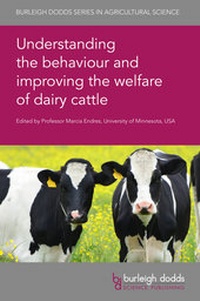
Understanding the Behaviour and Improving the Welfare of Dairy Cattle
Published on 23. February 2021
274 pages
978-1-78676-461-4 (ISBN)
Description

The welfare of farmed animals such as cattle is an increasing concern for consumers and regulatory agencies. This book explores the science behind our understanding of dairy cow behaviour and ways to improve their welfare.
Understanding the behaviour and improving the welfare of dairy cattle summarises this wealth of recent research and reviews dairy cattle behaviour in areas such as cognition, learning, pain and stress. The collection features authoritative assessments by leading experts on developments in welfare indicators, monitoring and certification, as well as approaches to improve welfare practices of calves, heifers and transition cows at different stages of production including housing, transport and slaughter.
With its distinguished author team and wide-ranging coverage, Understanding the behaviour and improving the welfare of dairy cattle will be a standard reference for university and other researchers in dairy and veterinary science as well as ethology. It will also be a key reference for government and other agencies involved in regulating and monitoring farm animal welfare, as well as dairy farmers and companies processing milk and other dairy products.
Understanding the behaviour and improving the welfare of dairy cattle summarises this wealth of recent research and reviews dairy cattle behaviour in areas such as cognition, learning, pain and stress. The collection features authoritative assessments by leading experts on developments in welfare indicators, monitoring and certification, as well as approaches to improve welfare practices of calves, heifers and transition cows at different stages of production including housing, transport and slaughter.
With its distinguished author team and wide-ranging coverage, Understanding the behaviour and improving the welfare of dairy cattle will be a standard reference for university and other researchers in dairy and veterinary science as well as ethology. It will also be a key reference for government and other agencies involved in regulating and monitoring farm animal welfare, as well as dairy farmers and companies processing milk and other dairy products.
More details
Series
Language
English
Place of publication
Cambridge
United Kingdom
Target group
Professional and scholarly
University and other researchers in dairy and veterinary science as well as ethology;government and other agencies involved in regulating and monitoring farm animal welfare;dairy farmers;companies processing milk and other dairy products
Illustrations
Color tables, photos and figures
ISBN-13
978-1-78676-461-4 (9781786764614)
DOI
10.19103/AS.2020.0084
Copyright in bibliographic data and cover images is held by Nielsen Book Services Limited or by the publishers or by their respective licensors: all rights reserved.
Schweitzer Classification
Other editions
Additional editions
Book
02/2021
Burleigh Dodds Science Publishing Limited
€229.10
Shipment within 3-4 weeks
Persons
Dr Marcia Endres is Professor of Dairy Cattle Production at the University of Minnesota, USA. She is past-President of the Dairy Cattle Welfare Council as well as Chair of the International Precision Dairy Farming Organisation. Professor Endres is internationally renowned for her research on dairy cattle welfare and the use of precision farming technology in the dairy sector.
Dr Henk Hogeveen is a Professor at Wageningen University and Research and Utrecht University, The Netherlands. He is a member of the IDF Standing Committee Animal Health and was chairman from 2008-2012. He has more than 200 peer reviewed scientific publications in highly ranked international journals and besides that many publications in scientific proceedings and trade journals. He is founder of the Association for Precision Dairy Farming and a a frequently asked speaker on conferences. Jennifer Van Os is an Assistant Professor and Extension Specialist in Animal Welfare on the faculty of the Department of Animal & Dairy Sciences at the University of Wisconsin-Madison, USA. The research in her lab at UW-Madison focuses on understanding, evaluating, and improving the welfare of dairy animals from a biological perspective.
Dr Henk Hogeveen is a Professor at Wageningen University and Research and Utrecht University, The Netherlands. He is a member of the IDF Standing Committee Animal Health and was chairman from 2008-2012. He has more than 200 peer reviewed scientific publications in highly ranked international journals and besides that many publications in scientific proceedings and trade journals. He is founder of the Association for Precision Dairy Farming and a a frequently asked speaker on conferences. Jennifer Van Os is an Assistant Professor and Extension Specialist in Animal Welfare on the faculty of the Department of Animal & Dairy Sciences at the University of Wisconsin-Madison, USA. The research in her lab at UW-Madison focuses on understanding, evaluating, and improving the welfare of dairy animals from a biological perspective.
Editor
University of Minnesota
Contributions
University of Cambridge (United Kingdom)
Swedish University of Agricultural Sciences
Leibniz Institute for Farm Animal Biology (FBN)
Scotland's Rural College (SRUC) (United Kingdom)
Scotland's Rural College (SRUC) (United Kingdom)
University of Kassel
University of Natural Resources and Life Sciences Vienna (Austria)
Universite Clermont Auvergne, INRAE, VetAgro Sup (France)
Universite Clermont Auvergne, INRAE, VetAgro Sup (France)
Content
1.Dairy cattle welfare and other aspects of sustainability: Donald M. Broom, University of Cambridge, UK;
Part 1 Understanding behaviour
2.Advances in understanding cognition and learning in cattle: Maria Vilain Rorvang, Swedish University of Agricultural Sciences, Sweden; and Christian Nawroth, Leibniz Institute for Farm Animal Biology, Germany;
3.Advances in understanding pain and stress in cows: Kenneth M. D. Rutherford and Marie J. Haskell, Scotland's Rural College (SRUC), UK;
Part 2 Welfare indicators and monitoring
4.Developing effective welfare measures for cattle: Ute Knierim, University of Kassel, Germany; Christoph Winckler, University of Natural Resources and Life Sciences Vienna, Austria; and Luc Mounier and Isabelle Veissier, Universite Clermont Auvergne, INRAE, VetAgro Sup, France;
5.Advances in precision livestock farming techniques for monitoring dairy cattle welfare: Henk Hogeveen and Mariska van der Voort, Wageningen University and Research, The Netherlands;
6.Developing effective training and certification schemes for improving on-farm dairy cattle welfare: Antoni Dalmau and Antonio Velarde, IRTA, Spain;
Part 3 Improving welfare practices
7.Developments in housing of cattle to promote health and welfare: Nigel B. Cook, University of Wisconsin-Madison, USA;
8.Advances in understanding behavioral needs and improving the welfare of calves and heifers: Emily Miller-Cushon, University of Florida, USA; and Jennifer Van Os, University of Wisconsin-Madison, USA;
9.Advances in understanding the needs and improving the welfare of transition dairy cows: Julia Lomb, University of British Columbia, Canada; and Kathryn L. Proudfoot, University of Prince Edward Island, Canada;
10.Optimizing welfare in transport and slaughter of cattle: Jan Shearer, Iowa State University, USA;
Part 1 Understanding behaviour
2.Advances in understanding cognition and learning in cattle: Maria Vilain Rorvang, Swedish University of Agricultural Sciences, Sweden; and Christian Nawroth, Leibniz Institute for Farm Animal Biology, Germany;
3.Advances in understanding pain and stress in cows: Kenneth M. D. Rutherford and Marie J. Haskell, Scotland's Rural College (SRUC), UK;
Part 2 Welfare indicators and monitoring
4.Developing effective welfare measures for cattle: Ute Knierim, University of Kassel, Germany; Christoph Winckler, University of Natural Resources and Life Sciences Vienna, Austria; and Luc Mounier and Isabelle Veissier, Universite Clermont Auvergne, INRAE, VetAgro Sup, France;
5.Advances in precision livestock farming techniques for monitoring dairy cattle welfare: Henk Hogeveen and Mariska van der Voort, Wageningen University and Research, The Netherlands;
6.Developing effective training and certification schemes for improving on-farm dairy cattle welfare: Antoni Dalmau and Antonio Velarde, IRTA, Spain;
Part 3 Improving welfare practices
7.Developments in housing of cattle to promote health and welfare: Nigel B. Cook, University of Wisconsin-Madison, USA;
8.Advances in understanding behavioral needs and improving the welfare of calves and heifers: Emily Miller-Cushon, University of Florida, USA; and Jennifer Van Os, University of Wisconsin-Madison, USA;
9.Advances in understanding the needs and improving the welfare of transition dairy cows: Julia Lomb, University of British Columbia, Canada; and Kathryn L. Proudfoot, University of Prince Edward Island, Canada;
10.Optimizing welfare in transport and slaughter of cattle: Jan Shearer, Iowa State University, USA;
