

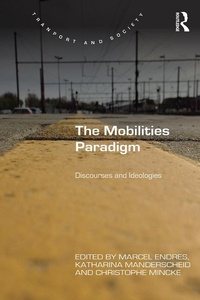
The Mobilities Paradigm
Discourses and Ideologies
Published on 12. May 2016
248 pages
978-1-317-02385-2 (ISBN)
Description

Over the last two decades, the conceptualisation and empirical analysis of mobilities of people, objects and symbols has become an important strand of social science. Yet, the increasing importance of mobilities in all parts of the social does not only happen as observable practices in the material world but also takes place against the background of changing discourses, scientific theories and conceptualisations and knowledge. Within the formation of these mobilities discourses, the social sciences constitute a relevant actor. Focussing on mobility as an object of knowledge from a Foucauldian perspective rather than a given entity within the historical contingency of movement, this book asks: How do discourses and ideologies structure the normative substance, social meanings, and the lived reality of mobilities? What are the real world effects of/on the will and the ability to be mobile? And, how do these lived realities, in turn, invigorate or interfere with certain discourses and ideologies of mobility?
Reviews / Votes
'An in-depth examination of how discourse constitutes mobilities is long overdue, and this book fills that gap in mobilities scholarship in an evocative and convincing manner. It is a must-read for scholars and students seeking to understand the power of movement and circulation across space and time.'Tim Schwanen, University of Oxford, UK
'Marcel Endres, Katharina Manderscheid and Christophe Mincke's book tackles the ideological dimension of mobility - far too often overlooked - with great finesse. It is an essential contribution to current debates in the social sciences on the role and importance of mobility in social relations.'
Vincent Kaufmann, Ecole Polytechnique Federale de Lausanne, Switzerland
More details
Series
Language
English
Place of publication
London
United Kingdom
Publishing group
Taylor & Francis Ltd
Target group
College/higher education
Product notice
Reflowable
File size
1,70 MB
ISBN-13
978-1-317-02385-2 (9781317023852)
Copyright in bibliographic data and cover images is held by Nielsen Book Services Limited or by the publishers or by their respective licensors: all rights reserved.
Schweitzer Classification
Other editions
Additional editions
Marcel Endres | Katharina Manderscheid | Christophe Mincke
The Mobilities Paradigm
Discourses and Ideologies
Book
02/2018
1st Edition
Routledge
€73.40
Shipment within 10-20 days
Marcel Endres | Katharina Manderscheid | Christophe Mincke
The Mobilities Paradigm
Discourses and Ideologies
Book
05/2016
1st Edition
Routledge
€237.70
Shipment within 10-20 days
Persons
Marcel Endres is a PhD Candidate at Darmstadt University of Technology, Germany.
Katharina Manderscheid is Lecturer at the University of Lucerne, Switzerland.
Christophe Mincke is Operational Head Criminology at the National Institute for Forensic Sciences and Criminology and Professor at the Saint-Louis University in Brussels, Belgium.
Katharina Manderscheid is Lecturer at the University of Lucerne, Switzerland.
Christophe Mincke is Operational Head Criminology at the National Institute for Forensic Sciences and Criminology and Professor at the Saint-Louis University in Brussels, Belgium.
Content
Discourses and Ideologies of Mobility - An Introduction
(Marcel Endres, Katharina Manderscheid and Christophe Mincke)
Part A: MOBILITY AND NORMATIVITY
1. From Mobility to its Ideology: when Mobility becomes an Imperative
(Christophe Mincke)
2. Identity Construction and Mobility in Pilgrims' and Travelers' Writings: Contemporary Reports about the Way of St. James and the Hippie Trail
(Frank Neubert)
3. Instrumentalising the 'Mobility Argument': Discursive Patterns in the Romanian Media
(Camelia Beciu and Mirela Lazar)
4. The Discursive Accomplishment of Rationalities in the Automobility Regime
(Laura Bang Lindegaard)
Part B: MOBILE SUBJECTS
5. Who does the move? Affirmation or de-construction of the solitary mobile subject
(Katharina Manderscheid)
6. Passengers without Havens? Discourses on the Hypermobile Subject and Self-Conceptions of Frequent Travellers
(Marcel Endres)
7. 'Inappropriate' Europeans. On Fear, Space, and Roma Mobility
(Birgitta Frello)
Part C: MOBILISED INFRASTRUCTURES
8. For the power, against the power: the political discourses of high-speed rail in Europe, the United States and China
(Ander Audikana and Zenhua Chen)
9. Small Technologies and Big Systems
(Thomas Birtchnell and John Urry)
10. From the Urban Planning Discourse to a Circulation Dispositif - An Epistemological Approach to the Mobility Turn
(Pauline Wolff)
(Marcel Endres, Katharina Manderscheid and Christophe Mincke)
Part A: MOBILITY AND NORMATIVITY
1. From Mobility to its Ideology: when Mobility becomes an Imperative
(Christophe Mincke)
2. Identity Construction and Mobility in Pilgrims' and Travelers' Writings: Contemporary Reports about the Way of St. James and the Hippie Trail
(Frank Neubert)
3. Instrumentalising the 'Mobility Argument': Discursive Patterns in the Romanian Media
(Camelia Beciu and Mirela Lazar)
4. The Discursive Accomplishment of Rationalities in the Automobility Regime
(Laura Bang Lindegaard)
Part B: MOBILE SUBJECTS
5. Who does the move? Affirmation or de-construction of the solitary mobile subject
(Katharina Manderscheid)
6. Passengers without Havens? Discourses on the Hypermobile Subject and Self-Conceptions of Frequent Travellers
(Marcel Endres)
7. 'Inappropriate' Europeans. On Fear, Space, and Roma Mobility
(Birgitta Frello)
Part C: MOBILISED INFRASTRUCTURES
8. For the power, against the power: the political discourses of high-speed rail in Europe, the United States and China
(Ander Audikana and Zenhua Chen)
9. Small Technologies and Big Systems
(Thomas Birtchnell and John Urry)
10. From the Urban Planning Discourse to a Circulation Dispositif - An Epistemological Approach to the Mobility Turn
(Pauline Wolff)
