

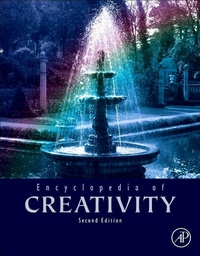
Encyclopedia of Creativity
Academic Press
2nd Edition
Published on 27. May 2011
1384 pages
978-0-12-375038-9 (ISBN)
Description

The first edition of the successful Encyclopedia of Creativity, Two Volume Set served to establish the study of creativity is a field in itself. Now completely updated and revised in its second edition, coverage encompasses the definition of creativity, the development and expression of creativity across the lifespan, the environmental conditions that encourage or discourage creativity, creativity within specific disciplines like music, dance, film, art, literature, etc., the relationship of creativity and mental health, intelligence, and learning styles, and the process of being creative. This reference also appeals to a lay audience with articles specifically on the application of creativity to business settings. Available online via ScienceDirect and in limited print release.
- Named a 2012 Outstanding Academic Title by the American Library Association's Choice publication
- Serves as a compendium of reviews of a number of domain-specific areas, such as acting, dance, expressive arts, film, food, music, religion, science, sports, theater, and writing.
- Creativity and education are examined in articles about thought processes, such as developmental trends in creative abilities and potentials, the enhancement of creativity, intelligence, knowledge, play, prodigies, programs and courses, talent and teaching creativity.
- Cognitive aspects of creativity can be investigated in articles about altered and transitional states, analogies, attention, cognitive style, divergent thinking, flow and optimal experience, metacognition, metaphors, problem-finding, problem-solving, and remote associates.
- Covers business and organizational creativity in articles about advertising with art, creative visuals, business/management, creativity coaching, creativity exercises, entrepreneurship, group dynamics, innovation, leadership, organizational culture, organizational development, teams, and training, among others.
- Explicitly examines the complex interrelationship between society and creativity in articles about awards, conformity and conventionality, the creative sector and class of society, cultural diversity, the dark side of creativity, East vs. West, networking, social psychology, war, zeitgeist, and others.
- Personal and interpersonal creativity is discussed in articles relating to collaboration, family, life stages, mentors, networking, personal creativity and self-actualization.
- Focuses on scientific information about creativity, there are also articles that discuss brain and neuropsychology, concepts of creativity, definitions of creativity, expertise, longitudinal studies, researching art, artists and art audiences, research methods, phenomenology research and qualitative research.
- Online version contains an additional 26 biographies of famously creative people
- Named a 2012 Outstanding Academic Title by the American Library Association's Choice publication
- Serves as a compendium of reviews of a number of domain-specific areas, such as acting, dance, expressive arts, film, food, music, religion, science, sports, theater, and writing.
- Creativity and education are examined in articles about thought processes, such as developmental trends in creative abilities and potentials, the enhancement of creativity, intelligence, knowledge, play, prodigies, programs and courses, talent and teaching creativity.
- Cognitive aspects of creativity can be investigated in articles about altered and transitional states, analogies, attention, cognitive style, divergent thinking, flow and optimal experience, metacognition, metaphors, problem-finding, problem-solving, and remote associates.
- Covers business and organizational creativity in articles about advertising with art, creative visuals, business/management, creativity coaching, creativity exercises, entrepreneurship, group dynamics, innovation, leadership, organizational culture, organizational development, teams, and training, among others.
- Explicitly examines the complex interrelationship between society and creativity in articles about awards, conformity and conventionality, the creative sector and class of society, cultural diversity, the dark side of creativity, East vs. West, networking, social psychology, war, zeitgeist, and others.
- Personal and interpersonal creativity is discussed in articles relating to collaboration, family, life stages, mentors, networking, personal creativity and self-actualization.
- Focuses on scientific information about creativity, there are also articles that discuss brain and neuropsychology, concepts of creativity, definitions of creativity, expertise, longitudinal studies, researching art, artists and art audiences, research methods, phenomenology research and qualitative research.
- Online version contains an additional 26 biographies of famously creative people
More details
Other editions
New editions
Mark A. Runco | Steven R. Pritzker
Encyclopedia of Creativity
E-Book
04/2020
3rd Edition
Academic Press
from
€1,420.00
Available for download
Additional editions
Book
07/2011
2nd Edition
Academic Press
€530.50
Article exhausted; check for reprint
Previous edition
Mark A. Runco | Steven R. Pritzker | Mark A. Runco
Encyclopedia of Creativity, Two-Volume Set
Two-Volume Set
E-Book
08/1999
1st Edition
Academic Press
from
€500.00
Available for download
Persons
Content
ActingAdaptation and CreativityAdvertisingAestheticsAgingAltered and Transitional StatesAnalogiesArchitecture, Modern WesternArt and AestheticsArt, Artists And Arts audiencesAssociative TheoryAsynchronicityAttentionAttitudesAttribution and CreativityAurobindo, SriAwardsBarriers to CreativityBeatlesBeethoven, LudwigBehavioral Approaches to CreativityBell, Alexander Graham*Bipolar DisorderBirth OrderBohm, DavidBrain and NeuropsychologyBronte Sisters*Business/ ManagementCassatt, MaryChaos Theory and CreativityCarroll, Lewis*Cezanne, Paul*Chaplin, CharlieChild, JuliaClaudel, CamilleCognitive Style and CreativityCollaborationComponential ModelsComputers and CreativityConcepts of Creativity: A historyConformity and ConventionalityConfusiousismConsensual AssessmentContrarianismCreative ClimateCreative Environments, Conditions, and SettingsCreative Products Creativity ComplexCreativity through HistoryCrime and CreativityCritical ThinkingCross-Cultural DifferencesCurie, Marie Sklodowska*Dance and CreativityDark Side of CreativityDarwin, Charles Robert*DaVinci, Leonardo*Definitions of CreativityDesignDevelopmental Trends in Creative Abilities and PotentialsDevianceDialectical Thinking: Implications for Creative ThinkingDineson, Isak*DiscoveryDistribution of CreativityDivergent ThinkingDiversity,CulturalDomains of CreativityDreams and CreativityEast vs.
