

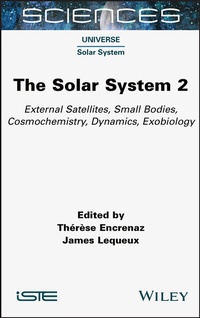
The Solar System 2
External Satellites, Small Bodies, Cosmochemistry, Dynamics, Exobiology
2nd Edition
Published on 19. November 2021
368 pages
978-1-119-88167-4 (ISBN)
Description

This book presents a global and synthetic vision of planetology - the study of objects in the Solar System. In the past several decades, planetology has undergone a real revolution, marked in particular by the discovery of the Kuiper belt beyond Neptune, the discovery of extrasolar planets, and also by the space exploration of ever more distant objects. Today, it is at the crossroads of many disciplines: astronomy, geophysics, geochemistry and biology.
The Solar System 2 studies the outer Solar System: satellites and rings of giant planets, small bodies and dwarf planets. It also deals with meteorites and cosmochemistry, as well as the formation and dynamics of the Solar System. It addresses the question of the origin of life and extraterrestrial life, and presents all of the methods in the study of planetology.
The Solar System 2 studies the outer Solar System: satellites and rings of giant planets, small bodies and dwarf planets. It also deals with meteorites and cosmochemistry, as well as the formation and dynamics of the Solar System. It addresses the question of the origin of life and extraterrestrial life, and presents all of the methods in the study of planetology.
More details
Other editions
Additional editions
Therese Encrenaz | James Lequeux
The Solar System 2
External Satellites, Small Bodies, Cosmochemistry, Dynamics, Exobiology
Book
01/2022
2nd Edition
ISTE Ltd
€164.50
Shipment within 3-4 weeks
Content
- Cover
- Half-Title Page
- Title Page
- Copyright Page
- Contents
- Preface
- 1. Satellites and Rings of the Giant Planets
- 1.1. Introduction
- 1.2. Jupiter's satellites
- 1.2.1. The Galilean satellites
- 1.2.2. The minor Jovian satellites
- 1.3. Saturn's satellites
- 1.3.1. Titan
- 1.3.2. Enceladus
- 1.3.3. The other icy satellites
- 1.3.4. Challenges for future missions in the Saturn system and Dragonfly
- 1.4. The satellites of Uranus and Neptune
- 1.4.1. The satellites of Uranus
- 1.4.2. The satellites of Neptune
- 1.4.3. Future exploration of the icy giant planets' systems
- 1.5. The rings
- 1.5.1. Tidal forces and the Roche limit
- 1.5.2. Flattening and ring dispersion
- 1.5.3. Jupiter's rings
- 1.5.4. Saturn's rings
- 1.5.5. Uranus's rings
- 1.5.6. Neptune's rings
- 1.5.7. The rings of small bodies
- 1.5.8. Ring dynamics
- 1.5.9. The origin of the rings
- 1.5.10. An exo-ring
- 1.6. References
- 2. Comets, Asteroids, and Dwarf Planets
- 2.1. Comets
- 2.1.1. Definition and nomenclature
- 2.1.2. The orbits and families of the comets
- 2.1.3. Cometary magnitude
- 2.1.4. Space exploration of the comets
- 2.1.5. The nucleus
- 2.1.6. The atmosphere
- 2.1.7. Dust and the tail
- 2.1.8. The chemical diversity of the comets: a relationship to their origins?
- 2.1.9. The interaction of comets with solar wind
- 2.2. The "historical" asteroids
- 2.2.1. The asteroids in the main belt
- 2.2.2. The asteroids that cross the orbit of the terrestrial planets
- 2.2.3. The Trojan asteroids
- 2.2.4. The properties of asteroids
- 2.3. The "new" asteroids
- 2.3.1. The Centaurs
- 2.3.2. Trans-Neptunian objects
- 2.3.3. Interstellar objects
- 2.3.4. The origin and evolution of the asteroids
- 2.4. The dwarf planets
- 2.4.1. Ceres
- 2.4.2. Pluto and its satellites
- 2.4.3. Eris, Haumea, and Makemake
- 2.5. References
- 3. Meteorites and Cosmochemistry
- 3.1. Rocks falling from the sky
- 3.2. Origin of meteorites
- 3.3. Planetary differentiation and groups of meteorites
- 3.4. Chondrites and the origin of the Solar System
- 3.4.1. The chemical composition of chondrites
- 3.4.2. The mineralogy of chondrites
- 3.4.3. The isotopic characteristics of bulk meteorites
- 3.5. Differentiated meteorites
- 3.5.1. Fragments of the asteroid Vesta
- 3.5.2. Iron meteorites
- 3.5.3. Pallasites
- 3.5.4. Fragments of the planet Mars
- 3.6. Witnesses to the formation and evolution of the Solar System
- 3.7. References
- 4. Formation and Dynamic History of the Solar System¹
- 4.1. Introduction
- 4.2. Laws of motion of the planets and satellites
- 4.2.1. Kepler's laws
- 4.2.2. Gravity
- 4.2.3. Newton's fundamental laws of dynamics
- 4.2.4. The orbital elements
- 4.3. The two-body problem
- 4.4. The three-body problem
- 4.4.1. Jacobi constant and Lagrange points
- 4.4.2. Tadpole and horseshoe orbits
- 4.4.3. Hill sphere
- 4.5. Perturbations and resonances
- 4.6. Stability and chaos in the Solar System
- 4.7. Orbits in relation to a flattened body
- 4.8. Tidal effect
- 4.8.1. Tidal deformation
- 4.8.2. Tidal torque
- 4.8.3. Roche limit
- 4.9. Nongravitational forces and orbits of small bodies
- 4.9.1. Radiation pressure (micrometer-sized grains)
- 4.9.2. Poynting-Robertson effect (small macroscopic particles)
- 4.9.3. The Yarkovsky Effect (meter to kilometer-sized particles)
- 4.9.4. Yorp torque (asymmetric bodies)
- 4.9.5. Friction from solar particles (submicrometer dust)
- 4.9.6. Friction in gas
- 4.10. Formation of planetary systems
- 4.10.1. A disk of planetoids
- 4.10.2. Formation of terrestrial planets
- 4.10.3. Formation of Jupiter
- 4.10.4. Formation of giant planets by core accretion
- 4.10.5. Formation by disk instability
- 4.10.6. Disappearance of the gas
- 4.10.7. Catastrophic collisions
- 4.10.8. Small bodies
- 4.10.9. Planetary migration
- 4.10.10. Fate of the small bodies
- 4.10.11. Exoplanetary formation
- 4.11. References
- 5. Origin of Life and Extraterrestrial Life
- 5.1. Definition of life
- 5.2. The appearance of life on Earth
- 5.2.1. Physicochemical conditions
- 5.2.2. The first forms of life
- 5.2.3. The formation of living cells
- 5.3. Life elsewhere in the Solar System
- 5.3.1. Mars
- 5.3.2. Venus
- 5.3.3. Satellites of the giant planets
- 5.4. How can life be detected on exoplanets?
- 5.5. Communicating with other civilizations?
- 5.6. References
- 6 Methods for Studying the Solar System
- 6.1. History
- 6.2. Observational techniques
- 6.2.1. Remote sensing
- 6.2.2. Methods of space exploration
- 6.2.3. Virtual Observatory and databases
- 6.2.4. Perspectives of ground-based and space observations
- 6.3. Computer simulations
- 6.3.1. Dynamics
- 6.3.2. Global climate models
- 6.4. References
- Appendix Web links
- Glossary
- List of Authors
- Index
- EULA
