

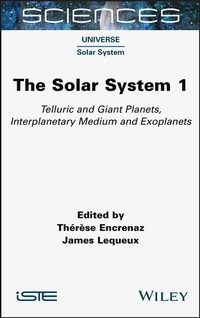
The Solar System 1
Telluric and Giant Planets
1st Edition
Published on 19. November 2021
352 pages
978-1-119-88164-3 (ISBN)
Description

This book presents a global and synthetic vision of planetology - the study of objects in the Solar System. In the past several decades, planetology has undergone a real revolution, marked in particular by the discovery of the Kuiper belt beyond Neptune, the discovery of extrasolar planets, and also by the space exploration of ever more distant objects. Today, it is at the crossroads of many disciplines: astronomy, geophysics, geochemistry and biology.
The Solar System 1 deals with the Solar System as a whole, offering a general presentation of the objects that compose it and its place in the galaxy. It also deals with planetary systems, exoplanets and the interaction of Solar System objects with interplanetary medium. Finally, it analyzes the telluric and giant planets.
The Solar System 1 deals with the Solar System as a whole, offering a general presentation of the objects that compose it and its place in the galaxy. It also deals with planetary systems, exoplanets and the interaction of Solar System objects with interplanetary medium. Finally, it analyzes the telluric and giant planets.
More details
Other editions
Additional editions
Therese Encrenaz | James Lequeux
The Solar System 1
Telluric and Giant Planets, Interplanetary Medium and Exoplanets
Book
01/2022
1st Edition
ISTE Ltd
€164.50
Shipment within 3-4 weeks
Content
- Cover
- Half-Title Page
- Title Page
- Copyright Page
- Contents
- Preface
- 1. General Presentation of the Solar System
- 1.1. Introduction
- 1.2. Mechanics and dynamics of the Solar System1
- 1.2.1. Newton's law of gravitation
- 1.2.2. Kepler's laws r
- 1.2.3. Mean motion resonances
- 1.2.4. The N-body problem
- 1.2.5. The role of collisions
- 1.2.6. Migrations in the Solar System
- 1.2.7. The role of gravity in a solid body
- 1.2.8. Special configurations of the Sun-Earth-Moon system
- 1.3. Physics of the Solar System
- 1.3.1. Equilibrium temperature of an object in the Solar System
- 1.3.2. Planets
- 1.3.3. Satellites
- 1.3.4. Small bodies of the Solar System
- 1.3.5. The interplanetary medium2
- 1.4. References
- 2 Solar and Planetary Systems
- 2.1. The Sun in the Galaxy
- 2.2. Planetary systems in the Galaxy
- 2.3. Interstellar matter¹
- 2.3.1. History
- 2.3.2. Chemical composition
- 2.3.3. Physical properties
- 2.4. The formation of stars with masses close to that of the Sun
- 2.5. Circumstellar disks
- 2.6. Formation of planetesimals and planetoids
- 2.7. The environment of the Solar System at its birth
- 2.8. Detection and properties of exoplanets and their systems
- 2.8.1. First attempts
- 2.8.2. The unexpected discovery of planets around a pulsar
- 2.8.3. Exoplanet detection methods
- 2.8.4. Some statistical results
- 2.8.5. The diversity of exoplanets
- 2.8.6. Exoplanet atmospheres
- 2.8.7. Habitable planets
- 2.8.8. Some extrasolar planetary systems
- 2.9. References
- 3 The Interaction of Solar System Bodies with the Interplanetary Medium¹
- 3.1. Interplanetary plasma: origin and properties of the solar wind
- 3.1.1. Coronal expansion
- 3.1.2. The structure of the heliosphere in the ecliptic plane
- 3.1.3. The three-dimensional structure of the heliosphere
- 3.1.4. Transient structures of the solar wind
- 3.1.5. The boundaries of the heliosphere
- 3.2. Planetary envelopes
- 3.2.1. Upper planetary atmospheres
- 3.2.2. Planetary magnetic fields
- 3.3. The solar wind's interaction with objects of the Solar System
- 3.3.1. The different types of interaction
- 3.3.2. The case of non-magnetized gaseous envelopes
- 3.3.3. The case of magnetized planets
- 3.3.4. Planetary auroral processes
- 3.4. Acknowledgements
- 3.5. References
- 4 Telluric Planets
- 4.1. The exploration of the telluric planets
- 4.1.1. From antiquity to the space age
- 4.1.2. The beginning of the space age
- 4.1.3. The return to Mars
- 4.1.4. The return to Venus
- 4.1.5. Observations from the ground
- 4.1.6. The exploration of planet Earth
- 4.1.7. Global Climatic Models
- 4.1.8. The electromagnetic spectrum of telluric planets
- 4.2. Objects without an atmosphere: Mercury, the Moon¹
- 4.2.1. Orbital parameters and macroscopic characteristics
- 4.2.2. Exospheres
- 4.2.3. Internal structure
- 4.2.4. The surfaces of Mercury and the Moon
- 4.2.5. The origin of Mercury and the Moon
- 4.2.6. Mercury's magnetosphere
- 4.3. Objects with an atmosphere (Venus, Earth, Mars)
- 4.3.1. The interior and the magnetic field²
- 4.3.2. The surface³
- 4.3.3. The atmosphere
- 4.3.4. The satellites of Mars
- 4.4. References
- 5 Giant Planets
- 5.1. The exploration of giant planets
- 5.1.1. From Antiquity to the Space Age
- 5.1.2. Space exploration
- 5.1.3. Exploration from Earth and the terrestrial environment
- 5.1.4. The electromagnetic spectrum of giant planets
- 5.2. The atmosphere of giant planets
- 5.2.1. Atmospheric composition
- 5.2.2. Elemental and isotopic abundance ratios
- 5.2.3. Thermal structure
- 5.2.4. Atmospheric circulation and cloud structure
- 5.2.5. High atmosphere and photochemistry
- 5.3. The internal structure of giant planets
- 5.3.1. Experimental data
- 5.3.2. The construction of internal energy models
- 5.3.3. The results
- 5.4. The magnetospheres of the giant planets
- 5.4.1. Jupiter's giant magnetosphere
- 5.4.2. Saturn's symmetrical magnetosphere
- 5.4.3. The asymmetric magnetospheres of Uranus and Neptune
- 5.5. References
- Appendix Web links
- Glossary
- List of Authors
- Index
- EULA
