

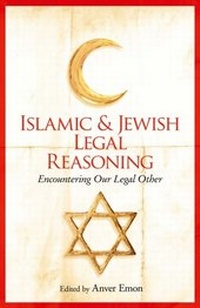
Islamic and Jewish Legal Reasoning
Encountering Our Legal Other
1st Edition
Published on 7. April 2016
304 pages
978-1-78074-881-8 (ISBN)
Description

By pairing a scholar of Islamic law with a scholar of Jewish law, a unique dynamic is created, and new perspectives are made possible. These new perspectives not only enable an understanding of the other's legal tradition, but most saliently, they offer new insights into one's own legal tradition, shedding light on what had previously been assumed to be outside the scope of analytic vision.
In the course of this volume, scholars come together to examine such issues as judicial authority, the legal policing of female sexuality, and the status of those who stand outside one's own tradition. Whether for the pursuit of advanced scholarship, pedagogic innovation in the classroom, or simply a greater appreciation of how to live in a multi-faith, post-secular world, these encounters are richly-stimulating, demonstrating how legal tradition can be used as a common site for developing discussions and opening up diverse approaches to questions about law, politics, and community. Islamic and Jewish Legal Reasoning offers a truly incisive model for considering the good, the right and the legal in our societies today.
In the course of this volume, scholars come together to examine such issues as judicial authority, the legal policing of female sexuality, and the status of those who stand outside one's own tradition. Whether for the pursuit of advanced scholarship, pedagogic innovation in the classroom, or simply a greater appreciation of how to live in a multi-faith, post-secular world, these encounters are richly-stimulating, demonstrating how legal tradition can be used as a common site for developing discussions and opening up diverse approaches to questions about law, politics, and community. Islamic and Jewish Legal Reasoning offers a truly incisive model for considering the good, the right and the legal in our societies today.
Reviews / Votes
'A revelatory exploration of faith traditions in deep dialogue with one another. Islamic and Jewish Legal Reasoning offers a model of reciprocal conversation at a time when it is too often in short supply.' -- Dr. Seth Anziska, Lecturer in Jewish-Muslim Relations, University College London 'A wonderfully engaging conversation about the meaning, value, and possible revision of legal traditions.' -- Michael Walzer, Professor Emeritus, Institute for Advanced Study, Princeton 'Islamic and Jewish Legal Reasoning is daring and innovative. The book is a conversation among scholars of law and religion in these two great traditions, based on intensive collective readings of and reflections on each other's key texts, specifically concerning the role of reason and authority in determining law. The result is a fascinating and highly readable account of this dialogue.' -- Ziba Mir-Hosseini, SOAS, University of London 'Anver Emon and Robert Gibbs are among the very best scholars of their generation on (respectively) Islamic and Jewish legal reasoning. This volume is a treasure, bringing their work into conversation with other notable scholars, helping us to better understand our shared heritage.' -- Amir Hussain, Professor of Theological Studies, Loyola Marymount University 'Islamic and Jewish Legal Reasoning is a series of thoughtful scholarly essays in which recognition of differences becomes the starting point for mutual understanding. The essays introduce the reader to pairs of outstanding scholars who reflect together on legal questions regarding animals, sovereignty, the status of women, and other issues. Their conversations provide a wealth of detail on these two important traditions, and they remind us again that to know our own law and culture, we must first understand the questions others raise about them.' -- Robin W. Lovin, William H. Scheide Senior Fellow in Theology, Center of Theological Inquiry 'Designed for the non-specialist, this fascinating book invites the reader to listen in on a conversation about law, Jewish law and Islamic law, among distinguished scholars thinking modern questions-the nature of law and judicial authority, the status of women, animal rights, and sovereignty-with ancient and medieval texts. It is a deeply serious book which models an informed and open dialogue about consequential matters rather than providing packaged pieties.' -- Winnifred Fallers Sullivan, Chair, Department of Religious Studies, Indiana University BloomingtonMore details
Language
English
Place of publication
Oxford
United Kingdom
File size
1,18 MB
ISBN-13
978-1-78074-881-8 (9781780748818)
Copyright in bibliographic data and cover images is held by Nielsen Book Services Limited or by the publishers or by their respective licensors: all rights reserved.
Schweitzer Classification
Other editions
Additional editions
Book
04/2016
Oneworld Academic
€29.00
Shipment within 3-4 weeks
Person
Dr. Anver M. Emon is Professor and Canada Research Chair in Religion, Pluralism and the Rule of Law at the University of Toronto.
Content
Introduction: Islamic and Jewish Legal Reasoning-Beginnings
(Anver M. Emon and Robert Gibbs)
On Reading Together
Formation of a Reading Practice
From Reading Together to Writing Together
PART I
1 Assuming Power: Judges, Imagined Authority, and the Quotidian
(Rumee Ahmed and Aryeh Cohen)
Introduction
Rumee Ahmed
Aryeh Cohen
Rumee Ahmed
Aryeh Cohen: Coda
Conclusion
2 Guardianship of Women in Islamic and Jewish Legal Texts
(Rachel Adler and Ayesha S. Chaudhry)
Introduction
Reading an Islamic Legal Text Together
Reading a Jewish Legal Text Together
Further Reflections: Rachel Adler
Comparative Reflections: Ayesha S. Chaudhry
Conclusion
3 The Cowering Calf and the Thirsty Dog: Narrating and Legislating Kindness to Animals in Jewish and Islamic Texts
(Beth Berkowitz and Marion Katz)
Introduction
Dialogue 1: Legal Obligations toward Animals
Dialogue 2: Compassion toward Animals
Conclusion
4 Policing Women: Virginity Checkers and the Sotah Ordeal as Sites of Women's Agency
(Ayesha S. Chaudhry and Shari Golberg)
Women Policing Women: From Montreal to Jerusalem
The Hidaya: Testimony in Cases of Zina
Mishnah Sotah: Testimony in the Case of Suspected Adultery
The Adulteress vs. the Adulterer
Conclusion
5 Sovereignty, Law, and the Pedagogy of Historical Fantasy: On the Halakha on the Laws of War and the Fiqh on Dhimmis
(Arye Edrei and Anver M. Emon)
Introduction
Early Rabbinic and Islamic Legal Trajectories
Inverting the Political Form
Conclusion
PART II
6 Cross-Textual Reflections on Tradition, Reason, and Authority
(Adam B. Seligman)
Introduction: Tradition and Reason
Tradition and Dialogue
Authority and Religion
7 The Social Life of Reason
(Robert Gibbs)
A Philosophical Framework
Philosophical Questions
List of Contributors
Index
(Anver M. Emon and Robert Gibbs)
On Reading Together
Formation of a Reading Practice
From Reading Together to Writing Together
PART I
1 Assuming Power: Judges, Imagined Authority, and the Quotidian
(Rumee Ahmed and Aryeh Cohen)
Introduction
Rumee Ahmed
Aryeh Cohen
Rumee Ahmed
Aryeh Cohen: Coda
Conclusion
2 Guardianship of Women in Islamic and Jewish Legal Texts
(Rachel Adler and Ayesha S. Chaudhry)
Introduction
Reading an Islamic Legal Text Together
Reading a Jewish Legal Text Together
Further Reflections: Rachel Adler
Comparative Reflections: Ayesha S. Chaudhry
Conclusion
3 The Cowering Calf and the Thirsty Dog: Narrating and Legislating Kindness to Animals in Jewish and Islamic Texts
(Beth Berkowitz and Marion Katz)
Introduction
Dialogue 1: Legal Obligations toward Animals
Dialogue 2: Compassion toward Animals
Conclusion
4 Policing Women: Virginity Checkers and the Sotah Ordeal as Sites of Women's Agency
(Ayesha S. Chaudhry and Shari Golberg)
Women Policing Women: From Montreal to Jerusalem
The Hidaya: Testimony in Cases of Zina
Mishnah Sotah: Testimony in the Case of Suspected Adultery
The Adulteress vs. the Adulterer
Conclusion
5 Sovereignty, Law, and the Pedagogy of Historical Fantasy: On the Halakha on the Laws of War and the Fiqh on Dhimmis
(Arye Edrei and Anver M. Emon)
Introduction
Early Rabbinic and Islamic Legal Trajectories
Inverting the Political Form
Conclusion
PART II
6 Cross-Textual Reflections on Tradition, Reason, and Authority
(Adam B. Seligman)
Introduction: Tradition and Reason
Tradition and Dialogue
Authority and Religion
7 The Social Life of Reason
(Robert Gibbs)
A Philosophical Framework
Philosophical Questions
List of Contributors
Index
