

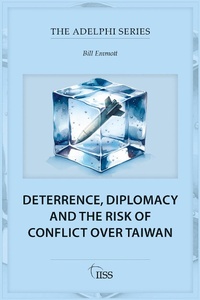
Deterrence, Diplomacy and the Risk of Conflict Over Taiwan
1st Edition
Published on 15. July 2024
192 pages
978-1-040-22398-7 (ISBN)
Description

Russia's full-scale invasion of Ukraine confirmed that revived great-power competition has heightened the prospect of global conflict, while restoring the concept of deterrence to centre stage. The stakes in a conflict in East Asia, however, would be even higher than those in Ukraine. A war over Taiwan could bring the United States and China, the world's two greatest powers, into a direct military conflict which would represent a contest for regional or global leadership and would be likely to draw other powers into the fight. Such a war - in which the nuclear question would be ever-present - can currently be described as 'possible, avoidable, but potentially catastrophic'.
In this Adelphi book, Bill Emmott evaluates the diplomatic and deterrence strategies that countries in and outside the Indo-Pacific region are using to try to reduce the risk of that conflict occurring. This book examines these strategies in the light of the lessons of the Ukraine war and identifies yardsticks with which to gauge their potential effectiveness and sustainability. Our goal, Emmott argues, must be for all sides to regard such a US-China conflict as 'inevitably catastrophic and therefore inconceivable'.
In this Adelphi book, Bill Emmott evaluates the diplomatic and deterrence strategies that countries in and outside the Indo-Pacific region are using to try to reduce the risk of that conflict occurring. This book examines these strategies in the light of the lessons of the Ukraine war and identifies yardsticks with which to gauge their potential effectiveness and sustainability. Our goal, Emmott argues, must be for all sides to regard such a US-China conflict as 'inevitably catastrophic and therefore inconceivable'.
Reviews / Votes
'Will China and the US go to war over Taiwan? How can war be deterred? Bill Emmott gives the clearest answers that I have read to these crucial questions. His work is both comprehensive and readable, as befits a former editor of The Economist.'Joseph S. Nye, former Dean of the Harvard Kennedy School and author of the memoir A Life in the American Century
'Bill Emmott's insightful exploration illuminates the precarious balance between power and peace in the Indo-Pacific, a strategic region where Europe's future is also at stake. Emmott is one of our best experts in this area and offers a compelling narrative that combines historical depth with contemporary urgency. This book stands as a crucial guide for navigating the intricate interplay of military strategy, diplomacy and the unyielding quest for stability in a region at the heart of global security.'
Florence Parly, former Minister of the Armed Forces, France (2017-22)
'Bill Emmott has done a masterly job of highlighting the necessity of a sophisticated and comprehensive deterrence strategy in the Indo-Pacific given the real dangers of Chinese military coercion against Taiwan. His work is particularly profound in warning that we have downplayed the taboo topic of nuclear escalation in a Taiwan Strait crisis even though a US-China conflict would be the first in history between nuclear great powers.'
Dennis Wilder, former Deputy Assistant Director for East Asia and the Pacific, CIA (2015-16); Assistant Professor of the Practice and Senior Fellow for the Initiative for US-China Dialogue on Global Issues, Georgetown University
'Bill Emmott is correct to describe our task as making war over Taiwan "inevitably catastrophic and therefore inconceivable". Japan both can and is determined to contribute to this goal by strengthening regional deterrence efforts.'
Ishii Masafumi, former Director for Policy Planning, Ministry of Foreign Affairs, Japan; former Japanese Ambassador to Indonesia
More details
Series
Edition
1. Auflage
Language
English
Place of publication
London
United Kingdom
Publishing group
Taylor & Francis Ltd
Target group
College/higher education
Professional and scholarly
ISBN-13
978-1-040-22398-7 (9781040223987)
Copyright in bibliographic data and cover images is held by Nielsen Book Services Limited or by the publishers or by their respective licensors: all rights reserved.
Schweitzer Classification
Other editions
Additional editions
Book
07/2024
1st Edition
Routledge
€53.20
Shipment within 10-20 days
Person
Bill Emmott is Chairman of the IISS Trustees and an independent writer and consultant. He spent 26 years at The Economist, which he joined in 1980, working as a correspondent and editor in Brussels, Tokyo and London, on subjects ranging from politics to finance, economics and business. In 1993, he was appointed editor-in-chief, a post he held for 13 years before stepping down in 2006.
He is Senior Adviser, Geopolitics for Montrose Associates, Chair of the Japan Society of the UK, an Ushioda Fellow of Tokyo College, University of Tokyo, Chair of the International Trade Institute, a trustee of the Chester Beatty Library, and a member of the Comitato Scientifico of the Centro Einaudi in Turin. He writes for La Stampa in Italy, Nikkei Business and the Mainichi Shimbun in Japan, and occasionally for the Financial Times. He is the author of numerous books on Japan, Asia, Italy and the West, his latest being The Fate of the West (Profile, 2017) and Japan's Far More Female Future: Increasing Gender Equality and Reducing Workplace Insecurity Will Make Japan Stronger (Oxford University Press, 2020).
He is Senior Adviser, Geopolitics for Montrose Associates, Chair of the Japan Society of the UK, an Ushioda Fellow of Tokyo College, University of Tokyo, Chair of the International Trade Institute, a trustee of the Chester Beatty Library, and a member of the Comitato Scientifico of the Centro Einaudi in Turin. He writes for La Stampa in Italy, Nikkei Business and the Mainichi Shimbun in Japan, and occasionally for the Financial Times. He is the author of numerous books on Japan, Asia, Italy and the West, his latest being The Fate of the West (Profile, 2017) and Japan's Far More Female Future: Increasing Gender Equality and Reducing Workplace Insecurity Will Make Japan Stronger (Oxford University Press, 2020).
Content
Author
Acknowledgements
Map 1: Taiwan and its surrounding region
Introduction: Danger, hiding in plain sight
Chapter One: Why Indo-Pacific deterrence matters
Why the stakes in Taiwan are so high
The conflict to be deterred
Chapter Two: Deterrence lessons from Ukraine
Eight lessons from Ukraine
Specific implications for China
Specific implications for Taiwan
Specific implications for the United States
Chapter Three: Yardsticks for deterrence
A world in flux
Rationality without MADness
An unstable status quo
Yardsticks for Indo-Pacific deterrence
Chapter Four: Consistent America, inconstant America
Political will: consistency and clarity of deterrence messages
Military capability and coalition credibility
The narrative yardstick
Chapter Five: Taiwan and its predicament
Military resilience
Civil resilience
Narrative clarity
Chapter Six: Coercive China, deterrent China
Deterring an intervention
Controlling the nuclear risk
Controlling the narrative
Chapter Seven: Allies and partners: the role of Japan
Japan, from self-defence to constrained deterrence
Constrained but speedy?
Many unanswered questions
Chapter Eight: The Philippines, Australia and other partners
The Philippines as an unsinkable logistics centre
Australia: far away but now committed
Other allies and bystanders, near and far
ASEAN non-centrality
Limits to the ASEAN way
Dreaming of a more balanced region
Conclusion: Nostalgic for Cold War realism
Needed: the good aspect of Cold War diplomacy
Notes
Index
Acknowledgements
Map 1: Taiwan and its surrounding region
Introduction: Danger, hiding in plain sight
Chapter One: Why Indo-Pacific deterrence matters
Why the stakes in Taiwan are so high
The conflict to be deterred
Chapter Two: Deterrence lessons from Ukraine
Eight lessons from Ukraine
Specific implications for China
Specific implications for Taiwan
Specific implications for the United States
Chapter Three: Yardsticks for deterrence
A world in flux
Rationality without MADness
An unstable status quo
Yardsticks for Indo-Pacific deterrence
Chapter Four: Consistent America, inconstant America
Political will: consistency and clarity of deterrence messages
Military capability and coalition credibility
The narrative yardstick
Chapter Five: Taiwan and its predicament
Military resilience
Civil resilience
Narrative clarity
Chapter Six: Coercive China, deterrent China
Deterring an intervention
Controlling the nuclear risk
Controlling the narrative
Chapter Seven: Allies and partners: the role of Japan
Japan, from self-defence to constrained deterrence
Constrained but speedy?
Many unanswered questions
Chapter Eight: The Philippines, Australia and other partners
The Philippines as an unsinkable logistics centre
Australia: far away but now committed
Other allies and bystanders, near and far
ASEAN non-centrality
Limits to the ASEAN way
Dreaming of a more balanced region
Conclusion: Nostalgic for Cold War realism
Needed: the good aspect of Cold War diplomacy
Notes
Index
