

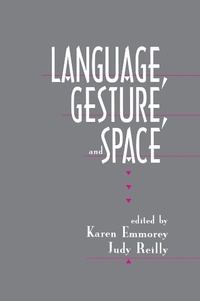
Language, Gesture, and Space
Published on 17. June 2013
464 pages
978-1-134-77966-6 (ISBN)
Description

This book brings together papers which address a range of issues regarding the nature and structure of sign languages and other gestural systems, and how they exploit the space in which they are conveyed. The chapters focus on five pertinent areas reflecting different, but related research topics:
* space in language and gesture,
* point of view and referential shift,
* morphosyntax of verbs in ASL,
* gestural systems and sign language, and
* language acquisition and gesture.
Sign languages and gestural systems are produced in physical space; they manipulate spatial contrasts for linguistic and communicative purposes. In addition to exploring the different functions of space, researchers discuss similarities and differences between visual-gestural systems -- established sign languages, pidgin sign language (International Sign), "homesign" systems developed by deaf children with no sign language input, novel gesture systems invented by hearing nonsigners, and the gesticulation that accompanies speech. The development of gesture and sign language in children is also examined in both hearing and deaf children, charting the emergence of gesture ("manual babbling"), its use as a prelinguistic communicative device, and its transformation into language-like systems in homesigners. Finally, theoretical linguistic accounts of the structure of sign languages are provided in chapters dealing with the analysis of referential shift, the structure of narrative, the analysis of tense and the structure of the verb phrase in American Sign Language. Taken together, the chapters in this volume present a comprehensive picture of sign language and gesture research from a group of international scholars who investigate a range of communicative systems from formal sign languages to the gesticulation that accompanies speech.
* space in language and gesture,
* point of view and referential shift,
* morphosyntax of verbs in ASL,
* gestural systems and sign language, and
* language acquisition and gesture.
Sign languages and gestural systems are produced in physical space; they manipulate spatial contrasts for linguistic and communicative purposes. In addition to exploring the different functions of space, researchers discuss similarities and differences between visual-gestural systems -- established sign languages, pidgin sign language (International Sign), "homesign" systems developed by deaf children with no sign language input, novel gesture systems invented by hearing nonsigners, and the gesticulation that accompanies speech. The development of gesture and sign language in children is also examined in both hearing and deaf children, charting the emergence of gesture ("manual babbling"), its use as a prelinguistic communicative device, and its transformation into language-like systems in homesigners. Finally, theoretical linguistic accounts of the structure of sign languages are provided in chapters dealing with the analysis of referential shift, the structure of narrative, the analysis of tense and the structure of the verb phrase in American Sign Language. Taken together, the chapters in this volume present a comprehensive picture of sign language and gesture research from a group of international scholars who investigate a range of communicative systems from formal sign languages to the gesticulation that accompanies speech.
Reviews / Votes
"Written in an easy-to-read style, this book will fill in gaps for the expert and will provide a thorough background for the novice with an interest in signs. Highly recommended for all libraries."-CHOICE
More details
Language
English
Place of publication
London
United Kingdom
Publishing group
Taylor & Francis Ltd
Target group
Professional and scholarly
File size
292,71 MB
ISBN-13
978-1-134-77966-6 (9781134779666)
Copyright in bibliographic data and cover images is held by Nielsen Book Services Limited or by the publishers or by their respective licensors: all rights reserved.
Schweitzer Classification
Other editions
Additional editions
Karen Emmorey | Judy S. Reilly
Language, Gesture, and Space
Book
12/2015
1st Edition
Psychology Press Ltd
€76.00
Shipment within 10-20 days
Karen Emmorey | Judy S. Reilly
Language, Gesture, and Space
Book
02/1995
Psychology Press
€208.00
Shipment within 10-20 days
Persons
Karen Emmorey, Judy S. Reilly
Content
Contents: K. Emmorey, J.S. Reilly, Theoretical Issues Relating Language, Gesture, and Space: An Overview. Part I:Space in Language and Gesture.S.K. Liddell, Real, Surrogate, and Token Space: Grammatical Consequences in ASL. K. Emmorey, D. Corina, U. Bellugi, Differential Processing of Topographic and Referential Functions of Space. D. McNeill, L.L. Pedelty, Right Brain and Gesture. E.A. Winston, Spatial Mapping in Comparative Discourse Frames. Part II:Point of View and Referential Shift.C. Poulin, C. Miller, On Narrative Discourse and Point of View in Quebec Sign Language. E. Engberg-Pedersen, Point of View Expressed Through Shifters. D. Lillo-Martin, The Point of View Predicate in American Sign Language. B.J. Bahan, S.J. Supalla, Line Segmentation and Narrative Structure: A Study of Eyegaze Behavior in American Sign Language. Part III:Morpho-Syntax of Verbs in ASL.W.D. Janis, A Crosslinguistic Perspective on ASL Verb Agreement. D. Aarons, B.J. Bahan, J. Kegl, C. Neidle, Lexical Tense Markers in American Sign Language. D.S. Metlay, T. Supalla, Morpho-Syntactic Structure of Aspect and Number Inflections in ASL. Part IV:Gestural Systems and Sign Language.J.L. Singleton, S. Goldin-Meadow, D. McNeill, The Cataclysmic Break Between Gesticulation and Sign: Evidence Against a Unified Continuum of Gestural Communication. J.P. Morford, J.L. Singleton, S. Goldin-Meadow, The Genesis of Language: How Much Time Is Needed to Generate Arbitrary Symbols in a Sign System? T. Supalla, R. Webb, The Grammar of International Sign: A New Look at Pidgin Languages. Part V:Language Acquisition and Gesture.R.I. Mayberry, Mental Phonology and Language Comprehension, or What Does That Sign Mistake Mean? V. Volterra, J.M. Iverson, When Do Modality Factors Affect the Course of Language Acquisition? R.P. Meier, R. Willerman, Prelinguistic Gesture in Deaf and Hearing Infants. X-L. Wang, C. Mylander, S. Goldin-Meadow, The Resilience of Language: Mother-Child Interaction and Its Effect on the Gesture Systems of Chinese and American Deaf Children.
