

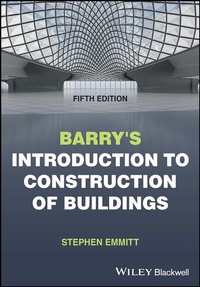
Barry's Introduction to Construction of Buildings
Description

Authoritative, well established, comprehensive, practical, and highly illustrated guide to construction practice
Barry's Introduction to Construction of Buildings provides the basic material an undergraduate student will need to understand how the majority of low-rise buildings are constructed. The text explains construction technology through key functional and performance requirements for the main elements common to all buildings. The material in the Fifth Edition has been updated to ensure it covers the latest building regulations and current construction technology, with particular attention paid to the decisions required on what and how to build to achieve a low carbon, resilient built environment. Design, technology, site assembly, and environmental issues are all covered, showing how buildings that are more efficient, with lower embodied carbon, are constructed. New 'in chapter' questions better facilitate self-reflection and learning.
Barry's Introduction to Construction of Buildings contains information on:
* General principles of construction, regulations and approvals, making choices and sources of information, and responding to climate change
* Site analysis, setup, security, bedrock and soil types, ground stability, drainage, strip, pad, and raft foundations and scaffolding
* Functional requirements for floors, including ground-supported concrete floor slabs, timber upper floors, floor finishes, and suspended timber ground floors
* Pitched roofs and their coverings, sheet metal covering to low-pitched roofs, flat roofs, thermal insulation in flat roofs, parapet walls, and green roofs
Barry's Introduction to Construction of Buildings is an ideal learning resource for undergraduate students and those working towards similar NQF level 5 and 6 qualifications in building and construction. This title is a companion to Barry's Advanced Construction of Buildings.
More details
Other editions
Additional editions
Person
Stephen Emmitt, PhD is Professor of Architectural Practice at the Department of Architecture and Civil Engineering, University of Bath, UK. He is an architect with industrial experience.
Content
1 Introduction 1
1.1 Towards a decarbonised built environment 1
1.2 Responding to climate change 2
1.3 The function and performance of buildings 3
1.4 General principles of construction 6
1.5 Regulations and approvals 11
1.6 Sources of information 13
Further reading 13
Chapter 2 AT A GLANCE 15
2 Site Analysis, Set-Up, Drainage, and Scaffolding 17
2.1 Site analysis 17
2.2 Site set-up and security 30
2.3 Site drainage 34
2.4 Foul drainage 41
2.5 Scaffolding 68
Further reading 88
Reflective exercises 88
Chapter 3 AT A GLANCE 89
3 Ground Stability and Foundations 91
3.1 Bedrock and soil types 91
3.2 Ground stability 98
3.3 Foundations: functional requirements 101
3.4 Foundation construction 113
3.5 Strip foundations 124
3.6 Pad foundations 134
3.7 Raft foundations 143
3.8 Short-bored pile foundations 151
3.9 Precast pile and beam foundation systems 153
Further reading 155
Reflective exercises 155
Chapter 4 AT A GLANCE 157
4 Floors 159
4.1 Functional requirements 159
4.2 Ground-supported concrete floor slab 162
4.3 Suspended concrete floor slabs 170
4.4 Suspended timber ground floors 176
4.5 Reinforced concrete upper floors 179
4.6 Timber upper floors 182
4.7 Floor finishes 190
Further reading 200
Reflective exercises 200
Chapter 5 AT A GLANCE 201
5 Loadbearing Walls 203
5.1 Functional requirements 203
5.2 Walling materials 210
5.3 Mortar 221
5.4 Bonding bricks and blocks 226
5.5 Damp-proof courses (DPCs) 231
5.6 Solid wall construction 239
5.7 Cavity wall construction 269
5.8 Internal and party walls 291
5.9 Straw wall construction 294
5.10 Earth wall construction 300
5.11 Green (living) walls 304
Further reading 305
Reflective exercises 305
Chapter 6 AT A GLANCE 307
6 Roofs 309
6.1 Functional requirements 309
6.2 Pitched roofs 313
6.3 Pitched roof coverings 328
6.4 Sheet metal covering to low-pitched roofs 351
6.5 Thermal insulation to pitched roofs 354
6.6 Flat roofs 359
6.7 Timber flat roof construction 362
6.8 Concrete flat roofs 378
6.9 Thermal insulation to flat roofs 381
6.10 Parapet walls 385
6.11 Green roofs 390
6.12 Roof drainage 394
Further reading 401
Reflective exercises 401
Chapter 7 AT A GLANCE 403
7 Windows 405
7.1 Functional requirements 405
7.2 Window types 430
7.3 Window frames 439
7.4 Glass and glazing 463
7.5 Hardware 481
7.6 Window cills 483
Further reading 490
Reflective exercises 490
Chapter 8 AT A GLANCE 491
8 Doors 493
8.1 Functional requirements 493
8.2 Door types 498
8.3 Door frames and linings 519
8.4 Hardware 535
Further reading 541
Reflective exercises 541
Chapter 9 AT A GLANCE 543
9 Stairs and Ramps 545
9.1 Functional requirements 545
9.2 Terms, definitions and materials 548
9.3 Types of stairs 557
9.4 Timber staircases 560
9.5 Stone stairs 571
9.6 Reinforced concrete stairs 571
9.7 Structural glass stairs 576
9.8 Ramps 576
Further reading 579
Reflective exercises 579
Chapter 10 AT A GLANCE 581
10 Surface Finishes 583
10.1 Functional requirements 583
10.2 Wall and ceiling finishes 585
10.3 Skirtings, architraves, and kitchen cabinets 600
10.4 Tiling to walls 604
10.5 Painting and decorating 605
Further reading 612
Reflective exercises 612
Chapter 11 AT A GLANCE 613
11 Internal Environment and Energy Supply 615
11.1 Principles and performance requirements 615
11.2 Heat loss calculations 617
11.3 Testing and monitoring thermal performance 626
11.4 Indoor climate control 629
11.5 Energy sources 634
11.6 Solid fuel-burning appliances 640
11.7 Domestic electrical supply and installations 655
11.8 Artificial lighting 677
Further reading 679
Reflective exercises 679
Chapter 12 AT A GLANCE 681
12 Water Supply and Sanitation 683
12.1 Cold water supply and distribution 683
12.2 Hot water supply and distribution 693
12.3 Water services to multi-storey buildings 699
12.4 Pipes for water supply 708
12.5 Sanitary appliances 712
Further reading 733
Reflective exercises 734
Index 735
How to Navigate this Book
The design and construction of buildings is about making informed choices. The choices made will be specific to the context of the site, client requirements, building type and size, prevailing socio-economic conditions, and be underpinned by respect for our planet. Whatever their function, buildings need to offer a safe, healthy, stimulating, and sustainable environment for all users.
The construction process will start with a thorough assessment of client needs and an equally thorough assessment of the building site, from which designs can be developed and options considered. Options will relate to where the building is to be positioned on the site, through to the general massing and appearance of the building. This is linked to significant decisions, such as whether to use loadbearing construction, framed construction, offsite or onsite construction methods, or some form of hybrid approach. In turn, these decisions help direct choices about the materials to be used and the selection of elements such as walls and windows; and on to decisions about fixings, fittings, services provision, and finishes.
To design buildings and to make choices about how they are to be constructed safely, economically, and sustainably requires knowledge of construction in the widest sense of the term. This encompasses knowledge about construction materials and technologies, construction techniques, economy, and environmental credentials. This is underpinned by knowledge of building laws, regulations and guidance in the form of building standards and codes. The environmental impact of the choices made should underly all decisions, as these will have a long-term influence on the performance and sustainability of the building. To make effective decisions requires a long-term vision of the building, from inception and assembly, through the building's use and adaption, to disassembly and reuse of materials and components; what we refer to as a circular economy. The intention is to design and construct buildings that produce no waste and also generate more energy than they consume; an active building.
Design and construction is predicated on proposing and evaluating a variety of options for the given context. In all but the smallest of projects choices are made by a variety of professionals and tradespeople as they aim to satisfy the needs of the building sponsor, the client, within given parameters such as time, cost, quality, and environmental impact. These parameters drive decisions and influence the choices made in a complex social and cultural context. The overall goal is to satisfy client requirements while also creating a functional and delightful building that makes a positive impact on the planet. The criteria by which options are evaluated is related to the functional requirements of individual elements, components, and materials; the parts that make up the whole. To do this effectively requires a thorough understanding of construction.
The original philosophy of Robin Barry - to address the functional requirements of building elements - is fundamental to making informed choices. Barry's Introduction to Construction of Buildings and Barry's Advanced Construction of Buildings are designed to inform readers about the underpinning construction principles relating to all buildings, regardless of size or intended use. This is achieved through the use of precedents, the description, and illustration of 'typical solutions' to common construction challenges. In doing this the intention is not to tell the reader how to solve the challenge before them, rather it is to provide an example that informs knowledge, and from which fundamental questions can be asked. Once we have developed an understanding of how buildings are constructed and how they may behave, we can then start to ask whether or not the techniques we use are appropriate for our context. We can apply our analytical skills to start to question conventional wisdom and to think about how we may go about doing things differently to respond to and anticipate changes in our climate and expectations of building users.
The Barry books are presented in two volumes, Introduction and Advanced, with the volumes designed to complement one another. The titles are used to reflect the stage at which these subjects are taught in colleges and universities in the UK. Introduction covers the first year, primarily dealing with loadbearing construction and domestic scale developments. It also explores the common elements found in most buildings. The Advanced volume includes material usually taught in the second to third year, primarily dealing with offsite techniques framed construction and reuse of existing buildings. Combined, the two volumes take the reader through the entire life cycle of a building, from inception and construction, to the building in use and eventual demolition, recycling and reuse of valuable resources.
An overview of the chapters in each volume is provided in Table 1, as an aid to navigation of the books.
Chapters are designed so that they can be read from front to back or they can be dipped into as the need arises. Each chapter or section introduces the primary functional requirements and then the reader is introduced to an increasing level of detail. The illustrations and photographs are provided to enhance our understanding of the main principles. At a glance sheets are used for each chapter to address the main what, why, how, and when questions.
Table 1 Overview of the chapters
Chapter Introduction Advanced 1 Introduction Introduction 2 Site Analysis, Set-Up, Drainage, and Scaffolding Offsite Construction 3 Ground Stability and Foundations Pile Foundations, Substructures and Basements 4 Floors Single Storey Frames, Shells and Lightweight Coverings 5 Loadbearing Walls Structural Timber Frames 6 Roofs Structural Steel Frames 7 Windows Structural Concrete Frames 8 Doors Envelopes to Framed Buildings 9 Stairs and Ramps Lifts and Escalators 10 Surface Finishes Fit Out and Second Fix 11 Internal Environment and Energy Supply Existing Buildings: Pathology, Upgrading and Demolition 12 Water Supply and SanitationIf readers are studying, for example, loadbearing construction, then they will need to read the Introduction volume and focus on specific chapters to supplement their learning in the classroom. In this situation, the reader will need to read chapters all the way through in the first instance, perhaps returning to specific issues, such as the position of the damp-proof course. Similarly, if readers are studying framed construction, the Advanced volume will be a valuable resource, supplemented with material on, for example, doors and windows from the Introduction volume. When it comes to revising for examinations in construction technology, the 'At a glance' feature will be useful in prompting one's memory, prior to revisiting key issues within the chapter. Chapters conclude with guidance on additional sources and reflective exercises. The reflective exercises aim to help readers question why and how we are constructing buildings in the way we do. These can be addressed by individual readers and also by small study groups as primers for discussion. We have set these in the context of (design) project work, so whatever the scale of the project or level of study the exercises should help readers to reflect on the most appropriate solution for a given context.
The principles and details illustrated here are intended as a guide to the construction of buildings. When readers use the books to help detail their building designs, dipping into chapters to see solutions to typical detailing problems will help with understanding. It is, however, important that we understand the principles underlying the construction of buildings - what needs to be achieved and why. Thus the details and photographs provided give an indication of how it could be done; not how it should be done. Details should not be copied without thinking about what is really going on. This also applies to details given in guidance documents and manufacturers' information.
Readers should be asking questions such as: How is the building to be assembled, maintained and disassembled safely and efficiently? Is the detail in question entirely suitable for the task at hand? We make this point because building practices and regulations vary from region to region and country to country. For example, a building located in a wet and sheltered area of the UK may benefit from a pitched roof with a large overhang, but a similar building in a dry and exposed part of the country may benefit from a pitched roof with clipped eaves or even a flat roof. It is impossible to cover every eventuality for every reader in these books. Instead, we would urge readers to engage in critical thinking, analyse the details, and then seek out more...
