

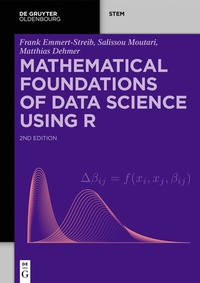
Mathematical Foundations of Data Science Using R
Description

The aim of the book is to help students become data scientists. Since this requires a series of courses over a considerable period of time, the book intends to accompany students from the beginning to an advanced understanding of the knowledge and skills that define a modern data scientist. The book presents a comprehensive overview of the mathematical foundations of the programming language R and of its applications to data science.
More details
Other editions
Additional editions
Persons
Prof. Dr. Frank Emmert-Streib,
Tampere University, Finnland
Frank Emmert-Streib is a Professor of Data Science at Tampere University, Finland, in the Faculty of Information Technology and Communication Sciences. His research interests are in the fields machine learning, artificial intelligence, statistics and network science in the development and application of methods for the analysis of big data from genomics, finance, business and social media.
Prof Dr Matthias Dehmer
UMIT-The Health and Life Science University
Hall, Tyrol, Austria,
Matthias Dehmer is Professor at UMIT - The Health and Life Sciences University. Also he holds a Guest Professorship at Nankai University. His research interests are in complex networks, complexity, data science, predictive analytics, machine learning and information theory. He published more than 225 publications in computer science and related disciplines.
Dr. Salissou Moutari
Queens University Belfast, UK
Salissou Moutari is a Senior Lecturer at Queen's University Belfast (UK), Centre for Statistical Science and Operational Research. He has more than 10 years of experience in Operational Research, Statistical Data Analysis, Predictive, Prescriptive and Decisive Analytics and also dealt with Mathematical Modelling, Computational Mathematics and Complex Systems Analysis. He is currently working in Operational Research and Computational Mathematics. He published more than 35 peer-reviewed publications.
