

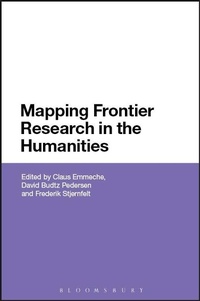
Mapping Frontier Research in the Humanities
1st Edition
Published on 1. December 2016
256 pages
978-1-4725-9770-0 (ISBN)
Description

Knowledge production in academia today is burgeoning and increasingly interdisciplinary in nature. Research within the humanities is no exception: it is distributed across a variety of methodic styles of research and increasingly involves interactions with fields outside the narrow confines of the university. As a result, the notion of liberal arts and humanities within Western universities is undergoing profound transformations. In Mapping Frontier Research in the Humanities, the contributors explore this transformative process. What are the implications, both for the modes of research and for the organisation of the humanities and higher education?
The volume explores the intra- and extra-academic engagement of humanities researchers, their styles of research, and exemplifies their interdisciplinary character. The humanities are shaping debates about culture and identity, but how? Has neuroscience changed the humanities? What do they tell us about 'hypes' and economic 'bubbles'? What is their international agenda? Drawing on a number of case studies from the humanities, the perceived divide between classical and 'post-academic' modes of research can be captured by a republican theory of the humanities. Avoiding simple mechanical metrics, the contributors suggest a heuristic appreciation of different types of impact and styles of research. From this perspective, a more composite picture of research on human culture, language and history emerges. It goes beyond "rational agents", and situates humanities research in more complex landscapes of collective identities, networks, and constraints that open for new forms of intellectual leadership in the 21st century.
The volume explores the intra- and extra-academic engagement of humanities researchers, their styles of research, and exemplifies their interdisciplinary character. The humanities are shaping debates about culture and identity, but how? Has neuroscience changed the humanities? What do they tell us about 'hypes' and economic 'bubbles'? What is their international agenda? Drawing on a number of case studies from the humanities, the perceived divide between classical and 'post-academic' modes of research can be captured by a republican theory of the humanities. Avoiding simple mechanical metrics, the contributors suggest a heuristic appreciation of different types of impact and styles of research. From this perspective, a more composite picture of research on human culture, language and history emerges. It goes beyond "rational agents", and situates humanities research in more complex landscapes of collective identities, networks, and constraints that open for new forms of intellectual leadership in the 21st century.
More details
Edition
1. Auflage
Language
English
Place of publication
London
United Kingdom
Publishing group
Bloomsbury Publishing PLC
Target group
College/higher education
Illustrations
11 bw illus
ISBN-13
978-1-4725-9770-0 (9781472597700)
Copyright in bibliographic data and cover images is held by Nielsen Book Services Limited or by the publishers or by their respective licensors: all rights reserved.
Schweitzer Classification
Other editions
Additional editions
Claus Emmeche | David Budtz Pedersen | Frederik Stjernfelt
Mapping Frontier Research in the Humanities
Book
06/2018
Bloomsbury Academic
€63.32
Shipment within 15-20 days
Claus Emmeche | David Budtz Pedersen | Frederik Stjernfelt
Mapping Frontier Research in the Humanities
Book
12/2016
Bloomsbury Academic
€162.80
Shipment within 15-20 days
Persons
Claus Emmeche is Associate Professor in the Center for the Philosophy of Nature and Science Studies at the Department of Science Education, University of Copenhagen, Denmark.
David Budtz Pedersen is Associate Project Manager of Humanomics in the Department of Media, Cognition and Communication's Philosophy Section at the University of Copenhagen, Denmark.
Frederik Stjernfelt is Professor of Semiotics, the History of Ideas and the Theory of Science in the Department of Arts and Cultural Studies at the University of Copenhagen, Denmark.
David Budtz Pedersen is Associate Project Manager of Humanomics in the Department of Media, Cognition and Communication's Philosophy Section at the University of Copenhagen, Denmark.
Frederik Stjernfelt is Professor of Semiotics, the History of Ideas and the Theory of Science in the Department of Arts and Cultural Studies at the University of Copenhagen, Denmark.
Content
List of figures
List of Tables
Notes on Contributors
Preface and Acknowledgements
Part 1 Knowledge Production in the Humanities
1. Disciplinary Knowledge Production and Interdisciplinarity, David Budtz Pedersen, Frederik Stjernfelt and Claus Emmeche
2. Research Styles and Extra-Academic Engagement of Humanities Researchers, Lasse Johansson and Jonas Grønvad
3. Research Styles in the Human Sciences, Svend Østergaard and Peter Lau Torst Nielsen
4. Criticizing Erroneous Abstractions: the Case of Culturalism, Frederik Stjernfelt
Part 2 Advances in Interdisciplinary Humanities
5. The Borderology of Interdisciplinarity : a Case of Love and Friendship, Claus Emmeche
6. Bubbles Studies: The Brass Tacks, Vincent Fella Hendricks
7. The Humanities Meet the Neurosciences, Magnus Biilmann and Simo Køppe
8. Open Human Science: Transdisciplinary and Transmedial Research, Kristian Moltke Martiny and David Budtz Pedersen
Part 3 An Argument for Classical Humanities
9. The Culture Debate between Terror Threats, Free Speech and Humanism, Esther Oluffa Pedersen
10. From a National to an International Agenda, Uffe Østergaard
11. A Republican Theory of the Humanities, David Budtz Pedersen
Index
List of Tables
Notes on Contributors
Preface and Acknowledgements
Part 1 Knowledge Production in the Humanities
1. Disciplinary Knowledge Production and Interdisciplinarity, David Budtz Pedersen, Frederik Stjernfelt and Claus Emmeche
2. Research Styles and Extra-Academic Engagement of Humanities Researchers, Lasse Johansson and Jonas Grønvad
3. Research Styles in the Human Sciences, Svend Østergaard and Peter Lau Torst Nielsen
4. Criticizing Erroneous Abstractions: the Case of Culturalism, Frederik Stjernfelt
Part 2 Advances in Interdisciplinary Humanities
5. The Borderology of Interdisciplinarity : a Case of Love and Friendship, Claus Emmeche
6. Bubbles Studies: The Brass Tacks, Vincent Fella Hendricks
7. The Humanities Meet the Neurosciences, Magnus Biilmann and Simo Køppe
8. Open Human Science: Transdisciplinary and Transmedial Research, Kristian Moltke Martiny and David Budtz Pedersen
Part 3 An Argument for Classical Humanities
9. The Culture Debate between Terror Threats, Free Speech and Humanism, Esther Oluffa Pedersen
10. From a National to an International Agenda, Uffe Østergaard
11. A Republican Theory of the Humanities, David Budtz Pedersen
Index
