

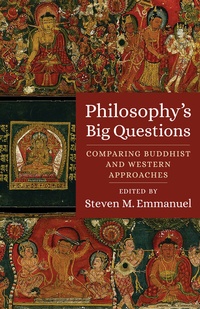
Philosophy's Big Questions
Comparing Buddhist and Western Approaches
1st Edition
Published on 8. September 2021
336 pages
978-0-231-55361-2 (ISBN)
Description

Certain questions have recurred throughout the history of philosophy. They are the big questions-about happiness and the good life, the limits of knowledge, the ultimate structure of reality, the nature of consciousness, the relation between causality and free will, the pervasiveness of suffering, and the conditions for a just and flourishing society-that thinkers in different cultures across the ages have formulated in their own terms in an attempt to make sense of their lives and the world around them.
The essays in this book turn to the major figures and texts of the Buddhist tradition in order to expand and enrich our thinking on these enduring questions. Examining them from a comparative and cross-cultural perspective demonstrates the value of alternative ways of addressing philosophical problems, showing how different approaches can produce new and unexpected kinds of questions and answers. Engaging with the Buddhist tradition, this book shows, helps return philosophy to its practical as well as theoretical aim: not only understanding the world but also knowing how to live in it.
Featuring striking and generative comparisons of Buddhist and Western thought, Philosophy's Big Questions challenges our thinking in fundamental ways and offers readers new conceptual tools, methods, and insights for the pursuit of a good and happy life.
The essays in this book turn to the major figures and texts of the Buddhist tradition in order to expand and enrich our thinking on these enduring questions. Examining them from a comparative and cross-cultural perspective demonstrates the value of alternative ways of addressing philosophical problems, showing how different approaches can produce new and unexpected kinds of questions and answers. Engaging with the Buddhist tradition, this book shows, helps return philosophy to its practical as well as theoretical aim: not only understanding the world but also knowing how to live in it.
Featuring striking and generative comparisons of Buddhist and Western thought, Philosophy's Big Questions challenges our thinking in fundamental ways and offers readers new conceptual tools, methods, and insights for the pursuit of a good and happy life.
More details
Other editions
Additional editions
Book
07/2021
Columbia University Press
€37.20
Shipment within 10-20 days
Book
07/2021
Columbia University Press
€124.00
Shipment within 10-20 days
Persons
Steven M. Emmanuel is professor of philosophy and dean of the Susan S. Goode School of Arts and Humanities at Virginia Wesleyan University. He is the editor of Buddhist Philosophy: A Comparative Approach (2018) and A Companion to Buddhist Philosophy (2013), as well as many publications on major figures in the modern European tradition.
Content
Foreword, by Leah Kalmanson
Acknowledgments
List of Abbreviations
Editor's Introduction, by Steven M. Emmanuel
1. How Should We Live? Happiness, Human Flourishing, and the Good Human Life, by Stephen J. Laumakis
2. What Is Knowledge? Knowledge in the Context of Buddhist Thought, by Douglas Duckworth
3. Does Reality Have a Ground? Madhyamaka and Nonfoundationalism, by Jan Westerhoff
4. Can Consciousness Be Explained? Buddhist Idealism and the "Hard Problem" in Philosophy of Mind, by Dan Arnold
5. Is Anything We Do Really Up to Us? Western and Buddhist Philosophical Perspectives on Free Will, by Rick Repetti
6. Why Do Bad Things Happen to Good People? "And None of Us Deserving the Cruelty or the Grace"-Buddhism and the Problem of Evil, by Amber D. Carpenter
7. How Much Is Enough? Greed, Prosperity, and the Economic Problem of Happiness-a Comparative Perspective, by Steven M. Emmanuel
8. What Do We Owe Future Generations? Compassion and Future Generations-a Buddhist Contribution to an Ethics of Global Interdependence, by Peter D. Hershock
Concluding Remarks, by Steven M. Emmanuel
For Further Reading and Study
Contributors
Index
Acknowledgments
List of Abbreviations
Editor's Introduction, by Steven M. Emmanuel
1. How Should We Live? Happiness, Human Flourishing, and the Good Human Life, by Stephen J. Laumakis
2. What Is Knowledge? Knowledge in the Context of Buddhist Thought, by Douglas Duckworth
3. Does Reality Have a Ground? Madhyamaka and Nonfoundationalism, by Jan Westerhoff
4. Can Consciousness Be Explained? Buddhist Idealism and the "Hard Problem" in Philosophy of Mind, by Dan Arnold
5. Is Anything We Do Really Up to Us? Western and Buddhist Philosophical Perspectives on Free Will, by Rick Repetti
6. Why Do Bad Things Happen to Good People? "And None of Us Deserving the Cruelty or the Grace"-Buddhism and the Problem of Evil, by Amber D. Carpenter
7. How Much Is Enough? Greed, Prosperity, and the Economic Problem of Happiness-a Comparative Perspective, by Steven M. Emmanuel
8. What Do We Owe Future Generations? Compassion and Future Generations-a Buddhist Contribution to an Ethics of Global Interdependence, by Peter D. Hershock
Concluding Remarks, by Steven M. Emmanuel
For Further Reading and Study
Contributors
Index
