

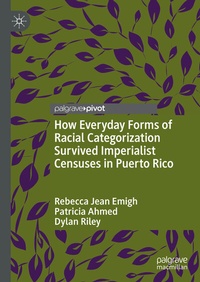
How Everyday Forms of Racial Categorization Survived Imperialist Censuses in Puerto Rico
Description

This book examines the history of racial classifications in Puerto Rico censuses, starting with the Spanish censuses and continuing through the US ones. Because Puerto Rican censuses were collected regularly over hundreds of years, they are fascinating "test cases" to see what census categories might have been available and effective in shaping everyday ones. Published twentieth-century censuses have been well studied, but this book also examines unpublished documents in previous centuries to understand the historical precursors of contemporary ones. State-centered theories hypothesize that censuses, especially colonial ones, have powerful transformative effects. In contrast, this book shows that such transformations are affected by the power and interests of social actors, not the strength of the state. Thus, despite hundreds of years of exposure to the official dichotomous and trichotomous census categories, these categories never replaced the continuous everyday ones because thecensus categories rarely coincided with Puerto Rican's interests.
More details
Other editions
Additional editions
Persons
Patricia Ahmed is Senior Lecturer in Sociology at South Dakota State University, USA. Her research interests include comparative/historical sociology, cross-cultural sociology, and globalization.
Dylan Riley is Professor of Sociology at the University of California, Berkeley, USA. He studies capitalism, socialism, democracy, authoritarianism, and knowledge regimes in a broad comparative and historical perspective.
