

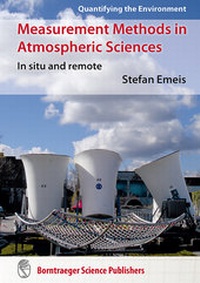
Measurement Methods in Atmospheric Sciences
In situ and remote
1st Edition
Published on 26. May 2020
257 pages
978-3-443-01118-5 (ISBN)
Description

Measurement Methods in Atmospheric Sciences provides a comprehensive overview of in-situ and remote sensing measurement techniques for probing the Earth's atmosphere. The methods presented in this book span the entire range from classical meteorology via atmospheric chemistry and micrometeorological flux determination to Earth observation from space. Standard instruments for meteorological and air quality monitoring methods, as well as specialized instrumentation predominantly used in scientific experiments, are covered. The presented techniques run from simple mechanical sensors to highly sophisticated electronic devices. Special emphasis is on the rapidly evolving field of remote sensing techniques. Here, active ground-based remote sending techniques such as SODAR and LIDAR find a detailed coverage. The book conveys the basic principles of the various observational and monitoring methods, enabling the user to identify the most appropriate method. An introductory chapter covers general principles (e.g. inversion of measured data, available platforms, statistical properties of data, data acquisition). Later chapters each treat methods for measuring a specific property (e.g. humidity, wind speed, wind direction). Long chapters provide an introductory tabular list of the methods treated. More than 100 figures and 400 references, mostly to the recent scientific literature, aid the reader in reading up on the details of the various methods at hand. Recommendations at the end of each major chapter provide additional hints on the use of some instruments in order to facilitate the selection of the proper instrument for a successful measurement. A large number of national and international standards, providing precise guidelines for measuring and acquiring reliable, reproducible and comparable data sets are listed in the appendix. A dedicated index allows easy access to this valuable information. The book addresses undergraduate and graduate students in meteorological and atmospheric sciences, physical geography, ecology, environmental sciences, agriculture and related disciplines as well as scientists in the process of planning atmospheric measurements in field campaigns or working with data already acquired. Practitioners in environmental agencies and similar institutions will benefit from instrument descriptions and the extended lists in the appendix. We are able to supply classroom sets at short notice. Please contact us: mail@schweizerbart.com In February 2011, the book has been awarded the 2010 ASLI CHOICE AWARD (alternatively: Am. Met. Soc Blog entry) for Measurement Methods in Atmospheric Sciences for 'a comprehensive overview of the many atmospheric monitoring and measurement methods and instruments'.
Reviews / Votes
In the era of modeling the importance of measurements seems not to be on the actual agenda. Not many books about measurement methods and techniques exist for atmospheric and related sciences. The present book is based on lectures held by the author for students in meteorology and environmental sciences. It has to be mentioned that the knowledge of meteorological/climatological techniques builds one of the most important targets also in climate and climate impact research. Therefore the present book is warmly welcomed and not only for teaching issues. Recent and older books are structured in a traditional way explaining in separate chapter?s different relevant meteorological parameters and measurement techniques. Here the author separates from the beginning in ?in situ? and ?remote techniques?. It has to be mentioned that the author has long experience in experimental meteorology and climatology and is predestinated as an appropriate author for a measurements book. The book starts with an introduction with focus on necessity, definition of measurements and historical aspects, which in my eyes had to be expanded. Chapter 2 defines and describes the basics of the different kinds of measurements on 21 pages. The chapter is comprehensive and includes all the required aspects for the characteristics of measurements, techniques, and data. The measurement techniques and instruments used for common/traditional meteorological variables are described and analyzed in chapter 3 which covers 34 pages. The chapter summarizes different measurement possibilities for temperature, humidity, air pressure, and wind. Chapter 4, which contains 9 pages, deals with the measurement of liquid water and ice by the use of different kind of measurement techniques starting from the Rain gauges (totalisators) and TDR-sondes for soil moisture. The book´s chapter 5 (25 pages) contains also the possibilities of measurement of air pollutants and gives the book some extra value. It contains all the relevant physical and chemical methods and also recommendations of the measurement of gas and particles in the atmosphere. I think that the title of the chapter should be ?In-situ measurements of pollutants? or similar. In comparison to other chapters it has less figures and pictures. The following chapter (6, contains24 pages) is dedicated to the in-situ flux measurements and covers the full spectrum. It starts from the measurement of radiation fluxes, different aspects of components of the energy budget of the near surface atmosphere based on traditional methods (Bowen) and eddy covariance and includes correction possibilities. Focus is also given i.e. in the different evaporation approaches. With chapter 7, the remote sensing methods are in focus. First the basics of remote sensing are given and explained. It contains surface based remote sensing techniques and applications and covers most of the adar and lidar approaches. Focus is also given in the active-path averaging techniques i.e. Scintillometers, FTUR and DOAS. It includes also passive methods like radiometers and photometers. For cross section approaches, tomography methods are presented and explained. The chapter contains 48 pages and is well structured. In the following 18 pages (chapter 8) the measurement methods based on remote sensing for spatial and vertical resolution are presented. In this chapter are included the methods for the detection of vertical profiles of air temperature, humidity and distributions of atmospheric parameters by satellites. Also included are the measurement possibilities for wind and turbulence and SODAR or LIDAR techniques. Chapter 9 (6 pages) deals with the possibilities for applying remote sensing for water and ice in the atmosphere. The measurement of gases and particles in the atmosphere with remote sensing methods are presented and explained in chapter 10. The chapter shows the diverse possibilities which are at moment very popular and object of research in atmospheric sciences. The following chapter 11 deals with the measurement of surface properties. It is a short chapter (6 pages) but includes all the relevant techniques and possibilities, which are of interest not only for meteorological applications. Finally two shorts chapters mention electrical phenomena measured with remote sensing and an outlook on new developments is given. In general this can be said to be a comprehensive book about measurement methods, techniques, and possible applications. High emphasis is given on the rapidly evolving experimental fields of remote sensing possibilities. More than 100 figures and 400 references mostly on recent literature and relevant photos complete the book. The balance between text and visual material in form of schematic diagrams, photos and tables is very good. Also very useful is the appendix with technical guidelines and standards. Most of the well known manufacturers of measurement equipment contributed via advertisements to the book. A very positive aspect is the recommendations given in each chapter. For the next edition I would like to recommend several appendices with unit conversions and if possible several full derivations of equations i.e. radiation errors etc. As a colleague mentioned flow chart diagrams of the methods and measurement systems would be helpful. In general I recommend the books not only for teaching in bachelor and master courses. The books is very informative and can be used also in Biometeorology and related disciplines. Andreas Matzarakis, Freiburg Biometeorology Bulletin Volume 14, No. 2, 2010, p. 12-14Measurement Methods in Atmospheric Sciences provides a comprehensive overview of in-situ and remote sensing measurement techniques for probing the Earth's atmosphere. The methods presented in this book span the entire range from classical meteorology via atmospheric chemistry and micrometeorological fiux determination to Earth observation from space. Standard instruments for meteorological and air quality monitoring methods, as well as specialized instrumentation predominantly used in scientific experiments, are covered. The presented techniques run from simple mechanical sensors to highly sophisticated electronic devices. Special emphasis is on the rapidly evolving field of remote sensing techniques. Here, active ground-based remote sending techniques such as SODAR and LIDAR find a detailed coverage. The book conveys the basic principles of the various observational and monitoring methods, enabling the user to identify the most appropriate method. An introductory chapter covers general principles (e. g. inversion of measured data, available platforms, statistical properties of data, data acquisition). Later chapters each treat methods for measuring a specific property (e.g. humidity, wind speed, wind direction). Long chapters provide an introductory tabular list of the methods treated. More than 100 figures and 400 references, mostly to the recent scientific literature, aid the reader in reading up on the details of the various methods at hand. Recommendations at the end of each major chapter provide additional hints on the use of some instruments in order to facilitate the selection of the proper instrument for a successful measurement. A large number of national and international standards, providing precise guidelines for measuring and acquiring reliable, reproducible and comparable data sets are listed in the appendix. A dedicated index allows easy access to this valuable information. The book addresses undergraduate and graduate students in meteorological and atmospheric sciences, physical geography, ecology, environmental sciences, agriculture and related disciplines as well as scientists in the process of planning atmospheric measurements in field campaigns or working with data already acquired. Practitioners in environmental agencies and similar institutions will benefit from instrument descriptions and the extended lists in the appendix. ETDE Energy Database DE11G4422 FIZ Karlsruhe - Leibniz-Institut für Informationsinfrastruktur
This book is an excellent reference resource which covers all aspects of measurements of properties of the atmosphere. Although there are small sections on such topics as ionospheric electron density measurements and remote sensing of clouds, this is predominantly a book about measurements of properties of the troposphere. The content is based on a series of lectures by the author at the University of Cologne, but its emphasis is on the principles of measurement and on measurement accuracy rather than detailed mathematical treatment of the measurement physics. This makes the book extremely readable, and also makes it possible to open the book at any section and read about one particular measurement method or how measurements are conducted to estimate one particular atmospheric property. The coverage of measurement technologies is very up-to-date, and a concluding chapter also gives some insights into likely future developments. One feature of the book is its inclusion of historical context as well as a wealth of citations to the most significant publications relating to each measurement methodology. The text is accompanied by very high quality photographs of instruments, and clear diagrams which help explain measurement principles. Initial chapters take some care in describing what a measurement is, and the main features of making a measurement. Also included is a discussion, with simple examples, of measurement error and ill-posed inversion problems. Such fundamental aspects are often overlooked in other texts. The awareness of the importance of measurement error and uncertainty is carried throughout the book, with estimates of the accuracy of each measurement method. This is a very useful guide to anyone wishing to employ a technology with which they are not familiar. Each section describing methods for measurement of a particular atmospheric property concludes with paragraphs such as ?Recommendations for wind measurements?, which also include best-practice guidelines. This allows the reader to obtain some grasp of the pitfalls which might occur if the reader were not well prepared. Measurement Methods is a very comprehensive coverage of the principles and current instrumentation. One difficulty though is that this does not leave room to describe in much detail the atmosphere itself and the nature and variability of the properties which are being measured. In particular, there is not much coverage of the temporal and spatial scales of variability of the various atmospheric properties. This means that the reader does not necessarily obtain a clear idea of how rapidly measurements should be made or how representative point measurements are. Given the very wide scope covered in this text, it is arranged in a very clear and logical manner. The most common atmospheric properties are treated first, starting with the simplest measurement methods. In situ measurements of temperature, water vapour, pressure and wind are covered first, followed by in situ measurements of liquid water and ice and trace substances. There follows a chapter on flux measurements, including radiative fluxes. There are then six chapters on remote sensing methods. These include a chapter on remote sensing of surface properties, which are only indirectly related to atmospheric measurements. The remote sensing chapters concentrate mostly on ground-based methods, such as lidar, sodar, radar, ceilometers and scintillometers, and give very good coverage of the principles involved and current state-of-the art. Treatment of remote sensing of atmospheric properties by satellites is quite brief, but this is an area already comprehensively covered by many other texts. In summary, Stefan Emeis? Measurement Methods in Atmospheric Sciences is an extremely readable and comprehensive compendium of all aspects of measurements of atmospheric properties. It should find a place on the bookshelf of anyone involved in meteorological observations as well as being an excellent resource for courses in atmospheric and environmental sciences. Prof. Stuart Bradley, Physics Department, Faculty of Science, The University of Auckland, New Zealand Meteorologische Zeitschrift vol. 21, 2012, no. 3
Les moyens d'observation de l'atmosphère évoluent rapidement, qui'il s'agisse des mesures in situ en surface et en altitude ou bien des mesures par télédétection depuis le sol et depuis l'espace. Ce manuel propose un large tour d'horizon des techniques de mesure, depuis les instruments classiques d'observation météorologique jusqu'aux techniques les plus novatrices utilisées pour la recherche atmosphérique. La Météorologie n° 73 - mai 2011
If you want to measure something within the atmosphere, Measurement Methods in Atmospheric Sciences is an excellent resource to determine the best technique to use. This book covers a wide range of topics, including classic in situ measurements of the state variables, precipitation, trace-gas and particle measurements, flux measurements, and passive and active remote sensing, as well as lesser-known topics such as olfactometry. Audience. This book would be useful to any scientist or engineer who desires to have an overview of the current techniques and instrumentation available in the world of atmospheric measurements. It could also be useful to students who are studying measurement techniques. Most of the material is at an undergraduate level. Strengths. I am not aware of any other book that covers such a complete range of atmospheric measurement techniques. In addition to a summary of the strengths/weaknesses of each technique, most sections include a recommendation of the best one to use. In my opinion, the sections on different remote sensing techniques (i.e., contrasting radar, sodar, lidar, etc.) and trace-gas measurements are particularly insightful. The appendix includes an index of technical standards and guidelines that have been determined by various agencies [such as the Association of German Engineers (VDI), the British Standards Institution (BSI), the International Organization for Standardization (ISO), etc.]. These valuable resources are sometimes overlooked in the scientific community, and are nicely presented in this book. Weaknesses. Because this book covers such a variety of topics, it doesn?t cover any one topic in great depth. In a class that focuses on one subject (such as remote sensing), additional resources will be needed, and much of the material in this book may not be relevant. Also, I?m not sure if it qualifies as a weakness, but interspersed throughout the book are advertisements from companies that make atmospheric instruments. Illustrations. The illustrations and photos in the book are all appropriate and useful. I found many of the tables to be particularly well thought-out and helpful. Bottom Line. As someone who makes atmospheric measurements, I love to have this book on my shelf. When someone asks me, ?What?s the best instrument to measure the boundary layer depth?? or ?How can I measure ozone??, this is undoubtedly the first book I would consult to find the answer (or at least find references that will lead me to the answer). Sean Burns Bulletin of the American Meteorological Society, October 2011
Das Titelbild zeigt eine in ihren Dimensionen recht raumgreifende Messapparatur, ein SODAR-RASS zur Fernerkundung von Wind- und Temperaturprofilen in der atmosphärischen Grenzschicht. Bei Atmosphärenmessungen geht es aber auch kleiner, z. B. bei der Temperaturmessung mit dem Flüssigkeitsthermometer oder der Bestimmung der Windrichtung und -stärke mit einem Windsack. Diese Beispiele illustrieren die Spanne und Komplexität der Messverfahren. Die Anzahl der in der Atmosphäre messbaren und gemessenen Parameter ist groß und entsprechend vielfältig die im Laufe der Zeit entwickelte Messtechnik. Prof. Dr. Stefan Emeis vom Institut für Meteorologie und Klimaforschung des Karlsruher Instituts für Technologie (KIT), hat sich die Aufgabe gestellt, diese Vielfalt anschaulich und übersichtlich darzustellen, ohne dabei die fachlichen und technischen Details bis in die letzte Tiefe ausloten zu wollen. Das Buch ist in 13 Kapitel unterteilt, zehn davon behandeln die Themenkomplexe ?In-situ-Messverfahren? (direkter Kontakt zwischen Messobjekt und Sensor) und ?Fernmessverfahren? (indirekte Erfassung des Messobjekts über elektromagnetische oder akustische Signale). Die Kapitel ?Einleitung? und ?Grundlagen? und ein Streifzug durch zukünftige Entwicklungen ergänzen diese. Die In-situ-Verfahren finden Anwendung für punktuelle Messungen der atmosphärischen Zustandsgrößen (Temperatur, Druck, Feuchte, Wind), von Wasser und Eis im Niederschlag, der Bodenfeuchte, von Spurenstoffen (Gase, Partikel) in der Atmosphäre und für Flussmessungen zwischen einzelnen Bereichen der Geosphäre (z. B. Strahlungsfluss, mikrometeorologische Flüsse). Die optischen und akustischen Fernmessverfahren gehen aufgrund ihrer spezifischen Eigenschaften (Reichweite, Detektionsverfahren, Signalspektrum, Trägersysteme bis hin zum Satelliten) über das Punktuelle hinaus und erschließen die Dimensionen. Dies ermöglicht drastisch erweiterte Möglichkeiten zur zeitlichen und räumlichen Erfassung des atmosphärischen Messobjekts und seiner Parameter (Aufnahme von Profilen der Zustandsgrößen, Ermittlung der Mischungsschichthöhe, Wolkenmessungen, Scans von Oberflächeneigenschaften, Säulendichtemessungen, Erfassung von Blitzen u. v. a. m.). Der Autor sieht sowohl für die In-situ- als auch die Fernmessverfahren Entwicklungspotenzial, das vor allem an die Entwicklung der Mikroelektronik gekoppelt sein wird. Aber auch neue Einsatzfelder bieten neue Aufgaben. So kann z. B. die Nutzung erneuerbarer Energien unter Verwendung spezifischer Daten, die durch meteorologische Messungen zur Verfügung gestellt werden, optimiert werden. In einem Anhang gibt der Autor einen Überblick über die dem Stoff entsprechend große Anzahl der relevanten nationalen und internationalen technischen Regeln. Dieses äußerst informative Buch wird dem eingangs genannten Ziel des Autors voll und ganz gerecht. Sehr empfehlenswert!  Dr. Norbert Höfert Fachzeitschrift Gefahrstoffe Reinhaltung der Luft 4/2011 Gefahrstoffe Reinhaltung der Luft
More details
Other editions
Additional editions
Book
08/2010
Borntraeger
€68.00
Shipment within 5-7 days
Content
- Cover
- Title
- Copyright
- Contents
- Preface
- 1 Introduction
- 1.1 The necessity for measurements
- 1.2 Definition of a measurement
- 1.3 Historical aspects
- 2 Measurement basics
- 2.1 Overview of methods
- 2.1.1 Direct and indirect methods
- 2.1.2 In-situ and remote sensing methods
- 2.1.3 Instantaneous and integrating methods
- 2.1.4 On-line and off-line methods, post-processing
- 2.1.5 Flux measurements
- 2.2 Main measurement principles
- 2.3 Measurements by inversion
- 2.3.1 Inversion with one variable
- 2.3.2 Inversion with more than one variable
- 2.3.3 Well-posed and ill-posed problems
- 2.4 Measurement instruments
- 2.4.1 Active and passive instruments
- 2.4.2 Analogue and digital instruments
- 2.5 Measurement platforms
- 2.6 Measurement variables
- 2.7 General characteristics of measured data
- 2.8 Data logging
- 2.9 Quality assurance/quality control
- 3 In-situ measurements of state variables
- 3.1 Thermometers
- 3.1.1 Liquid-in-glass thermometers
- 3.1.2 Bimetal thermometers
- 3.1.3 Resistance thermometers, thermistors
- 3.1.4 Thermocouples, thermopiles
- 3.1.5 Sonic thermometry
- 3.1.6 Measurement of infrared radiation
- 3.1.7 Soil thermometer
- 3.1.8 Recommendations for temperature measurements
- 3.2 Measuring moisture
- 3.2.1 Hygrometer
- 3.2.2 Psychrometers
- 3.2.3 Dewpoint determination
- 3.2.4 Capacitive methods
- 3.2.5 Recommendations for humidity measurements
- 3.3 Pressure sensors
- 3.3.1 Barometers
- 3.3.2 Hypsometers
- 3.3.3 Electronic barometers
- 3.3.4 Microbarometer
- 3.3.5 Pressure balance
- 3.3.6 Recommendations for pressure measurements
- 3.4 Wind measurements
- 3.4.1 Estimation from visual observations
- 3.4.2 Wind direction
- 3.4.3 Cup anemometer
- 3.4.4 Pressure tube
- 3.4.5 Hot wire anemometer
- 3.4.6 Ultrasonic anemometer
- 3.4.7 Propeller anemometer
- 3.4.8 Recommendations for wind measurements
- 4 In-situ methods for observing liquid water and ice
- 4.1 Precipitation
- 4.1.1 Rain sensors (Present Weather Sensors)
- 4.1.2 Rain gauges (totalisators)
- 4.1.3 Pluviographs
- 4.1.4 Disdrometer
- 4.1.5 Special instruments for snow
- 4.1.6 Recommendations for precipitation measurements
- 4.2 Soil moisture
- 4.2.1 Gravimetric methods
- 4.2.2 Neutron probes
- 4.2.3 Time domain reflectrometry (TDR)
- 4.2.4 Tensiometers
- 4.2.5 Resistance block tensiometer
- 4.2.6 Recommendations for soil moisture measurements
- 5 In-situ measurement of trace substances
- 5.1 Measurement of trace gases
- 5.1.1 Physical methods
- 5.1.2 Chemical methods
- 5.1.3 Recommendations for the measurement of trace gases
- 5.2 Particle measurements
- 5.2.1 Determination of the particle mass
- 5.2.2 Measuring particle size distributions
- 5.2.3 Measurement of the chemical composition of particles
- 5.2.4 Measuring the particle structure
- 5.2.5 Saltiphon
- 5.2.6 Recommendations for particle measurements
- 5.3 Olfactometry
- 5.4 Radioactivity
- 5.4.1 Counter tubes
- 5.4.2 Scintillation counters
- 5.4.3 Recommendations for radioactivity monitoring
- 6 In-situ flux measurements
- 6.1 Measuring radiation
- 6.1.1 Measuring direct solar radiation
- 6.1.2 Measuring shortwave irradiance
- 6.1.3 Measuring longwave irradiance
- 6.1.4 Measuring the total irradiance
- 6.1.5 Measuring chill
- 6.1.6 Sunshine recorder
- 6.1.7 Recommendations for radiation measurements
- 6.2 Visual range
- 6.3 Micrometeorological flux measurements
- 6.3.1 Cuvettes
- 6.3.2 Surface chambers
- 6.3.3 Mass balance method
- 6.3.4 Inferential method
- 6.3.5 Gradient method
- 6.3.6 Bowen-ratio method
- 6.3.7 Flux variance method
- 6.3.8 Dissipation method
- 6.3.9 Eddy covariance method
- 6.3.10 Eddy accumulation methods
- 6.3.11 Disjunct eddy covariance method
- 6.3.12 Recommendations for the measurement of turbulent fluxes
- 6.4 Evaporation
- 6.4.1 Atmometers
- 6.4.2 Lysimeters
- 6.4.3 Evaporation pans and tanks
- 6.4.4 Recommendations for evaporation measurements
- 6.5 Soil heat flux
- 6.6 Inverse emission flux modelling
- 7 Remote sensing methods
- 7.1 Basics of remote sensing
- 7.2 Active sounding methods
- 7.2.1 RADAR
- 7.2.2 Windprofilers
- 7.2.3 SODAR
- 7.2.4 RASS
- 7.2.5 LIDAR
- 7.2.6 Further LIDAR techniques
- 7.3 Active path-averaging methods
- 7.3.1 Scintillometers
- 7.3.2 FTIR
- 7.3.3 DOAS
- 7.3.4 Quantum cascade laser
- 7.4 Passive methods
- 7.4.1 Radiometers
- 7.4.2 Photometers
- 7.4.3 Infrared-Interferometer
- 7.5 Tomography
- 7.5.1 Simultaneous Iterative Reconstruction Technique (SIRT)
- 7.5.2 Algebraic Reconstruction Technique (ART)
- 7.5.3 Smooth Basis Function Minimization (SBFM)
- 8 Remote sensing of atmospheric state variables
- 8.1 Temperature
- 8.1.1 Near-surface temperatures
- 8.1.2 Temperature profiles
- 8.2 Gaseous humidity
- 8.2.1 Integral water vapour content
- 8.2.2 Vertical profiles
- 8.2.3 Large-scale humidity distribution
- 8.3 Wind and turbulence
- 8.3.1 Small-scale near-surface turbulence
- 8.3.2 Horizontal wind fields
- 8.3.3 Vertical wind profiles
- 8.3.4 Turbulence profiles
- 8.3.5 Cloud winds
- 8.3.6 Ionospheric winds
- 8.4 Mixing-layer heights
- 8.4.1 LIDAR
- 8.4.2 SODAR
- 8.5 Turbulent fluxes
- 8.6 Ionospheric electron densities
- 8.7 Recommendations for remote sensing of state variables
- 9 Remote sensing of water and ice
- 9.1 Precipitation
- 9.1.1 RADAR
- 9.1.2 Precipitation measurements from satellites
- 9.2 Clouds
- 9.2.1 Cloud base
- 9.2.2 Cloud cover
- 9.2.3 Cloud movement
- 9.2.4 Water content
- 9.3 Recommendations for remote sensing of liquid water and ice
- 10 Remote sensing of trace substances
- 10.1 Trace gases
- 10.1.1 Horizontal path-averaging methods
- 10.1.2 Vertical column densities
- 10.1.3 Sounding methods
- 10.2 Aerosols
- 10.2.1 Aerosol optical depths (AOD)
- 10.2.2 Sounding methods
- 10.3 Recommendations for remote sensing of trace substances
- 11 Remote sensing of surface properties
- 11.1 Properties of the solid surface
- 11.1.1 Surface roughness
- 11.1.2 Land surface temperature
- 11.1.3 Soil moisture
- 11.1.4 Vegetation
- 11.1.5 Snow and ice
- 11.1.6 Fires
- 11.2 Properties of the ocean surface
- 11.2.1 Altitudes of the sea surface
- 11.2.2 Wave heights
- 11.2.3 Sea surface temperature
- 11.2.4 Salinity
- 11.2.5 Ocean currents
- 11.2.6 Ice cover, size of ice floes
- 11.2.7 Algae and suspended sediment concentrations
- 12 Remote sensing of electrical phenomena
- 12.1 Spherics
- 12.1.1 Directional analyses
- 12.1.2 Distance analyses
- 12.2 Optical lightning detection
- 13 Outlook on new developments
- Literature
- Subject index
- Appendix: Technical guidelines and standards
- Index to the Appendix
